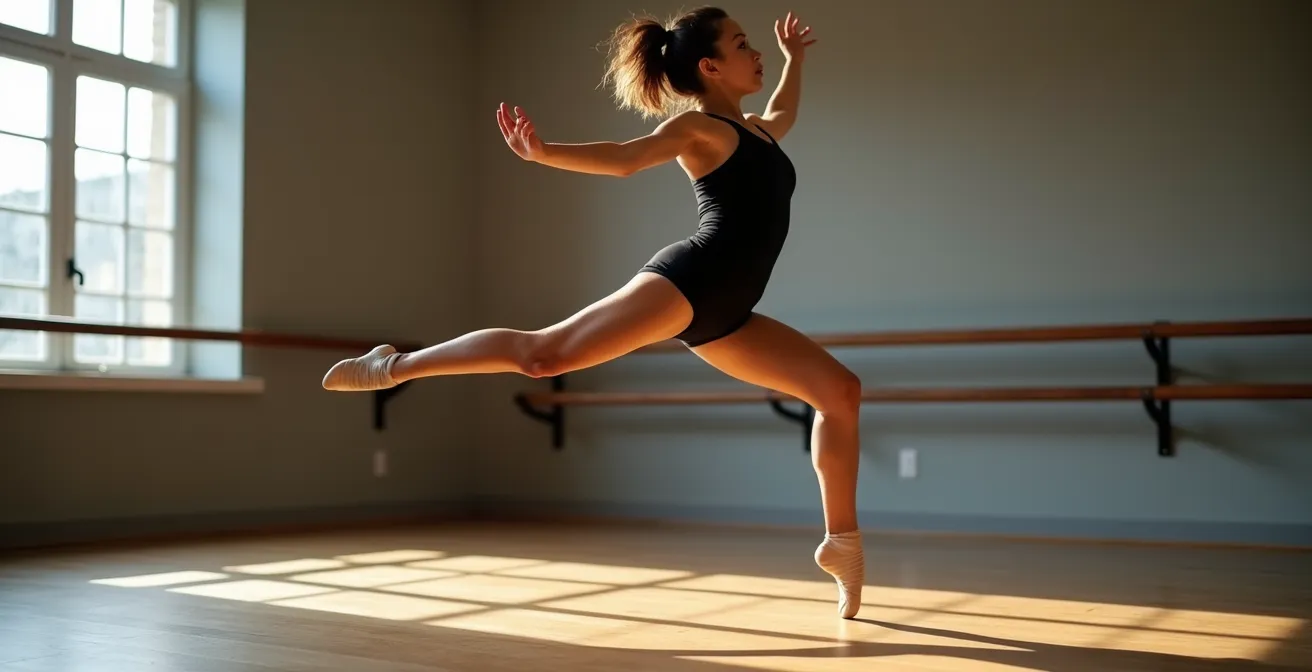
The common approach to preventing knee injuries by focusing on the knee itself is fundamentally flawed; true prevention lies in mastering the body’s entire kinetic chain.
- Knee pain is often a symptom of dysfunction elsewhere, such as poor foot mechanics, a weak core, or upper body fatigue.
- Static stretching before performance can decrease power output, making dynamic warm-ups a safer and more effective alternative.
Recommendation: Shift your training focus from isolating the knee to integrating the whole body, treating it as an interconnected system to build resilient, long-term joint health.
For contemporary dancers, the knee is a site of incredible expression and immense physical stress. The constant cycle of jumps, floor work, and deep pliés places it at the center of injury risk. It’s no surprise that many dancers and instructors focus intently on knee alignment and quadriceps strength. However, this narrow focus often misses the root cause of the problem. A dancer’s knee rarely fails in isolation; it is most often the victim of a breakdown somewhere else in the body’s interconnected system.
The pervasive advice to simply “strengthen your knees” or “always warm-up” is not wrong, but it is dangerously incomplete. This perspective ignores the complex journey of force as it travels from the floor, through the foot, up the leg, and is stabilized by the core and upper body. True injury prevention requires a more sophisticated, holistic understanding—a shift from treating the symptom to mastering the system. What if the key to protecting your knees wasn’t just in the plié, but in the way you articulate your foot upon landing, or the stability of your shoulders during floor work?
This guide moves beyond the platitudes to provide an anatomical and preventative framework for knee health. We will explore the knee’s role within the body’s kinetic chain, revealing how integrated strength, intelligent training choices, and a deep awareness of fatigue are the true pillars of a long and healthy dance career. We will deconstruct common training myths and provide actionable protocols for every stage of your practice, from warm-up to performance crisis.
The following sections break down the crucial components of this holistic approach. By understanding these principles, you can transform your training from a reactive battle against pain into a proactive strategy for career-long resilience and peak performance.
Summary: A Holistic Approach to Knee Health in Dance
- Why rolling Through the Foot Reduces Impact Force by 50%?
- How to Prepare the Shoulders for High-Intensity Floor Work?
- Pilates or Yoga: Which Cross-Training Best Supports Joint Stability?
- The Static Stretching Mistake That Decreases Power Before Performance
- When to Take a Rest Day: The Signs of Micro-Trauma Overload
- Stop or Continue: The Decision Matrix for On-Stage Injuries
- The “Gorilla Arm” Effect That Shortens Play Sessions to 15 Minutes
- Managing Live Theater Mishaps: Protocol When Tech Fails Mid-Show
Why rolling Through the Foot Reduces Impact Force by 50%?
The foundation of knee protection begins not at the knee, but at the point of contact with the floor: the foot. Every jump, leap, and run generates significant ground reaction forces that must be absorbed by the body. When the foot and ankle are rigid, these forces travel directly up the kinetic chain, shocking the knee joint. This is a primary contributor to chronic pain; indeed, research from the Harkness Center for Dance Injuries shows that 33% of dancers experience anterior knee pain, often linked to poor impact absorption.
The solution lies in a technique dancers know well but may not fully appreciate from a biomechanical standpoint: articulating the foot. “Rolling through the foot” during a landing—from toe, to ball, to heel—is not just an aesthetic choice. It is a critical mechanism for force dissipation. This sequential movement allows the arch of the foot to flatten and rebound, acting as a natural spring that dramatically lengthens the time over which the impact force is absorbed. This simple action can reduce the peak force transmitted to the knee by up to 50%.
Case Study: Harkness Center’s Research on Ballet Jumps
The Harkness Center for Dance Injuries conducted a pivotal study on jump training in young ballet dancers. They observed that programs emphasizing landing with the balls of the feet first, which naturally promotes a protective bend in the knee on impact, resulted in a significantly lower risk of ACL injuries compared to other female athletes who did not receive this specific training. This highlights a direct, trainable link between foot mechanics and the prevention of catastrophic knee injuries.
Therefore, focusing on drills that improve foot articulation and ankle mobility is not secondary; it is a primary knee preservation strategy. Exercises like doming, slow tendus focusing on the roll-through, and small, controlled jumps (sautés) with an emphasis on a “quiet” landing are essential investments in the longevity of a dancer’s knees.
How to Prepare the Shoulders for High-Intensity Floor Work?
It may seem counter-intuitive, but the stability of a dancer’s shoulders and torso is directly linked to the health of their knees. The body functions as a single, interconnected kinetic chain. Weakness or instability in the upper body and core forces the lower body to compensate, leading to aberrant movement patterns and excessive strain on the joints, particularly the knees. Research has demonstrated a significant correlation between deficient torso strength and knee injury, proving that a weak core makes the knees vulnerable.
For contemporary dance, with its demanding floor work, this connection is even more critical. Movements like inversions, slides, and complex weight transfers require the shoulders and core to provide a stable platform. When this upper-body stability is lacking, the dancer must use their legs to “muscle through” the movement, creating torque and shear forces at the knee joint. Preparing the shoulders is therefore not just about arm strength; it is about training the entire core to function as an integrated unit.
This involves focusing on closed-chain exercises, where the hands are fixed, forcing the shoulder girdle and core muscles to work together to stabilize the torso. Visualizing the connection from the hands, through the arms, across the latissimus dorsi, and into the opposing hip is key.
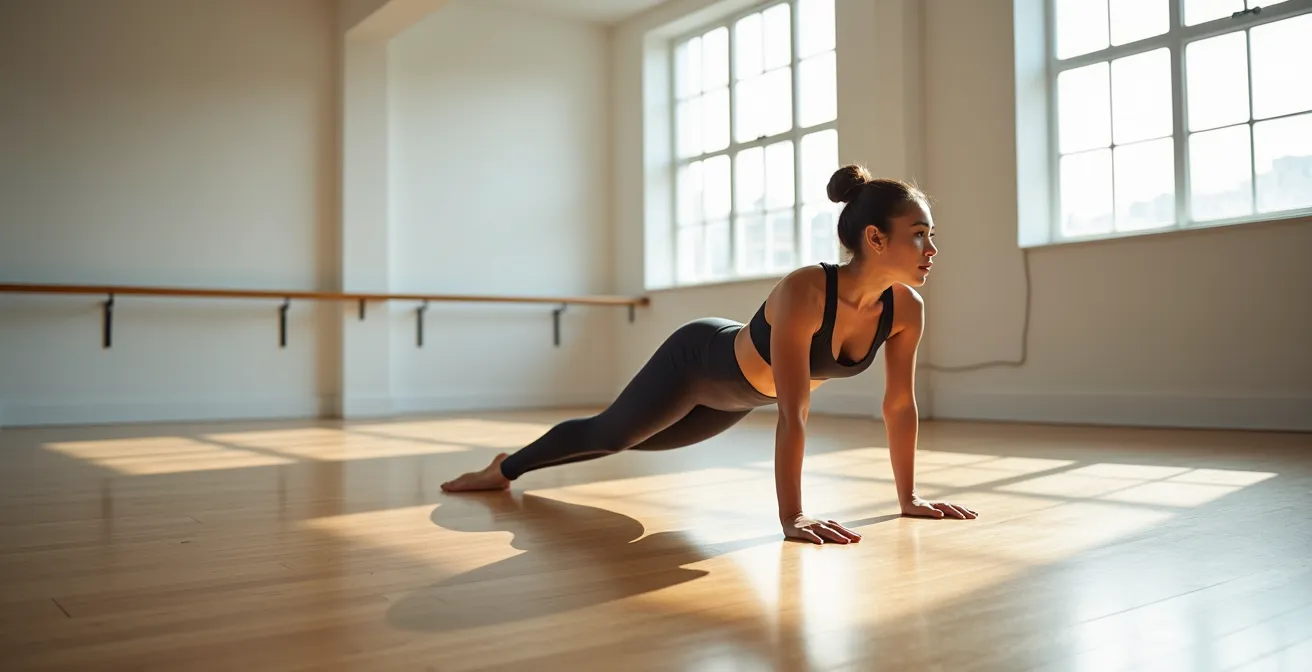
As shown in the image, exercises like planks and their variations are fundamental. They train the serratus anterior and rotator cuff muscles to stabilize the shoulder blades against the ribcage, creating a solid base. This core-to-extremity control ensures that when a dancer pushes off the floor, the force is generated and controlled from the center, protecting the peripheral joints like the knee from compensatory stress.
Pilates or Yoga: Which Cross-Training Best Supports Joint Stability?
While dance class builds technique and artistry, cross-training builds the robust physical scaffolding needed to prevent injuries. Relying solely on dance for conditioning can create muscular imbalances, as it repeatedly reinforces the same movement patterns. It’s well-established that dancers who cross-train have fewer injuries and often achieve higher levels of performance. For knee health, the debate often centers on two popular methods: Pilates and Yoga. Both are excellent, but they offer distinct benefits for joint stability.
Pilates, particularly when using a reformer, is unparalleled for teaching eccentric muscle control. This is the ability of a muscle to lengthen under load, which is critical for absorbing shock during landings from jumps. By providing variable resistance, Pilates builds deep, intrinsic stabilizer muscles around the hips and core that are often underdeveloped in traditional dance training. Yoga, on the other hand, excels in promoting multi-planar stability and proprioceptive awareness—the body’s sense of its position in space. The practice of holding and transitioning between complex poses challenges the body’s balance and control in ways that directly translate to the dynamic, often unpredictable movements of contemporary choreography.
The following table, based on an analysis of different training modalities, breaks down their core advantages for dancers seeking to protect their joints.
| Training Method | Primary Benefits | Best For |
|---|---|---|
| Pilates | Eccentric muscle control, core strength, reformer-based resistance | Jump landing control, deep stabilization |
| Yoga | Multi-planar stability, flexibility, proprioceptive awareness | Balance, dynamic flexibility, body awareness |
| Combined Approach | Comprehensive strength and flexibility, injury prevention | Overall joint stability and movement quality |
Ultimately, the choice is not about one being definitively “better” than the other. The ideal approach is often a combination of both. A dancer might use Pilates to build the foundational core strength and control for landings, while using Yoga to enhance their dynamic flexibility and balance. The best cross-training regimen is one that targets a dancer’s specific weaknesses and provides a balanced supplement to the demands of their dance practice, creating a more resilient and injury-proof body.
The Static Stretching Mistake That Decreases Power Before Performance
The image of a dancer holding a deep stretch for minutes before class or a performance is iconic. For decades, this type of static stretching was believed to be the cornerstone of injury prevention. However, modern sports science has revealed a startling truth: prolonged static stretching immediately before explosive activity can actually be detrimental. It temporarily decreases muscle power output and can reduce joint stability by making ligaments and tendons too lax.
This isn’t to say stretching is bad; its timing and type are what matter. The mistake is using long, passive holds as part of a warm-up. This practice can trick the nervous system into a state of relaxation, dampening the stretch-reflex mechanism that helps protect joints during fast movements. The shift in perspective has been so significant that when the Australian Ballet announced they stopped stretching and focused instead on strengthening, it sent waves through the dance community. Their goal was to build active, stable range of motion, not passive flexibility, to prevent injuries.
The appropriate pre-performance routine should focus on a dynamic warm-up. This involves moving the body through progressively larger ranges of motion to increase blood flow, raise core body temperature, and activate the specific neuromuscular pathways needed for performance. Dynamic movements prepare the muscles and joints for the demands of dance without compromising their power and stability. Static stretching should be reserved for the cool-down period, when its purpose is to help restore muscles to their resting length and improve long-term flexibility.
Here are several effective dynamic alternatives to pre-performance static holds:
- Walking Lunges: Step forward with one leg and lower the hips until both knees are bent at a 90-degree angle. This loosens the quadriceps and promotes core activation.
- Controlled Leg Swings: Performing forward-back and side-to-side swings increases range of motion through active movement, warming the hip joint.
- Hip Circles and Torso Twists: These movements engage the core while mobilizing the joints of the spine and hips in multiple planes of motion.
- Progressive Plyometric Movements: Start with small, gentle hops and gradually increase the height and intensity to prepare the body for explosive jumps.
When to Take a Rest Day: The Signs of Micro-Trauma Overload
In the demanding world of dance, pushing through discomfort is often worn as a badge of honor. However, there is a fine line between productive effort and damaging overuse. Most significant dance injuries are not the result of a single, dramatic event but the culmination of repeated stress, a process known as micro-trauma overload. Each rehearsal and performance creates tiny tears in muscle and connective tissue. With adequate rest, the body repairs this damage and becomes stronger. Without it, the damage accumulates until a minor strain becomes a major injury. This is why research indicates that as many as 50% of dancers present with injuries each year, the majority of which stem from overuse.
Learning to recognize the early warning signs of overload is one of the most important skills a dancer can develop for career longevity. It requires an honest and analytical self-assessment, moving beyond the simple question of “Does it hurt?” to a more nuanced evaluation of the body’s state. The physical therapy team at SOS Physiotherapy offers a blunt but crucial piece of advice:
Overuse injuries are incredibly popular with dancers! Ensure you take a proper amount of recovery time between rehearsals and performances as well as if you feel like something is wrong or in pain … SIT OUT!
– Physical Therapy Team, SOS Physiotherapy Guide
Key signs of micro-trauma overload include: a dull, persistent ache that worsens with activity; localized swelling or puffiness around a joint after cooling down; a feeling of stiffness in the morning that takes longer than usual to resolve; and a noticeable decrease in performance, such as not being able to jump as high or balance as long. It is in these moments that a dancer must perform a careful self-assessment.
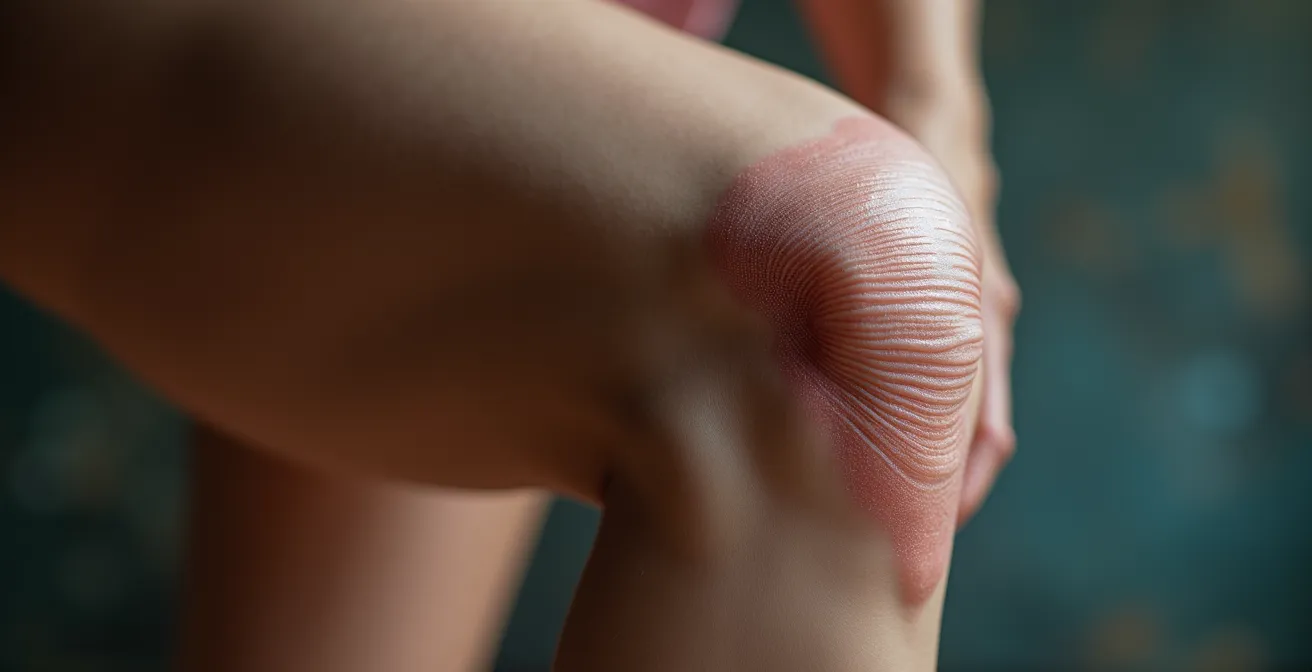
Paying attention to these subtle signals and choosing a rest or modification day is not a sign of weakness; it is a sign of professional intelligence. It allows the body’s natural healing processes to work, preventing the accumulation of micro-trauma and stopping a serious injury before it begins. A rest day is an active and essential part of a successful training schedule.
Stop or Continue: The Decision Matrix for On-Stage Injuries
The adrenaline of a live performance can mask the severity of a sudden injury. A misstep on a landing, a tweak in a turn, or a sudden, sharp pain can occur in an instant. In that moment, the dancer faces a high-stakes decision: push through to the end of the piece or stop to prevent further damage? The professional dance world is physically demanding, with systematic reviews showing an injury rate of 1.24 per 1000 dance hours in professionals. Having a clear mental framework for this decision is a critical part of a dancer’s toolkit.
The “show must go on” mentality can lead to career-ending consequences. A minor sprain that is ignored can become a complete ligament tear. The key is to quickly and honestly assess the nature of the pain and the level of functional impairment. This is not about being “tough”; it is about being smart. A quick mental checklist can help differentiate between a manageable issue and a red-flag injury that demands an immediate stop. This involves testing weight-bearing capacity, functional range of motion, and noting the type and quality of the pain.
If the injury involves a loud “pop,” immediate and significant swelling, or the inability to bear weight, the decision is simple: stop immediately. Continuing under these conditions is reckless. However, for less severe issues, a dancer might be able to modify their choreography to finish a performance safely. This requires deep body awareness and a pre-existing repertoire of modifications, such as converting leaps to rolls or altering the landing leg. For any acute injury, the RICE (Rest, Ice, Compression, Elevation) protocol should be applied as soon as possible after leaving the stage.
Action Plan: On-Stage Injury Assessment
- Immediate Weight-Bearing Test: Can you bear full weight on the injured leg without your body compensating or your alignment collapsing? A “no” is a strong indicator to stop.
- Functional Movement Check: Attempt a small, controlled plié. Is there sharp, stabbing pain, or is it a dull ache? Sharp pain signals a potential structural problem.
- Range of Motion Scan: Is the joint’s movement significantly restricted compared to its normal range? A sudden loss of motion suggests swelling or a mechanical block.
- Identify Red Flags: Was there an audible “pop” or “snap” at the time of injury? Is swelling appearing rapidly? These are signs of significant tissue damage that require an immediate stop.
- Formulate an Action Plan: If red flags are absent and function is maintained, consider choreographic modification (e.g., altering a landing). If any doubt, stop. Apply the RICE protocol immediately after.
Key takeaways
- Knee health is a whole-body issue; focusing solely on the knee is an ineffective and outdated strategy.
- Force dissipation through the feet, core stability, and control from the shoulder girdle are non-negotiable for protecting the lower limbs.
- Intelligent training choices, such as prioritizing dynamic warm-ups over pre-performance static stretching and recognizing the signs of overuse, are critical for injury prevention.
The “Gorilla Arm” Effect That Shortens Play Sessions to 15 Minutes
While the term “Gorilla Arm” originates from the world of virtual reality to describe arm fatigue, the underlying principle is profoundly relevant to dancers: exhaustion in one part of the body will inevitably compromise another. In dance, this is most often seen when upper body and core fatigue leads directly to lower extremity injuries. Dancers performing choreography with extensive lifts, prolonged floor work, or demanding partnering can experience significant upper body exhaustion. As the arms, shoulders, and back fatigue, the dancer’s core stability falters.
This breakdown in the central pillar of the kinetic chain has immediate consequences for the knees. To maintain balance and execute movements, the body begins to rely on compensatory strategies. The pelvis may tilt, the hips may shift out of alignment, and the dancer will start to “muscle” through movements using their quadriceps and hip flexors instead of their deep core stabilizers. This creates abnormal loading patterns and torsional stress on the knee joint, which is now forced to absorb forces it was never designed to handle.
Study: The Domino Effect of Upper Body Fatigue
Studies examining dancers performing repetitive, hours-long routines have found that as the upper body tires from lifts or floorwork, breathing patterns become shallower and core engagement is disrupted. This forces compensatory movements from the pelvis and hips to generate power, resulting in abnormal stress on the knee joint. It proves that the endurance of the upper body is a direct factor in the safety of the lower body.
The link between fatigue and injury is well-documented; research has found that the incidence of dance injuries is dramatically higher towards the end of a long rehearsal day or a demanding performance season. This is the “Gorilla Arm” effect in action. The lesson is clear: conditioning for dancers cannot be compartmentalized. Endurance in the upper body and core is not just for aesthetics or lifting power; it is a fundamental component of knee injury prevention.
Managing Live Theater Mishaps: Protocol When Tech Fails Mid-Show
A dancer’s body is their primary instrument, but performance relies on a host of external factors: the stage surface, the lighting, the sound cues. When a technical element fails mid-show—a patch of water on the marley floor, a missed lighting cue plunging the stage into darkness—it creates a sudden, un-choreographed physical challenge. In these moments, the risk of injury skyrockets. The dancer’s ability to manage their body through this chaos is a crucial, though rarely taught, survival skill.
The psychological pressure in these situations is immense. There’s a powerful impulse to carry on at all costs, ignoring the sudden change in physical risk. This mindset is dangerous, as dancers are often conditioned to ignore pain. As Dr. Lauren Elson of Mass General Brigham’s Dance Medicine program notes, “Dancers often don’t seek medical care because they’re afraid that they’re going to be told to stop dancing or they don’t think anything can be done for them.” This fear can lead to poor decisions in high-stress moments.
The key to navigating a technical mishap is not brute force but heightened proprioceptive awareness and immediate, intelligent adaptation. Instead of panicking, the dancer must rely on their deepest training: grounding their feet, engaging their core, and using their internal senses to navigate the unexpected. This requires a mental protocol to fall back on, allowing for rapid modification of the choreography to suit the new, hazardous conditions. A grand jeté might become a controlled turn; a complex floor sequence might be simplified to maintain stability on a slippery surface.
A prepared dancer has a mental checklist for such an emergency:
- Mental Reset: Take a deep breath, feel the ground beneath your feet, and lift through your core. This re-centers the body and focuses the mind.
- Activate Redundant Systems: Rely on the deep stability built through cross-training to maintain control, even when the planned movement is impossible.
- Modify Intelligently: If pain develops or risk is high, immediately alter the choreography. Prioritize safety over perfect execution. Jumps and pointe work are often the highest-risk movements and the first to be modified.
- Maintain Connection: Even if lower body movements are compromised, continue upper body work and maintain artistic presence to keep a connection with the performance and the audience.
This capacity for improvisation is not just an artistic skill but a critical safety mechanism. It transforms a dancer from a performer of steps into a master of their physical instrument, capable of protecting it even when the world around them becomes unpredictable.
By embracing a holistic, full-body approach to conditioning and injury prevention, you are not just protecting your knees; you are investing in the longevity and quality of your entire dance career. This intelligent, preventative mindset is the hallmark of a true professional athlete and artist.