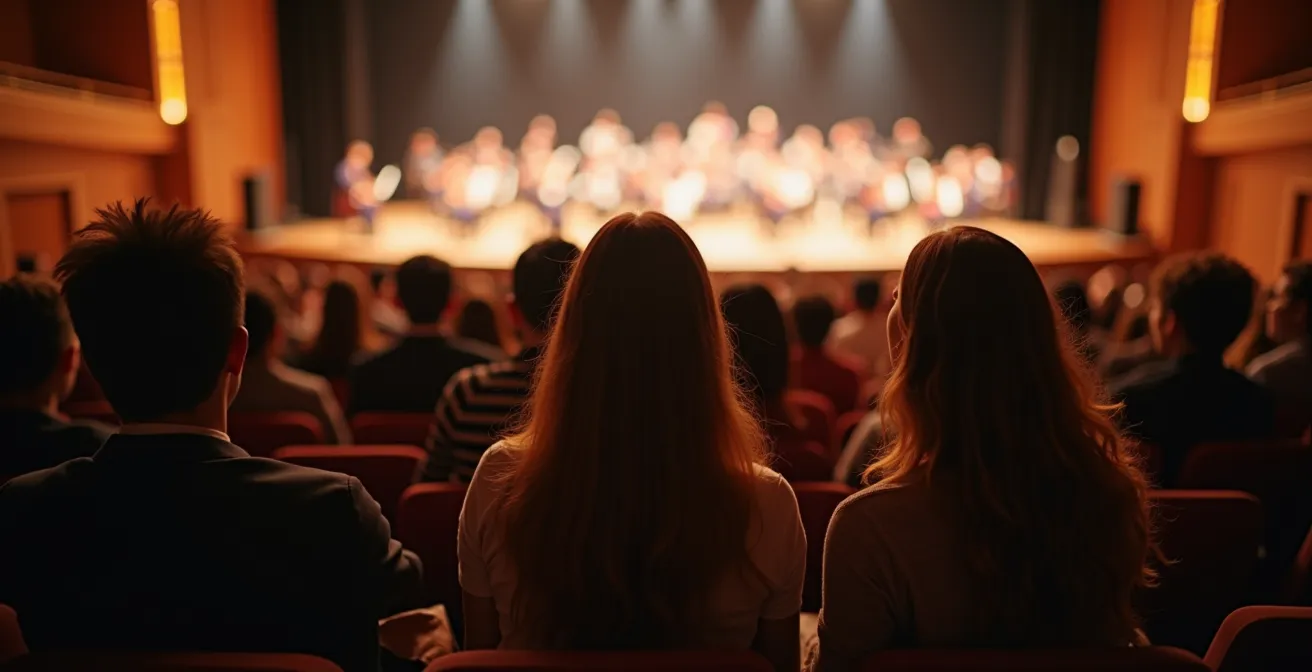
Filling your concert hall with younger audiences requires a fundamental shift from selling tickets to designing a complete social and digital experience.
- Lowering barriers to entry, such as rigid dress codes and traditional subscription models, is the critical first step.
- Programming familiar music, like film and video game scores, acts as a powerful gateway to the core classical repertoire.
Recommendation: Focus on building a vibrant pre- and post-concert “lobby experience” and a supporting digital content ecosystem to drive retention and convert first-time attendees into genuine fans.
For decades, orchestra marketing directors have faced a persistent challenge: the graying of the audience. The conventional wisdom often involves surface-level tactics like social media posts or student discounts, yet the average age in many concert halls remains stubbornly high. These approaches fail to address the core issue, treating younger generations as a monolith to be marketed at, rather than as a diverse group with distinct cultural values and consumption habits. The fear of alienating long-term subscribers often leads to timid, incremental changes that satisfy no one and fail to move the needle on audience demographics.
But what if the problem isn’t the music, but the container it’s presented in? The true challenge lies not in making Beethoven more “relevant,” but in re-architecting the entire concert-going journey. This means shifting focus from the singular performance to a holistic experience architecture that begins with digital discovery and extends far beyond the final bow. It’s about creating low-stakes entry points that value flexibility, fostering a sense of community, and providing narrative resonance that connects the art form to their lives. This isn’t about “dumbing down” the repertoire; it’s about building a modern framework of engagement around it.
This guide moves beyond the platitudes to offer data-backed, actionable strategies that address the fundamental behaviors and expectations of Millennial and Gen Z audiences. We will deconstruct the concert experience into its core components—from dress codes and ticketing to the crucial social hour—and provide a new playbook for building a sustainable and generationally diverse audience for the future.
To navigate these strategies effectively, this article breaks down the essential pillars of modernizing the classical music experience. Below is a summary of the key areas we will explore to help you build a comprehensive plan for audience development.
Summary: A Strategic Guide to Engaging Younger Audiences
- Why Relaxing Dress Codes Increases First-Time Ticket Sales?
- How to Mix Film Scores with Classical Repertoire to Bridge Genres?
- Subscription or Flex-Pass: Which Model Suits the Millennial Lifestyle?
- The Modernization Trap That Angers Long-Term Subscribers
- Designing the Lobby Experience: The Social Hour That Drives Retention
- Audio Guides or Mobile Apps: Which Increases Learning Retention?
- Scheduling the Vibe: The Playlist Strategy for Morning vs. Rush Hour
- Vintage vs. Modern Violins: Which Offers Better ROI for Students?
Why Relaxing Dress Codes Increases First-Time Ticket Sales?
The perception of stuffiness is one of the highest barriers preventing younger audiences from ever buying a ticket. The unspoken rules of concert etiquette, particularly the expectation of formal attire, can create a powerful sense of “imposter syndrome.” For a generation that values authenticity and casual expression, the need to dress up for an event can feel both anachronistic and exclusionary. Relaxing or eliminating dress codes is not a trivial gesture; it’s a direct signal that the institution is accessible, welcoming, and focused on the music rather than on social policing. It is a critical low-stakes entry point that removes a significant psychological hurdle for first-time attendees.
Orchestras like the Seattle Symphony have seen success with “Untuxed” programs where musicians dress down and interact more directly with the audience. This simple change transforms the power dynamic, making the performers appear more human and the experience less intimidating. It acknowledges a fundamental shift in how culture is consumed. As Andrew Bryan, who leads Canada’s popular Candlelight Concerts, noted when discussing the rigid traditions of classical music, “It just is not the way that we consume media. It’s not the way that young people are used to consuming media.” This sentiment, as highlighted in a recent CBC analysis on the genre’s resurgence, underscores the need for change.
It just is not the way that we consume media. It’s not the way that young people are used to consuming media.
– Andrew Bryan, Lead of Canada’s Candlelight Concerts
By explicitly stating “come as you are,” orchestras dismantle a key barrier and communicate a message of inclusivity. This initial step can dramatically increase the likelihood of a Millennial or Gen Z individual purchasing their first ticket, as it aligns the concert experience with the casual, accessible nature of other live events they frequent, from rock concerts to theater.
How to Mix Film Scores with Classical Repertoire to Bridge Genres?
While a relaxed atmosphere can get new audiences in the door, the music itself remains the core product. A powerful strategy for engagement is “repertoire bridging”—using familiar, emotionally resonant music from films and video games as a gateway to the traditional classical canon. For many millennials, their first and most profound exposure to orchestral music came from John Williams, Hans Zimmer, or Nobuo Uematsu. This music is not a “lesser” form; it is a powerful cultural touchstone and a ready-made bridge to the works of Holst, Wagner, or Debussy that inspired it.
The opportunity here is immense. While data shows only a small fraction of younger demographics actively prefers classical music, research reveals a significant opportunity, as nearly 90% of teens play video games, a medium rich with complex orchestral scores. Programming concerts that feature music from *Star Wars*, *Final Fantasy*, or *The Lord of the Rings* isn’t just a gimmick; it’s a strategic use of existing brand loyalty and emotional connection. These events attract dedicated fanbases who are already primed to appreciate symphonic sound, creating a perfect environment to introduce them to thematically similar classical pieces.
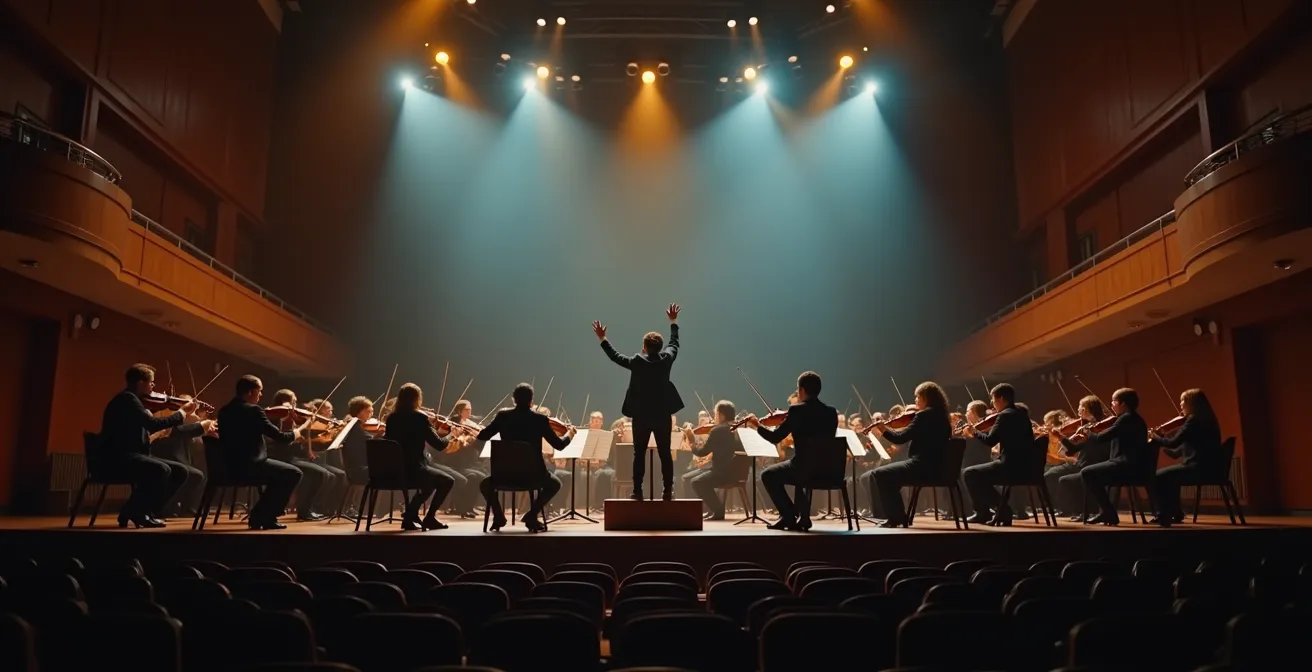
As the cinematic atmosphere of a film score concert demonstrates, the key is intelligent curation. An effective program might pair the epic marches from *Star Wars* with Holst’s “Mars, the Bringer of War,” or the lyrical melodies of a Studio Ghibli film with pieces by Debussy. This approach provides narrative resonance, framing classical music not as an intimidating historical artifact, but as part of a living, breathing tradition that continues to shape the soundtracks of their lives. It respects the audience’s existing tastes while gently expanding their musical horizons.
Subscription or Flex-Pass: Which Model Suits the Millennial Lifestyle?
The traditional, full-season subscription model is fundamentally misaligned with the Millennial lifestyle, which prioritizes flexibility, spontaneity, and experience over long-term commitment. Asking a 30-year-old to commit to eight specific Saturday nights a year in advance is a significant hurdle. They are accustomed to on-demand services and last-minute plans. To effectively engage this demographic, orchestras must rethink their ticketing and embrace models that offer choice and reduce upfront commitment. The Flex-Pass and other flexible membership tiers are proving to be the most effective tools for this.
Unlike a rigid subscription, a flex-pass allows a patron to purchase a bundle of tickets (e.g., three or five concerts) that they can redeem for any performance throughout the season, often with minimal notice. This model provides the financial benefit of a package deal while preserving the freedom of choice that younger consumers demand. It’s a perfect low-stakes entry point for someone who is curious about the symphony but not yet ready to become a die-hard traditional subscriber. Evidence shows that organizations embracing these models are succeeding; data confirms that orchestras implementing flexible ticketing have seen Millennial purchasers increase from 22% to 26% of their audience, with Gen Z also growing.
This data highlights the need for a tiered approach to audience membership, catering to different levels of commitment. The goal is to create a customer journey that can gracefully move someone from a single-ticket buyer to a flex-pass holder, and eventually, perhaps, to a traditional subscriber or donor. The table below outlines how different models serve distinct audience segments.
| Model Type | Best For | Key Benefits | Commitment Level |
|---|---|---|---|
| Flex-Pass | Discovery phase audiences | Low commitment, high flexibility | Minimal |
| Traditional Subscription | Converted classical fans | Predictable schedule, best seats | High |
| Experience Membership | Building super-fans | Exclusive perks, community access | Medium |
By offering a spectrum of choices, an orchestra can meet younger patrons where they are. The flex-pass acknowledges their lifestyle and builds trust, making the symphony hall feel like an adaptable, modern institution rather than a rigid, unchanging one.
The Modernization Trap That Angers Long-Term Subscribers
While attracting new audiences is critical, the process of modernization comes with a significant risk: alienating the loyal, long-term subscribers who form the financial and cultural bedrock of the institution. This is the “modernization trap.” When an orchestra pivots too aggressively towards “pops” programming, overly casual formats, or marketing that seems to dismiss traditionalism, it can send a message to its core audience that they are no longer the priority. This can lead to resentment, attrition, and a decline in the high-level donations that are vital for survival. As former San Francisco Symphony Executive Director Brent Assink observed, millennials are “a huge segment of our population that orchestras typically have not ignored, but have sort of not figured out what to do with.” The key is finding a solution that doesn’t disenfranchise the existing base.
[Millennials are] a huge segment of our population that orchestras typically have not ignored, but have sort of not figured out what to do with
– Brent Assink, former Executive Director, San Francisco Symphony
The most successful strategies avoid a one-size-fits-all approach. Instead, they involve targeted programming and audience segmentation. This means creating specific concert series or events designed for new audiences, while simultaneously preserving and honoring the traditional concert experience that core subscribers cherish. It’s not about replacing Beethoven with film scores in the main subscription series; it’s about adding a separate, parallel track of “gateway” performances.
Case Study: English National Opera’s Dual-Audience Strategy
The English National Opera (ENO) masterfully navigated this challenge. To attract younger attendees, they launched a program offering free tickets to anyone under 21. Simultaneously, they maintained their traditional programming for their established audience. The results, as documented in an analysis of their audience data, were remarkable: over 7,000 free tickets were distributed, and a staggering 60% of their audiences were first-time bookers. By creating separate, clearly defined offerings, the ENO successfully brought in a new generation without disrupting the experience for its loyal patrons, proving that growth and retention can coexist.
This dual-track approach is the essence of successful experience architecture. It allows an organization to innovate and experiment with one hand while providing stability and tradition with the other. Clear communication is paramount, ensuring that long-term subscribers understand that the new initiatives are an “and,” not an “instead of,” safeguarding their sense of belonging and value.
Designing the Lobby Experience: The Social Hour That Drives Retention
For many millennials, the value of a live event lies as much in the social experience as in the performance itself. The concert doesn’t begin at the downbeat and end with the applause; it’s a full-evening event. Orchestras that overlook the pre- and post-concert experience are missing a massive opportunity for engagement and retention. The lobby should not be a transactional space for coats and tickets, but a vibrant social hub—a place for connection, conversation, and community. A well-designed lobby experience can be the deciding factor that turns a one-time ticket buyer into a repeat attendee.
This means transforming the often-sterile lobby into an inviting, comfortable, and stimulating environment. It’s about creating spaces that encourage lingering, not just queuing. This can involve partnering with local craft breweries or artisanal food vendors for themed pop-ups, setting up a mix of seating (from high-top tables to lounge areas), and carefully managing a background music playlist to create an atmosphere that allows for conversation. The goal is to provide strong social proof by making the concert hall a place where people can see their peers, meet new people, and feel a sense of belonging.

Extending the artistic experience into the lobby is also key. Simple additions like informal 15-minute Q&As with a conductor or musician after the show, or even conversation-starter cards on tables related to the performance, can bridge the gap between the stage and the audience. These touches make the art form more accessible and human. Building a compelling social hour is a direct investment in audience retention, transforming the concert from a passive listening experience into an active, memorable social outing.
Action Plan: Designing a Retention-Driving Lobby Experience
- Host Post-Show Q&As: Schedule brief, informal 15-minute Q&As with conductors or principal musicians immediately following the performance to break down the “fourth wall.”
- Forge Local Partnerships: Collaborate with local craft breweries, distilleries, and artisanal food makers for themed pop-up bars and tasting stations.
- Diversify Seating: Design varied seating arrangements, including high-top tables for mingling, and comfortable lounge areas for quieter conversation.
- Manage the Soundscape: Curate a pre- and post-show playlist and maintain ambient sound levels that permit easy conversation without being silent or overwhelming.
- Provide Conversation Starters: Place small, well-designed cards or digital prompts on tables with questions or interesting facts related to the evening’s performance to spark discussion.
Audio Guides or Mobile Apps: Which Increases Learning Retention?
To deepen the connection with new audiences, orchestras must extend the experience beyond the physical concert hall, creating a rich content ecosystem. Digital tools are not a distraction but a vital layer for providing context, storytelling, and educational content that enhances the live performance. While traditional audio guides served this purpose in museums, the modern symphony-goer is best served by a well-designed mobile app. An app offers far greater flexibility and a more dynamic, interactive experience that aligns with the digital-native habits of millennials and Gen Z.
Unlike a static audio guide, a mobile app can serve as a central hub for the entire concert journey. Before the concert, it can build anticipation by delivering content like:
- Thematic Playlists: Curated Spotify or Apple Music playlists that introduce the evening’s composers and musical themes.
- “Behind the Music” Podcasts: Short-form audio content featuring interviews with musicians, the conductor, or musicologists explaining the history and significance of the pieces.
- Composer Biographies: Interactive timelines and short articles that bring the stories of the composers to life.
This pre-concert engagement primes the audience, transforming them from passive listeners into informed participants. It gives them a narrative foothold, which dramatically increases their ability to connect with and retain what they hear during the performance.
Case Study: Digital Storytelling for Pre-Concert Engagement
A number of classical music organizations have successfully leveraged mobile apps to build a robust content ecosystem. By delivering pre-concert content like podcasts and composer deep-dives, they effectively build anticipation and provide educational context. Crucially, after the performance, the app can be used to track engagement metrics, revealing which pieces of content resonated most with the audience. This data provides a direct ROI on content creation, informing future programming and marketing decisions by showing exactly what stories and sounds capture the interest of their emerging audience base.
Furthermore, an app can continue the experience post-concert with access to recordings, post-show discussions, and information about upcoming events. It creates a continuous loop of engagement that keeps the orchestra top-of-mind. In the choice between audio guides and mobile apps, the app is the clear winner for its ability to create a holistic, data-rich, and retention-focused experience.
Scheduling the Vibe: The Playlist Strategy for Morning vs. Rush Hour
For an orchestra to truly embed itself in the lives of younger audiences, it must compete for “share of ear” outside the concert hall. The primary battlefield for this is the digital streaming platform. A strategic and data-driven playlisting strategy on services like Spotify and Apple Music is no longer a “nice-to-have”; it is an essential component of modern arts marketing. It allows the orchestra’s brand to become a part of its audience’s daily routines—their morning commute, their workout, or their deep-focus work session. The viral potential is undeniable, with social media platforms demonstrating classical music’s viral potential with #classicalmusic on TikTok garnering hundreds of thousands of videos.
The key to a successful playlist strategy is to move away from composer-centric collections (e.g., “The Best of Mozart”) and towards mood- and activity-based curation. This is how millennials and Gen Z discover music. They search for “Deep Focus Classical,” “Symphonic Power Hour,” or “Calm Morning Classical.” By creating and branding high-quality playlists that serve these functional needs, an orchestra can organically insert itself into a listener’s daily life. This strategy has several benefits:
- Humanizes the Orchestra: Featuring playlists curated by individual musicians (“Our Principal Cellist’s Favorite Cello Suites”) shows off their personalities and tastes.
- Provides Market Research: Playlist performance metrics (like skip rates and completion rates) offer invaluable, low-cost data on which composers, periods, and styles are most popular with a younger demographic.
- Drives Ticket Sales: Playlists can be used to subtly promote upcoming concerts by featuring pieces from the program, creating a low-risk “taster” for potential ticket buyers.
This approach transforms the orchestra from a remote institution into a trusted curator of music. It builds brand affinity and a regular listening habit, which is a powerful precursor to attending a live performance. By scheduling the “vibe” for every part of a listener’s day, an orchestra can maintain a constant, relevant presence in their cultural landscape.
Key Takeaways
- Audience development requires a holistic “experience architecture,” not isolated tactics.
- Lowering barriers like formal dress codes and rigid ticketing is crucial for attracting first-time attendees.
- A balanced strategy of innovation for new audiences and honoring tradition for loyal subscribers is essential to avoid the “modernization trap.”
Vintage vs. Modern Violins: Which Offers Better ROI for Students?
While the title of this section might suggest a financial calculation for a music student, the real “Return on Investment” for an orchestra lies in a different kind of student: the newcomer to classical music. In this context, the ROI is measured in audience connection and emotional engagement. And here, the most valuable assets are not the instruments themselves, but the stories behind them. Focusing on narrative resonance—by telling the human stories of the musicians and the unique histories of their instruments—offers a profound return on engagement.
People connect with stories far more than with abstract concepts of musical quality. A program note stating a violin is a 17th-century Stradivarius is an interesting fact. A video feature where the principal violinist shares the personal journey of acquiring that instrument, demonstrates its unique voice, and explains how its history influences her playing—that is a story. This type of content transforms the orchestra from a faceless collective into a community of dedicated artists. It makes the institution relatable and its art form more tangible.
Content Marketing through Instrument Storytelling
Orchestras are finding great success by creating high-quality video series that feature their principal players and their instruments. These short films delve into the history of a vintage cello or the cutting-edge technology of a modern flute, but always through the personal lens of the musician who plays it. This approach effectively translates abstract ideas of sound quality into compelling, authentic narratives that resonate deeply with audiences who crave behind-the-scenes content and a deeper connection to the artists they support.
As Numa Bischof Ullmann of the Lucerne Symphony Orchestra notes, “Classical music has always been something you need to take time to grow into.” Storytelling is the most powerful tool we have to nurture that growth. It provides the context and emotional hooks that help a new listener “grow into” the music. Whether the violin is vintage or modern is secondary; the real ROI comes from investing in telling its story, thereby building a bridge of human connection between the stage and the seats.
By moving beyond a product-focused mindset and embracing the role of an experience architect, orchestra marketing directors can build a vibrant, sustainable future. These strategies, when implemented cohesively, create a welcoming and engaging ecosystem that not only attracts but also retains the next generation of classical music lovers. Begin today by evaluating which of these pillars—accessibility, programming, or social experience—offers the greatest immediate opportunity for your institution.