Discover performing arts
Performing arts represent one of humanity’s oldest forms of expression, combining physical skill, emotional depth, and artistic vision into live experiences that connect performers directly with audiences. Whether you’re drawn to the dramatic intensity of theater, the athletic grace of dance, or the technical precision of vocal performance, each discipline demands years of dedicated training, financial planning, and an understanding of both craft and business.
The journey into performing arts encompasses far more than mastering your chosen art form. It requires navigating audition processes, managing unpredictable budgets, protecting your body from injury, and developing the resilience to handle everything from prop malfunctions to complete technical failures. This comprehensive exploration addresses the fundamental disciplines, practical techniques, and professional realities that every performing artist must understand to build a sustainable career.
What Are the Core Disciplines of Performing Arts?
Performing arts traditionally divide into three primary disciplines, each with distinct technical requirements, training methodologies, and performance contexts. Understanding these fundamental differences helps artists choose their path and appreciate the interconnected nature of live performance.
Theater: The Art of Embodied Storytelling
Theater artists transform themselves into characters through voice, movement, and psychological understanding. Classical theater, particularly Shakespearean work, requires specific analytical skills to decode verse structure, iambic pentameter, and rhetorical devices that reveal character intentions. The common mistake performers make is playing the “idea” of a character rather than discovering moment-to-moment motivations and reactions.
Modern theater demands versatility across dramatic styles, from naturalistic contemporary plays to heightened theatrical forms. Successful theater practitioners develop strong text analysis abilities, understanding how punctuation, rhythm, and word choice inform performance choices.
Dance: Physical Excellence and Artistic Expression
Dance combines biomechanical precision with artistic interpretation, requiring extraordinary body awareness and physical conditioning. Professional dancers must master technique-specific movements—whether ballet’s turnout, contemporary’s floor work, or jazz’s isolations—while maintaining the cardiovascular endurance for sustained performance.
The physical demands create unique challenges. Unlike musicians who can practice their instrument without bodily risk, dancers are their instrument, making injury prevention and recovery protocols essential to career longevity. Cross-training strengthens supporting muscle groups without overloading primary movers, while proper rest scheduling allows tissue repair between intensive rehearsal periods.
Vocal Performance: Technical Mastery Meets Musical Interpretation
Singers navigate complex technical transitions between musical styles, each requiring different laryngeal positions, resonance strategies, and articulation approaches. German diction emphasizes precise consonants and forward placement, while Italian diction prioritizes vowel purity and legato line. Musical theater demands a mix of classical technique and contemporary belt qualities, requiring careful sequencing of repertoire to maintain vocal health.
The physiological reality of singing means that over-darkening the tone or forcing vibrato speed creates vocal fatigue and potential damage. Healthy vocal technique balances muscular engagement with efficient breath management, allowing singers to perform demanding repertoire without strain.
Preparing for Professional Auditions
Auditions represent high-stakes moments where artists must demonstrate technical skill, artistic interpretation, and professional presence within severely limited timeframes. Success requires understanding both the psychology of performance under pressure and the specific requirements of each audition format.
The Audition Room Psychology
Entering an audition room triggers physiological stress responses that can undermine preparation. The most effective performers develop pre-audition rituals that manage anxiety while maintaining energized focus. This might include specific breathing patterns, physical warm-ups that release tension, or mental rehearsal techniques that build confidence.
Understanding that audition panels want you to succeed—they’re searching for the right performer to solve their casting needs—shifts the dynamic from judgment to collaboration. Your job isn’t to be perfect; it’s to show your unique interpretive choices clearly and confidently.
Material Selection and Preparation
Choosing audition material involves balancing several factors. For classical theater, monologue pairings should demonstrate range through contrast versus thematic similarity—showing different emotional qualities, historical periods, or character types. For musical auditions, the 16-bar cut must showcase your strongest vocal qualities while fitting the show’s style, requiring careful editing that creates a complete musical moment rather than an arbitrary excerpt.
Preparation goes beyond memorization. Analyzing Shakespearean verse for auditions means understanding how line endings, shared lines, and metrical irregularities reveal character psychology and inform delivery choices. This technical analysis serves emotional truth rather than replacing it.
Managing the Financial Reality of Performance
The romantic notion of the starving artist persists, but successful performing artists develop sophisticated financial strategies that balance artistic integrity with economic sustainability. Independent theater companies and freelance performers face unique budgeting challenges that require both creativity and business acumen.
Strategic Budget Allocation
Independent theater budgets force difficult choices about allocating funds between talent and tech. While professional-quality lighting and sound enhance production values, underpaying performers creates ethical concerns and limits access to skilled artists. Effective budget strategies prioritize essential elements while finding creative solutions for secondary needs.
Costume sourcing offers opportunities for resourcefulness. Many theaters successfully source costumes through:
- Costume exchanges and borrowing agreements with other companies
- Thrift store shopping combined with alterations and modifications
- Community donation drives targeting specific period pieces
- Rental negotiations with costume houses for package deals
Understanding Contract Structures and Insurance
The difference between Equity versus non-union contracts significantly impacts both performer compensation and production costs. Equity contracts guarantee minimum salaries, working conditions, and benefit contributions, but substantially increase production budgets. Non-union work offers flexibility but requires careful attention to fair compensation and safe working conditions.
Venue insurance requirements represent a hidden cost that surprises many independent producers. Liability coverage, property insurance, and cancellation policies can consume a significant portion of production budgets, making early quotes essential to accurate financial planning. Timing fundraising campaigns to align with venue deposits and insurance payments prevents cash flow crises.
Protecting Your Instrument: Health and Safety
Performing artists’ bodies are their primary tools, making injury prevention and recovery not merely health concerns but career necessities. Understanding biomechanics, proper warm-up protocols, and the physiological requirements of different performance demands extends career longevity.
Dancer Injury Prevention Strategies
Professional dancers face extraordinary physical demands that make injury prevention protocols essential. The biomechanics of safe landings involve sequencing movement from toe to heel while engaging core stabilizers to distribute impact forces. Landing with locked knees or collapsed arches concentrates stress in vulnerable joints, increasing injury risk.
Warm-up specificity matters tremendously. Floor work requires particular attention to spinal articulation and shoulder girdle stability, making generic stretching routines insufficient. The critical error dancers make is stretching cold muscles, which increases injury risk rather than reducing it. Effective warm-ups begin with gentle cardiovascular activity that raises tissue temperature before progressing to dynamic stretching and movement-specific preparation.
Cross-training strengthens supporting musculature without overloading primary movers, but the line between beneficial cross-training and over-training requires careful monitoring. Scheduling adequate rest for tissue repair between intensive rehearsal periods isn’t laziness—it’s essential physiology that allows muscles to strengthen and adapt.
Vocal Health for Singers
Vocal technique transitions between musical styles require understanding physiological differences in sound production. Classical singing typically employs a lower laryngeal position that creates acoustic space for resonance, while contemporary commercial music often uses higher, speech-like larynx positions for a more conversational quality. Transitioning between these approaches without adequate technical adjustment creates vocal strain.
Modifying vibrato speed, adjusting resonance strategies for different languages, and sequencing repertoire to balance demanding pieces with recovery selections all contribute to sustainable vocal health. Singers who ignore these considerations face shortened careers and potential vocal damage.
Crisis Management During Live Performance
Live performance’s immediacy creates its magic but also its vulnerability. Technical failures, prop malfunctions, and emergency situations test performers’ professionalism and quick thinking. Successful companies develop crisis management protocols that protect both audience safety and performance quality.
Technical Failures and Performance Decisions
Communication channels during a blackout must be established long before emergencies occur. Stage managers, technical directors, and front-of-house staff need pre-arranged signals and backup systems that function without electricity. The risk of relying on un-backed-up automation becomes catastrophically clear when computerized systems fail mid-performance.
Deciding between stopping the show versus pushing through requires instant assessment of safety risks versus performance disruption. Minor prop malfunctions can often be handled through skilled ad-libbing, maintaining the performance’s momentum while addressing the issue. How to ad-lib through a prop malfunction involves acknowledgment when necessary, creative substitution, and maintaining character while solving practical problems.
Safety Protocols and Emergency Preparedness
Briefing the cast for emergency evacuations should occur during every technical rehearsal, not just opening week. Performers need to know evacuation routes from every position on stage, understand communication protocols for different emergency types, and practice maintaining calm authority that prevents audience panic.
Professional companies conduct regular safety reviews, update emergency contact lists, maintain first aid supplies, and ensure all staff understand their specific crisis management roles. This preparation transforms potential disasters into managed incidents.
The performing arts demand extraordinary dedication, combining artistic passion with technical skill, financial pragmatism, and professional resilience. Whether you’re analyzing Shakespearean verse, perfecting your grand jeté, or transitioning between vocal registers, success requires understanding both your specific discipline and the broader practical realities of building a sustainable performance career. Each audition, each performance, and each professional challenge offers opportunities to deepen your craft while developing the versatility that defines truly accomplished performing artists.
Transitioning from Musical Theater to Opera: The Vocal Adjustment Required
Success in transitioning from musical theater to opera is not achieved by singing “louder,” but by fundamentally re-engineering your vocal production for acoustic efficiency. Musical theater singing is optimized for microphones; opera singing is optimized to fill a hall over…
Read more
A Physiotherapist’s Guide to Preventing Knee Injuries in Contemporary Dance
The common approach to preventing knee injuries by focusing on the knee itself is fundamentally flawed; true prevention lies in mastering the body’s entire kinetic chain. Knee pain is often a symptom of dysfunction elsewhere, such as poor foot mechanics,…
Read more
Monologue Selection: Why Casting Directors Reject 80% of Classical Choices?
Contrary to popular belief, your classical monologue audition isn’t primarily a test of raw talent; it’s a high-stakes diagnostic of your professionalism and technical craft. Most rejections stem not from a bad performance, but from a failure to analyze the…
Read more
How to Budget an Off-Broadway Play for Under $10,000
Producing a professional show for under $10,000 isn’t about spending less; it’s about budgeting backwards and treating liability mitigation as your most valuable asset. The most critical choice isn’t actors vs. sets, but which union contract (or lack thereof) aligns…
Read more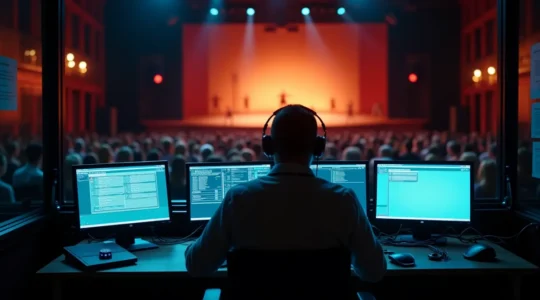
Managing Live Theater Mishaps: Protocol When Tech Fails Mid-Show
Effective theater crisis management isn’t about memorizing checklists, but building a system of human and technical resilience. Clear communication chains and objective decision matrices are non-negotiable for ensuring the safety of everyone on and off stage. Investing in experienced, adaptable…
Read more