
For an independent producer, legal compliance is not a checklist of tasks but a single, interconnected ecosystem of liability where one failure can trigger a cascade of project-ending consequences.
- A missing location permit can void your general liability insurance, making you personally liable for accidents.
- Improper copyright documentation or clearance will prevent you from obtaining the E&O insurance required for distribution.
Recommendation: Shift your mindset from “ticking boxes” to proactively building a documented, insurable production from day one.
For the independent producer, the allure of guerrilla filmmaking—grabbing a camera and capturing the story—is powerful. It feels creative, immediate, and free from the bureaucracy of a major studio. However, this freedom is an illusion that often conceals a minefield of legal and financial liabilities. The common advice is to “get permits” and “buy insurance,” but this treats these critical functions as isolated administrative tasks. This approach is dangerously flawed.
The reality is that permits, insurance policies, talent contracts, and safety protocols form an interconnected liability ecosystem. A weakness in one area does not just create a single problem; it systematically undermines the integrity of the entire production’s legal and financial protection. For example, a simple permit oversight can invalidate a multi-million dollar insurance policy, and a failure to clear background art can halt distribution entirely, rendering your entire investment worthless.
This guide moves beyond the simplistic checklist. As a production lawyer, my goal is to equip you with a compliance-oriented mindset, showing you how each legal component interacts with the others. We will dissect the critical areas where indie producers are most vulnerable, not just to explain the rules, but to reveal how they connect. By understanding this ecosystem, you can stop reacting to problems and start building a production that is legally sound, insurable, and ultimately, distributable.
This article provides a structured overview of the essential legal and insurance considerations for your independent production. Explore the sections below to understand how to build a legally secure and successful project from the ground up.
Summary: A Producer’s Guide to Film Permits, Insurance, and Legal Liability
- Why Shooting Without a Permit Costs More Than the Fee in Fines?
- How to Schedule Child Actors to Comply with Union Work Hours?
- Real Guns or Replicas: The Safety Protocols That Prevent Tragedy?
- The “Borrowed Gear” Oversight That Leaves You Liable for $50k
- Blurring or Clearing: The Rule for Artwork Visible in Your Shot?
- Equity Showcase or Non-Union: Which Contract Fits a Micro-Budget?
- When to Register a Copyright: The Window Before Release Date
- Developing a Film Festival Strategy for Short Films Under 15 Minutes?
Why Shooting Without a Permit Costs More Than the Fee in Fines?
For an indie producer on a tight budget, the cost of a film permit can seem like an unnecessary expense. This perspective fundamentally misunderstands the purpose of a permit. It is not a mere fee to avoid a fine; it is the foundational document that activates your production’s legal and financial protections on location. Shooting without one exposes you to risks far greater than a simple citation. The primary risk is the voiding of your general liability insurance. If an accident occurs on a location for which you have no permit—a crew member is injured, or property is damaged—your insurer can and likely will deny the claim, arguing you were operating in breach of your policy by engaging in an unsanctioned activity. Suddenly, you are personally liable for medical bills, legal fees, and damages.
Furthermore, the cost of basic production insurance is a predictable and manageable expense. Annual policies for general liability can range from $540 to $1,080 annually, a negligible sum compared to the catastrophic financial fallout of a single uninsured incident. A permit is the key that unlocks this protection. It serves as proof to your insurer, the location owner, and municipal authorities that your production is a legitimate, authorized, and insured operation. It transforms your presence from trespassing to a sanctioned professional activity. The fine for not having a permit is the least of your worries; the true cost is the complete loss of your liability shield.
Action Plan: Avoid Permit-Related Production Shutdowns
- Submit your Certificate of Insurance (COI) with the permit application at least 72 hours before the shoot.
- Verify your insurance meets the minimum $1 million general liability requirement standard for most locations.
- Review location-specific insurance riders that may require higher coverage, sometimes up to $5 million.
- Ensure all key crew and equipment rental houses are listed as “additional insured” on your COI.
- Keep physical and digital copies of all permits and insurance documents on set for immediate verification by officials.
How to Schedule Child Actors to Comply with Union Work Hours?
Working with child actors introduces a stringent set of legal requirements that leave no room for error. These regulations, primarily governed by state laws and union agreements (like SAG-AFTRA’s), are not guidelines; they are strict, non-negotiable rules designed to protect the well-being of minors. A producer’s failure to comply can lead to significant fines, production shutdowns, and legal action. The core of these regulations revolves around tightly controlled work hours, mandatory schooling, and dedicated rest periods. These rules are far more restrictive than those for adult performers and vary significantly based on the child’s age.
For instance, an infant under six months may only be allowed on set for two hours with a maximum work time of 20 minutes, whereas a teenager might have a nine-hour day that includes at least three hours of schooling. A studio teacher, or set teacher, is a mandatory presence on any union set with a minor. This individual is not just a tutor; they are the legal advocate for the child, responsible for enforcing labor laws and ensuring education requirements are met. They have the authority to halt production if they deem conditions unsafe or non-compliant. Meticulous documentation is paramount. Using digital tools like SetKeeper or Wrapbook to automatically track work, meal, and school hours is no longer a luxury but a necessity for creating an auditable record of compliance.

As the table below illustrates, these regulations are precise. The producer, along with the Assistant Director, must build the shooting schedule around these constraints, not the other way around. This proactive scheduling prevents costly overtime violations and ensures the production remains both legal and insurable.
| Age Group | Maximum On-Set Time | Maximum Work Time | Required School Hours |
|---|---|---|---|
| Under 6 months | 2 hours | 20 minutes | N/A |
| 6-8 years | 8 hours | 4-6 hours | 3 hours |
| 9-15 years | 9 hours | 5-7 hours | 3 hours |
| 16-17 years | 10 hours | 6-8 hours | 3 hours |
Real Guns or Replicas: The Safety Protocols That Prevent Tragedy?
The decision to use a real firearm versus a replica on set is not merely a creative choice; it is a critical risk management decision with profound legal, insurance, and safety implications. While modern replicas can be incredibly realistic, some productions still opt for real firearms that fire blanks for authenticity. Regardless of the choice, a production is legally and ethically bound to a strict set of safety protocols. The presence of any weapon, real or replica, automatically elevates the risk profile of the production, and your insurer must be notified. Productions involving weapons almost always require a specialty add-on or rider to their production insurance policy to cover the increased liability.
The industry-standard best practice is a three-tier safety check protocol that must be performed every time a prop weapon is brought to set. First, the licensed armorer or prop master inspects the weapon and demonstrates to the cast and crew that it is safe for the intended action. Second, the First Assistant Director (1st AD) performs a secondary verification and announces the status of the weapon to the set. Finally, the actor who will handle the weapon conducts a final personal check immediately before the take. Each of these checks must be documented with timestamps to provide a clear, auditable record for insurance and legal purposes. This rigorous, documented process is a cornerstone of maintaining your production’s insurability.
There is no room for improvisation or cutting corners. A designated, qualified armorer must be present on set at all times when weapons are being handled. They are responsible for maintaining the chain of custody, ensuring secure storage, and supervising all handling. Assuming a replica is “safe” and bypassing these protocols is a negligent act that can lead to tragic accidents and leave the producer and production company facing catastrophic legal and financial liability.
The “Borrowed Gear” Oversight That Leaves You Liable for $50k
One of the most common and dangerous oversights in indie filmmaking is the casual borrowing of equipment. A friend lends you their $50,000 cinema camera package for the weekend shoot. It feels like a huge budget-saver, but without the proper legal and insurance framework, it’s a massive liability waiting to happen. If that camera is damaged, stolen, or destroyed, who is responsible? Unless you have a clear, written agreement and the correct insurance coverage, the answer is: you are, personally. Your standard general liability policy does not cover this; you need specific Hired & Non-Owned Equipment coverage. This rider is designed specifically to cover property you are renting or borrowing.
Rental houses are well aware of this risk and will not release equipment without proof of insurance. They typically require minimum coverage of $250,000 to $500,000 and demand to be listed as “additional insured” and “loss payee” on your policy. You must treat a friendly loan with the same professional rigor. Before the equipment ever leaves its owner’s possession, a comprehensive documentation process must be completed. This includes creating an itemized list with serial numbers, taking timestamped photos or videos of the gear’s condition with the owner present, and signing a Personal Gear Use Agreement. This simple contract clarifies liability, specifies the insurance coverage in place, and confirms whether it’s a free loan or a paid kit fee, which can impact liability.
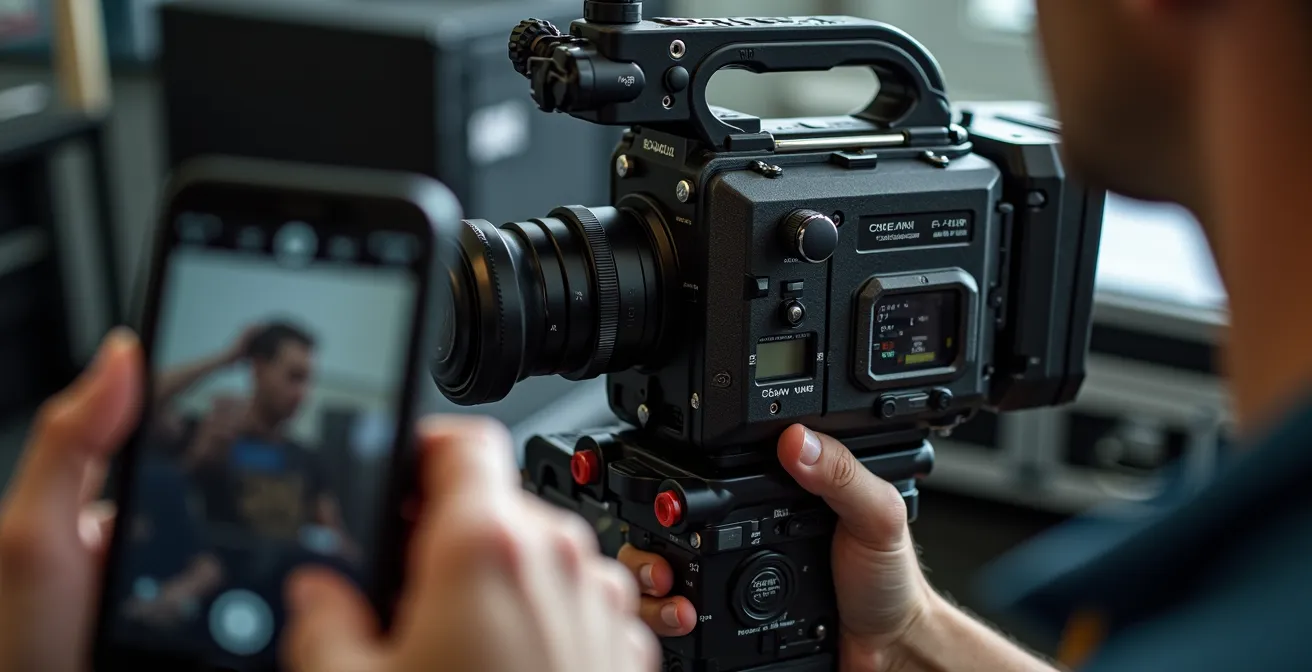
This documentation serves a dual purpose. First, it prevents disputes with the owner about pre-existing damage. Second, and more importantly, it provides your insurer with the necessary proof of value and condition required to process a claim. Without this paper trail, you have little to no chance of a successful claim, leaving you responsible for the full replacement cost of the equipment. What felt like a favor has now become a crippling financial blow to your production and your personal finances.
Blurring or Clearing: The Rule for Artwork Visible in Your Shot?
The artwork hanging on the wall of your filming location, the logo on a character’s laptop, or the mural in the background of a street scene—these are not just set dressing. They are copyrighted materials, and their unauthorized use in your film constitutes copyright infringement. This issue, often overlooked during the chaos of a shoot, can become a major legal and financial obstacle in post-production and distribution. You have two primary options for dealing with copyrighted material visible in your shot: clearance or removal. Clearance involves proactively seeking permission from the copyright holder and often paying a licensing fee. Removal involves digitally altering the shot in post-production to blur, obscure, or replace the offending material.
From a risk management perspective, proactive clearance is almost always the superior option. While it requires upfront effort and a potential fee, it provides legal certainty. Post-production fixes, such as VFX rotoscoping or blurring, can be significantly more expensive and time-consuming than a simple clearance fee, and the results can sometimes look artificial. The decision often hinges on whether the material’s appearance is incidental or integral. If a logo flashes by in the deep background for a split second, the risk is lower (though not zero). If the artwork is a key part of the story or featured prominently in a scene, it is integral, and clearance is non-negotiable.
The most crucial reason to address this in pre-production is your Errors & Omissions (E&O) insurance. E&O insurance, which protects you from lawsuits related to copyright infringement and other clearance issues, is a mandatory requirement for almost any distribution deal. To obtain this policy, you must provide your insurer with a complete record of all clearances. If you cannot prove you have cleared all visible copyrighted material, you will not get the insurance, and you will not get distribution. The cost of failing to clear a single piece of art is not just a potential lawsuit; it’s the potential inability to ever sell or screen your film.
| Solution Type | Typical Cost Range | Time Required | Risk Level |
|---|---|---|---|
| Copyright Clearance + Legal Review | $500-$2,000 | 1-2 weeks | Low |
| VFX Rotoscope/Blurring | $1,000-$5,000 | 2-5 days post | Medium |
| Public Domain Alternatives | $0-$100 | 1-2 days prep | None |
| Custom Prop Art Creation | $200-$800 | 3-5 days | None |
Equity Showcase or Non-Union: Which Contract Fits a Micro-Budget?
For micro-budget independent films, casting is a delicate balance of finding talent and managing costs. The decision between using union or non-union actors is a pivotal one that extends far beyond daily pay rates. While non-union productions offer more flexibility, working with union talent (such as SAG-AFTRA members) provides access to a wider pool of experienced professionals. Several SAG-AFTRA agreements are specifically designed for low-budget projects, such as the Short Project Agreement or the Micro-Budget Project Agreement, which allow for deferred pay or lower rates in exchange for granting actors union eligibility and protections.
However, a producer must understand that “low-cost” union talent is never “no-cost.” Opting for a union agreement, even a micro-budget one, triggers a cascade of associated costs and administrative duties. These “hidden costs” can quickly add up and must be factored into your budget from the outset. For example, if you cast a child actor, union rules are incredibly strict. A spokesperson for SAG-AFTRA has noted the union provides “comprehensive protections for young performers,” and these protections have direct financial consequences for the producer. This includes mandatory contributions to a Coogan Account (typically 15% of the actor’s gross earnings set aside in a trust), the hiring of a studio teacher (which can cost $500-$1000 per day), and adherence to strict work-hour limits that can lead to costly overtime penalties if mismanaged.
Furthermore, union agreements come with specific insurance requirements and administrative processing fees. The choice of contract also has long-term implications for your film’s distribution. A film produced under certain union agreements may have restrictions on how and where it can be exhibited. The decision is therefore not simply “union vs. non-union,” but a strategic choice about which specific agreement aligns with your budget, casting needs, and long-term distribution plan. Choosing an agreement without fully understanding its financial and administrative obligations is a common and costly mistake for new producers.
When to Register a Copyright: The Window Before Release Date
Copyright registration is one of the most misunderstood and undervalued steps in indie production. Many filmmakers believe it’s a simple formality to be handled “later.” This is a critical error. Copyright is not just about proving ownership; it is a strategic tool for establishing your film’s chain of title and securing its insurability and distributability. Chain of title is the legal documentation that proves you own every creative element of your film, from the script to the final cut. Without a clean chain of title, you cannot secure Errors & Omissions (E&O) insurance.
E&O insurance is the policy that protects you from lawsuits alleging copyright infringement, defamation, or invasion of privacy. No distributor or broadcaster will acquire a film without proof of E&O insurance, as they do not want to inherit your legal risks. The cost for this coverage can range from $2,000 for basic festival coverage up to $3,500 or more, depending on the film’s profile. You cannot obtain this insurance without first proving you own the copyright to your work. Therefore, copyright registration is a direct prerequisite for distribution.
The registration process should be a strategic timeline, not a single event. First, you should register the screenplay with the U.S. Copyright Office before you even begin seeking funding. This establishes your ownership of the underlying work from day one. As you bring on writers or other creative contributors, ensure they all sign work-for-hire agreements, which state that the production company owns the copyright to their contributions. It is also wise to register a rough cut of the film before submitting it to festivals to protect it during its most vulnerable public exposure. The final, picture-locked version of the film should then receive its own registration before any distribution deal is signed. This documented, multi-step process creates an unbroken, defensible chain of title that will satisfy any insurer or distributor.
Key Takeaways
- Legal compliance for an indie film is an interconnected ecosystem, not a simple checklist. A failure in one area, like permits, can void protections in another, like insurance.
- Thorough documentation is the most powerful tool for mitigating liability. This includes permits, contracts, clearance records, and safety checks.
- Proactive legal and insurance planning during pre-production is fundamentally cheaper and more effective than trying to fix legal problems in post-production or during litigation.
From Compliance to Celebration: Developing a Film Festival Strategy
After navigating the complex legal and insurance landscape of production, the film festival circuit represents the culmination of your efforts. However, a successful festival run is not a matter of luck; it is a strategy built upon the very foundation of compliance you established in pre-production. Festivals are not just looking for great stories; they are looking for professionally executed projects that are legally clear for exhibition. When you submit your film, you are implicitly warranting that you have the right to screen it. An infringement claim or a rights issue discovered during a festival run can be a public relations disaster for both you and the festival.
To be “festival-ready,” you must assemble a comprehensive deliverables package. This is the collection of legal documents that proves your film is clear for exhibition. This package is the final product of your entire compliance effort. It must include proof of copyright registration for both the script and the final cut, a complete music cue sheet with all licenses documented, signed talent contracts and location releases, and, most importantly, your certificate of Errors & Omissions (E&O) insurance. As we’ve established, obtaining that E&O certificate is impossible without a clean chain of title and cleared rights. Every step, from permits to prop safety, contributes to the integrity of this final package.
Your submission strategy should be tiered. Start with smaller, local, or genre-specific festivals to build momentum, gather laurels, and test audience reactions. These often have lower submission fees and can provide valuable reviews. Use this momentum to target mid-tier national festivals to gain industry exposure, and finally, leverage any success to approach top-tier international festivals where distribution deals are made. Each tier has a different strategic value and cost, but none will consider a film that arrives with legal baggage. In this sense, your festival strategy begins not on FilmFreeway, but in the first production meeting where you decide to prioritize legal compliance.
To apply these principles effectively, begin by conducting a thorough audit of your current production’s legal and insurance documentation. Identify any gaps in your chain of title, clearance records, or insurance coverage, and address them before proceeding to the next stage of production or distribution.