Producing a professional show for under $10,000 isn’t about spending less; it’s about budgeting backwards and treating liability mitigation as your most valuable asset.
- The most critical choice isn’t actors vs. sets, but which union contract (or lack thereof) aligns with your micro-budget reality.
- Your biggest financial risks aren’t rental costs, but the uninsured liabilities from “borrowed” gear and overlooked venue clauses.
Recommendation: Start by inventorying your non-monetary assets—skilled people, free spaces, community relationships—and build your production concept around them.
The dream for many is to see their show come to life under the bright lights of New York, but the reality can feel brutally out of reach. With industry analyses pointing to lavish productions costing upwards of $2 million for an off-Broadway musical, the aspiration of mounting professional work can seem impossible. The common advice—”cut costs,” “find cheap sets,” “ask for money”—is well-meaning but fundamentally misunderstands the challenge of a true micro-budget.
Producing a compelling theatrical experience for less than $10,000 requires a radical shift in thinking. It’s not about shrinking a large-scale budget; it’s about building from zero. This isn’t a guide on how to spend less money. It’s a producer’s playbook on how to operate with almost none. The key isn’t in pinching pennies, but in a philosophy of “reverse budgeting”—starting not with a script’s demands, but with the resources you can acquire for free. It’s about creative asset swapping, a relentless focus on mitigating liability, and understanding that on a shoestring, your most valuable currency isn’t the dollar, but your resourcefulness.
This article will deconstruct the financial and logistical hurdles of micro-budget theater. We will move beyond platitudes to offer a strategic framework, covering the critical decisions on actor contracts, the hidden dangers of insurance and borrowed equipment, and the precise timing needed for successful funding. This is the financial reality check and strategic toolkit for turning a sub-$10,000 budget from a constraint into a creative catalyst.
To navigate these crucial financial decisions, this guide breaks down the essential strategies into a clear, actionable roadmap. The following sections provide a comprehensive overview of how to allocate funds, source materials, manage legal contracts, and build an audience without breaking your micro-budget.
Summary: A Producer’s Guide to the Sub-$10,000 Show
- Actors or Sets: Where Should You Spend 50% of Your Budget?
- How to Source Period Costumes from Thrift Stores and Donations?
- Equity Showcase or Non-Union: Which Contract Fits a Micro-Budget?
- The Insurance Clause That Adds $1,000 to Your Venue Rental
- When to Launch Crowdfunding: The Timeline That Ensures Funding Before Rehearsals
- The Automation Failure That Can Leave Actors Stranded Mid-Air
- The “Borrowed Gear” Oversight That Leaves You Liable for $50k
- Attracting a Niche Audience: A Zero-Budget Marketing Playbook
Actors or Sets: Where Should You Spend 50% of Your Budget?
For a sub-$10,000 production, the classic debate of “actors versus sets” is a false choice. On a micro-budget, the answer is neither. Your primary financial focus must be on what you *cannot* get for free: the venue, insurance, and mandatory artist stipends. The question isn’t where to spend your money, but how to leverage your limited cash to support a production built almost entirely on non-monetary assets. Lavish sets are a fantasy; even a “minimalist” build can consume thousands. Instead, your most valuable resources are the people in the room and the relationships you can build.
The core philosophy is reverse budgeting. You don’t budget for a preconceived design; you design around what you have. Do you know a brilliant lighting designer who will work for a stipend and a great portfolio piece? Then your show is a lighting-heavy concept. Does your cousin own a vintage furniture store? Your play is now set in a world filled with beautiful, free antiques. The 50% of your budget isn’t a single line item; it’s the glue that holds these free or “swapped” assets together. It pays for the truck to move the free furniture, the gels for the friendly lighting designer, and the transportation stipends for the actors who believe in the vision. The talent is the show, and your budget’s main job is to remove any obstacle that prevents that talent from doing their best work.
Your Reverse Budgeting Action Plan: Building from Zero
- Points of contact: List every skilled person you know (actors, designers, marketers, administrators) who might trade work for a stipend, credit, or a non-monetary exchange.
- Collecte: Inventory all available physical assets you can access for free or cheap—potential rehearsal/performance spaces, props, costume pieces, existing sound equipment.
- Cohérence: Confront your artistic vision with your available assets. Design the production concept around your strongest free resources, not a wishlist.
- Mémorabilité/émotion: Identify where a single, impactful spend can elevate the entire production (e.g., one stunning costume piece, a single high-quality projector). Allocate cash to fill only these critical, high-impact gaps.
- Plan d’intégration: Convert major set pieces or design elements into marketing opportunities. A unique visual can become the poster, the social media campaign, and the talk of the town, providing value far beyond its stage presence.
How to Source Period Costumes from Thrift Stores and Donations?
Period costumes can feel like a budget-breaking impossibility for a sub-$10k show. The key is to think like a resourceful detective, not a high-end shopper. Your first stop should be local thrift stores, but not with a vague hope of finding the perfect 18th-century gown. Go armed with a deep understanding of silhouettes, fabrics, and adaptable modern clothing. A 1980s blouse with the right neckline, shoulder pads removed, and new buttons can read as 1940s. A simple modern dress can be transformed with a donated piece of lace or by altering the hemline. The goal is to hunt for shape and texture, not for a complete, historically perfect garment.
Beyond thrifting, strategic donations are your most powerful tool. Reach out to local community theaters, high schools, and especially university drama departments. These organizations often have vast costume stocks and may be willing to loan or donate items, particularly if their storage is overflowing. Timing is everything. Contacting a university at the end of a semester, when they are cleaning out their storage for the summer, can yield incredible results. This strategy is not just about getting free clothes; it’s about building institutional relationships that can pay dividends for future productions.
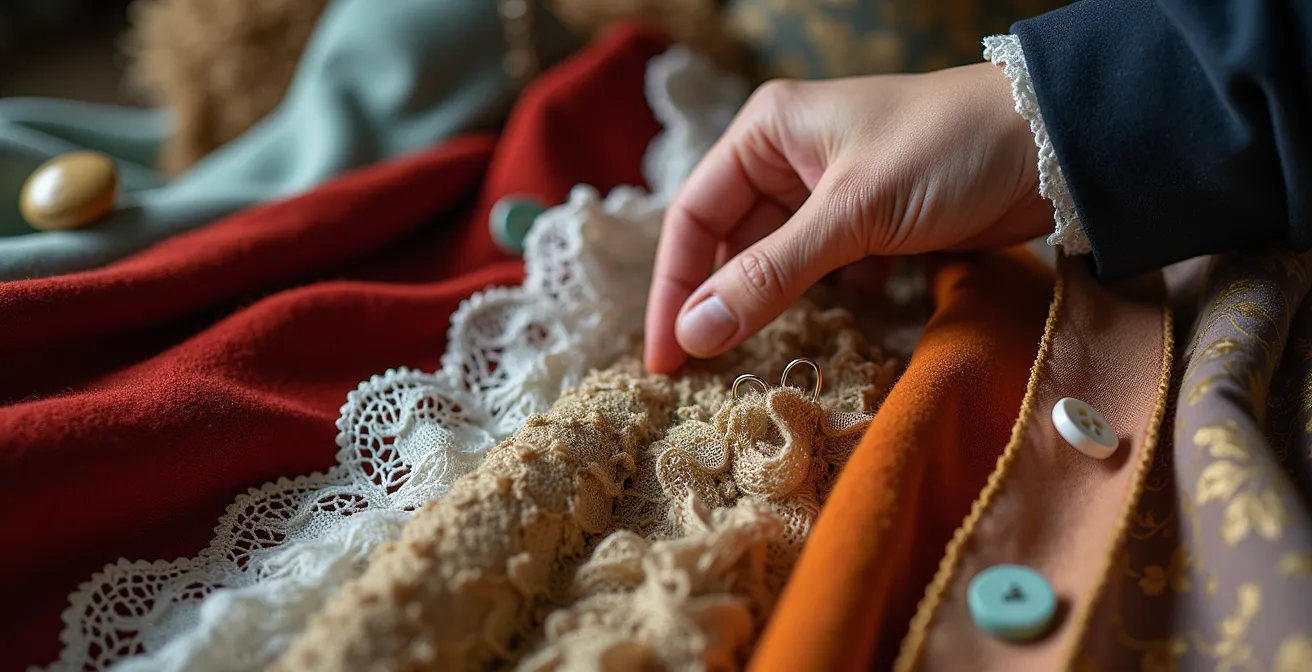
As this approach shows, the most effective costume design on a micro-budget is a collage. It’s a mix of altered modern clothes, carefully selected thrift finds, and key donated pieces that tell the story. This requires a designer with more ingenuity than budget, someone who sees the potential in a rack of Goodwill dresses and knows who to call to borrow that one perfect hat that ties it all together.
Case Study: The University Partnership Strategy
Educational theatre programs often clear out costume stock at semester’s end, creating opportunities for micro-budget productions. One high school production successfully secured an entire period wardrobe by timing their request with a university’s annual storage cleanout, saving over $3,000 in rental fees while building a lasting institutional relationship.
Equity Showcase or Non-Union: Which Contract Fits a Micro-Budget?
This is arguably the most critical financial and logistical decision you will make. It dictates your casting pool, your rehearsal schedule, your performance limits, and the very structure of your budget. For a sub-$10,000 show, a standard Equity contract is not an option. The choice is between a Non-Union production and the AEA’s Approved Showcase Code. Understanding the trade-offs is non-negotiable.
A Non-Union production offers maximum flexibility. There are no rules on how much (or how little) you pay actors, no limits on the number of performances, and no restrictions on ticket prices. This freedom can be essential for a micro-budget, but it comes at a cost: you lose access to the vast pool of talented, professional Equity actors. An Equity Showcase, on the other hand, allows you to work with union members without paying union salaries. You gain access to incredible talent and the credibility that comes with it, but you must operate within a strict set of rules. For instance, the Showcase Code requires that productions operate with a $35,000 maximum production budget (excluding Equity stipends), a limit you will comfortably be under. More importantly, it limits you to 16 performances and requires you to pay transportation reimbursement.
The choice depends on your goals. If your primary aim is a long run or to generate profit, Non-Union is your only path. If your goal is to showcase a new work for industry, attract high-caliber talent for a limited run, and build your professional network, the Equity Showcase is an invaluable tool. It is designed precisely for projects like yours: artistically ambitious but financially constrained. As the Actors’ Equity Association itself clarifies the terms:
There are no minimum salaries, there is no obligation to remain in a production and none of the regular benefits or protections of standard agreements apply
– Actors’ Equity Association, Official Showcase Code Documentation
This highlights the code’s nature as a framework for collaboration, not traditional employment. To make an informed decision, a direct comparison of the core constraints and benefits is essential, especially since the rules can change.
| Aspect | Equity Showcase | Non-Union |
|---|---|---|
| Budget Cap | $35,000 (excluding stipends) | No limit |
| Performance Limit | 16 performances maximum | Unlimited |
| Actor Payment | Transportation reimbursement only | Negotiable |
| Ticket Price | No longer capped (changed 2018) | Unlimited |
| Industry Credibility | Higher with Equity actors | Varies |
The Insurance Clause That Adds $1,000 to Your Venue Rental
On a micro-budget, insurance feels like a painful, intangible expense—until you need it. A seemingly minor venue requirement can quietly add $1,000 or more to your costs, a devastating blow for a sub-$10k show. Many producers are surprised to find that their venue’s rental agreement requires them to purchase a separate general liability policy with specific coverage limits, often naming the venue as “additionally insured.” This isn’t a negotiable point for the venue; it’s a fundamental transfer of risk. Ignoring or underestimating this will halt your production before it even begins.
However, you are not powerless. The key is to be proactive, not reactive. Don’t wait for the venue to hand you their requirements. When you are shopping for spaces, ask for their insurance specifications upfront. More importantly, don’t just accept the first quote from an insurance broker. You can actively manage this cost. Proposing a higher deductible, for instance, can sometimes lower your premium. Providing the insurance company with a detailed risk mitigation plan—showing you have thorough safety protocols for your set, crew, and audience—can demonstrate that you are a lower-risk client. The goal is to transform from a passive cost-acceptor into an active risk-manager. This proactive approach can make a significant difference, turning a budget-breaking expense into a manageable one.
Case Study: The Off-Off-Broadway Insurance Negotiation
An Off-Off-Broadway production with a $5,500 budget successfully negotiated venue insurance requirements by presenting a comprehensive safety protocol document and agreeing to a higher deductible. This strategy reduced their insurance costs from a quoted $1,200 to just $650, while still maintaining adequate coverage for their 16-performance run.
Your 5-Point Venue Risk Audit
- Points of contact: Request insurance certificates from both the venue and any major equipment vendors to identify all parties requiring coverage and their minimum liability limits.
- Collecte: Before load-in, conduct a walkthrough and inventory all pre-existing venue damage or hazards with timestamped photographs to establish a baseline condition.
- Cohérence: Compare the venue’s required coverage against your production’s actual risks. If your show has no open flames or fight choreography, ensure you aren’t paying for a policy designed for a high-risk stunt show.
- Mémorabilité/émotion: Identify the single biggest potential liability in your show (e.g., a large set piece, an electrical-heavy design) and create a specific, one-page mitigation plan for it to present to insurers.
- Plan d’intégration: Propose a higher deductible in your policy as a negotiation tactic to lower your upfront premium, shifting the balance from a fixed cost to a calculated risk.
When to Launch Crowdfunding: The Timeline That Ensures Funding Before Rehearsals
Crowdfunding is not a magic wand; it’s a marketing campaign that requires a precise, strategic timeline. Launching a campaign and hoping for the best is a recipe for failure, a fact reflected in sobering data. The reality is that only about 36% of Kickstarter campaigns reach full funding, highlighting the crucial need for pre-launch preparation. For a theatrical production, the goal is to have cash in hand *before* rehearsals begin and costs become unavoidable. This means your campaign must be fully funded, processed, and deposited weeks before your actors’ first day.
The most successful campaigns build momentum long before they go public. The “soft launch” is your most powerful tool. This involves reaching out to your inner circle—family, friends, past collaborators, and your most ardent supporters—in the week *before* your campaign is public. The goal is to secure 20-30% of your total funding goal before anyone else even sees the page. When you do launch publicly, you do so with a campaign that already looks successful, creating powerful social proof that encourages strangers to join in. A campaign at $0 is intimidating; a campaign already a third of the way to its goal feels like a winner.
To maximize this effect, consider fiscal sponsorship through an organization like Fractured Atlas. This allows donations to your project to be tax-deductible, a massive incentive for larger donors in your “inner circle.” This is not just a perk; it’s a core strategic tool that legitimizes your project and unlocks a different level of giving. The timeline is therefore critical: secure fiscal sponsorship, build your core support list, create compelling non-monetary rewards (rehearsal access, signed scripts), soft launch to your inner circle, and only then, with momentum firmly established, launch to the public. This turns crowdfunding from a gamble into a calculated financial strategy.
The Automation Failure That Can Leave Actors Stranded Mid-Air
In the world of micro-budget theatre, complexity is the enemy. The allure of a high-tech moment—a slick automated set change, a dramatic flying effect—can be powerful. But every layer of technology you add is another potential point of failure, and on a shoestring budget, you have no safety net. An automation glitch that might be a momentary problem on a Broadway budget can be a show-canceling catastrophe for you. A motor fails, a sensor misfires, and suddenly your lead actor is stuck ten feet in the air, the show grinds to a halt, and your credibility evaporates.
This is where the principle of failsafe simplicity becomes a producer’s best friend. Instead of asking “What is the coolest way to do this?”, ask “What is the most reliable way to do this?”. Often, the answer is manual. A scene change executed by choreographed stagehands can be more elegant and is infinitely more reliable than a temperamental automated platform. A simple effect operated by a well-rehearsed crew member with a rope and pulley is less likely to fail than a complex digital controller. This isn’t about being anti-technology; it’s about being pro-reliability. On a sub-$10k budget, you cannot afford downtime, repairs, or the insurance premiums that come with complex machinery.
Case Study: Low-Tech Failsafe Implementation
A micro-budget production replaced a proposed $3,000 automated flying effect with a $400 manual counterweight system operated by two crew members. The manual system proved more reliable through 20 performances with zero failures, while providing employment for additional crew members and eliminating insurance premium increases associated with automation.
Choosing simplicity is a strategic, not an aesthetic, compromise. It saves money on equipment, reduces insurance costs, often creates more jobs for your crew, and, most importantly, ensures the show will go on. Every dollar spent on complex tech is a dollar not spent on the artists who are the heart of your show.
The “Borrowed Gear” Oversight That Leaves You Liable for $50k
“I can borrow a soundboard from a friend” is one of the most dangerous sentences in low-budget producing. While it sounds like savvy resourcefulness, it often masks a massive, uninsured liability. What happens if that “borrowed” $5,000 projector gets knocked over during tech rehearsal? What if the soundboard shorts out and is damaged beyond repair? Your friend’s goodwill won’t cover the replacement cost, and your general liability insurance almost certainly won’t either. Without a specific agreement and the right kind of insurance rider, you, the producer, are personally on the hook for the full replacement value.
This is the liability calculus in action. You saved $500 on a rental fee but exposed yourself to a $50,000 liability. The math doesn’t work. While technical elements and promotion can eat up a significant portion of a budget, often 40% of budget according to Off-Off-Broadway producer surveys, cutting corners on liability is not the place to save. If you must borrow, you must treat it like a professional rental. This means creating a simple, one-page loan agreement that details the equipment, its condition, and its replacement value. It means taking timestamped photos of the gear upon receipt. Crucially, it means verifying that your insurance policy has what’s called an “Inland Marine” or “equipment floater” rider that covers rented or borrowed gear. This small, additional premium is infinitely cheaper than buying a new lighting console.
A proper check-in/check-out protocol with dual signatures for every piece of borrowed equipment might seem like overkill, but it’s the only thing that stands between a successful collaboration and a friendship-ending, production-sinking financial disaster. Renting from a professional vendor is often safer because the insurance and liability are clear from the start. If you borrow, you must replicate that professional rigor yourself. The risk is simply too high to do otherwise.
Key Takeaways
- Budget backwards from your assets, not forwards from your needs. Your production concept should be defined by the talent and resources you can get for free or cheap.
- Liability mitigation is a financial strategy. The money you save by proactively managing insurance, contracts, and equipment loans is as real as any donation.
- Embrace failsafe simplicity. On a micro-budget, reliability is more valuable than complexity. Manual, human-powered solutions are often cheaper, safer, and more reliable.
Attracting a Niche Audience: A Zero-Budget Marketing Playbook
With a budget under $10,000, your marketing spend is likely zero. Paid ads, glossy posters, and press agents are off the table. This is not a disadvantage; it is a clarification. Your only path to an audience is through pure, unadulterated hustle and creative, targeted outreach. The strategies used to attract new, younger audiences to established institutions like symphony halls hold a valuable lesson: go to the audience where they are, and speak their language. Don’t try to pull a broad audience to you; find a hyper-niche community and make your show an essential event for them.
This means abandoning the idea of marketing to “theatre lovers” in general. Is your play a verse drama? Your target audience isn’t theatre-goers; it’s the local poetry slam community. Is it a period piece with stunning costumes? Your target audience is fashion bloggers and vintage clothing enthusiasts. The strategy is to identify these adjacent communities and engage their micro-influencers—not with money, but with access. Offer a fashion blogger an exclusive pre-show look at the costumes. Invite a history podcaster to a tech rehearsal. Create “shareable moments” that align with their brand and give them authentic content to share with their followers.
This approach is the ultimate form of asset swapping. You are trading the unique, behind-the-scenes experience of your production—an asset that is free for you to give—for direct access to a pre-built, passionate audience. This is far more effective than a generic Facebook ad. It requires diligent research, personalized outreach, and a genuine effort to connect your play’s themes to the existing conversations in these communities. Your marketing becomes less about promotion and more about community partnership.
- Identify micro-influencers in adjacent communities (e.g., history buffs for a period piece, political activists for a topical drama).
- Offer exclusive behind-the-scenes access and interviews instead of just complimentary tickets.
- Create specific, visually compelling “shareable moments” during rehearsals or backstage tours that are tailor-made for social media.
- Partner with non-theatrical venues where your target audience already gathers—like bookstores, coffee shops, or galleries—for small pre-show events or cross-promotions.
- Develop themed pre-show talks or post-show Q&As that connect the play’s themes to contemporary issues relevant to your target niche.
You now have the strategic framework. You understand that a sub-$10,000 budget is not a smaller version of a large budget, but a different species of producing entirely. It demands a mindset rooted in resourcefulness, risk management, and creative problem-solving. Now, stop dreaming and start producing. Use this playbook to build your budget, assemble your team, and bring your story to the stage.