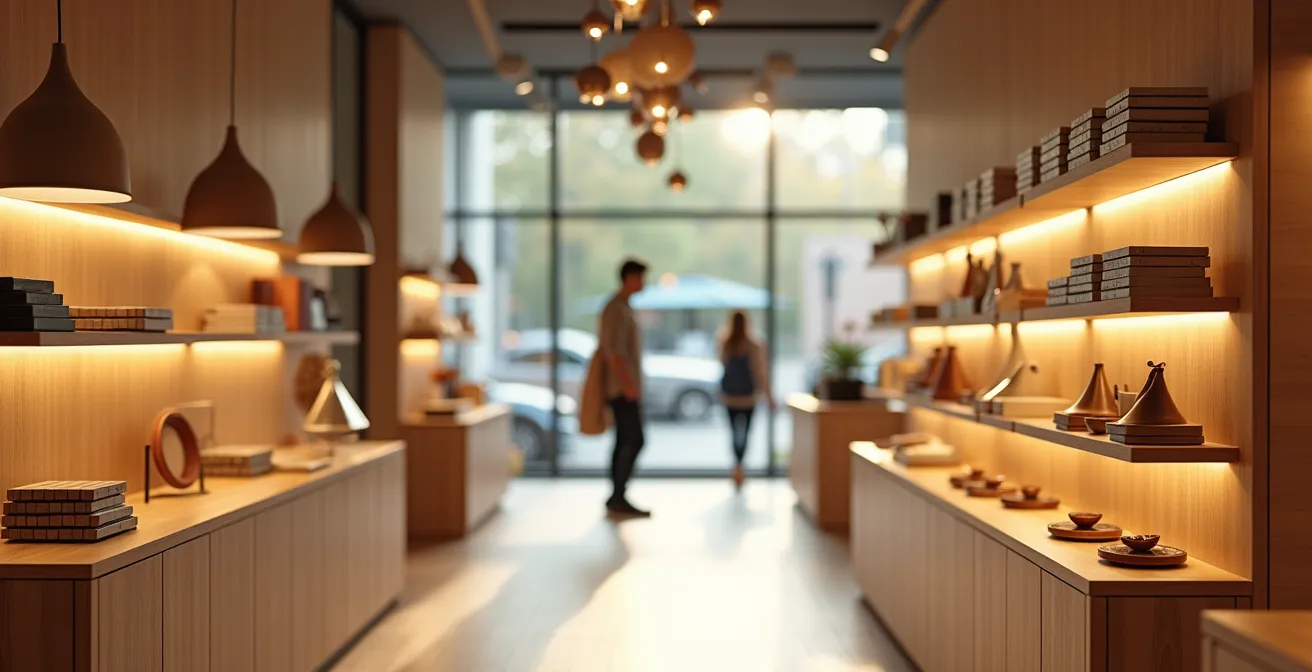
Effective retail sound design isn’t about background music; it’s a form of behavioral architecture that actively sculpts the customer experience to drive revenue.
- Slower tempos and nature-based sounds demonstrably increase dwell time and spending by reducing cognitive load and anxiety.
- Inconsistent volume is a major source of “sonic friction,” while technical solutions like acoustic zoning and LUFS normalization create a seamless, non-irritating aural journey.
Recommendation: Prioritize your budget on foundational acoustic treatment and quality speaker distribution over the music source itself to build a high-fidelity environment where every sonic element can be effective.
The sound of a retail space is often its most neglected, yet most pervasive, design element. Many managers believe the job is done once a generic playlist is streaming, but this overlooks a powerful psychological tool. We’ve all been there: driven out of a store by music that’s too loud, too fast, or simply grating. This common experience is a symptom of a missed opportunity, a failure to see sound not as filler, but as a primary driver of customer behavior.
The conventional wisdom is to match the music to your brand’s “vibe” or to simply keep the volume at a comfortable level. While not incorrect, these are surface-level tactics. They fail to harness the deeper, scientifically-proven principles of psychoacoustics that can directly influence perception, mood, and ultimately, purchasing decisions. What if the key wasn’t just the ‘what’ of the playlist, but the ‘how’ of its delivery? What if silence, texture, and technical fidelity were as important as the songs themselves?
This is the essence of designing a soundscape as a form of acoustic architecture. It’s a strategic approach that moves beyond mere background music to actively sculpt the customer’s perceptual and emotional journey through a space. This article will deconstruct the core behavioral triggers of retail sound. We will explore the science behind tempo’s effect on spending, the strategic use of noise to enhance comfort, the technical mistakes that kill sales, and where to intelligently invest your budget to build a soundscape that doesn’t just entertain, but performs.
This guide provides a comprehensive framework for understanding and implementing a high-performing retail sound strategy. Explore the sections below to master each component of sonic influence.
Summary: The Architect’s Guide to Profitable Retail Sound
- Why Slow-Tempo Music Increases Customer Spending by 15%?
- How to Use White Noise to Mask Conversations in Open Plans?
- Nature Sounds or Instrumental Loops: Which Reduces Anxiety Best?
- The Volume Fluctuation Mistake That Irritates 40% of Shoppers
- Scheduling the Vibe: The Playlist Strategy for Morning vs. Rush Hour
- Why Blue Artwork Sells Better in Corporate Office Environments?
- How to Design Exhibition Paths That Prevent Museum Fatigue?
- Building a Hi-Fi Signal Chain: Where to Invest Your Budget First?
Why Slow-Tempo Music Increases Customer Spending by 15%?
The connection between music tempo and consumer behavior is one of the most well-documented phenomena in acoustic psychology. The underlying mechanism is the way our brains process time and motion. Fast-paced music (typically above 100-120 beats per minute) creates a sense of urgency, subconsciously encouraging faster movement. In a retail environment, this translates to customers walking more quickly, browsing less, and moving on. Conversely, slow-tempo music works as a powerful behavioral trigger for lingering.
When the music is slow and relaxed (around 60-80 BPM), it reduces our internal sense of urgency and alters our perception of time. Customers feel less rushed, their cognitive load decreases, and they become more open to browsing and discovery. This increased “dwell time” directly correlates with higher spending. They simply have more opportunities to see products and make unplanned purchases. While the title suggests a 15% increase, the impact can be even more dramatic depending on the context.
The foundational research in this area demonstrates this effect clearly. In fact, a landmark study on the subject found that supermarket sales increased by 38 percent when stores switched from fast to slow music. This isn’t just about making the environment pleasant; it’s about strategically slowing down the customer’s internal clock to align with the goal of thoughtful purchasing, a core principle of perceptual sculpting.
How to Use White Noise to Mask Conversations in Open Plans?
In many retail environments, especially those with open layouts, cafes, or consultation areas, the intelligibility of other people’s conversations can be a major source of distraction and discomfort. This acoustic intrusion can make customers feel self-conscious or prevent them from focusing. The solution is not silence, but the strategic application of sound masking, often using “white noise” or, more effectively, “pink noise.”
Sound masking works by introducing a neutral, unobtrusive background sound that is specifically engineered to match the frequencies of human speech. This doesn’t “cancel” the noise, but rather raises the ambient sound floor of the space. As a result, nearby conversations fade into the background, becoming unintelligible. The brain ceases to try and decipher them, reducing cognitive load and creating a sense of perceived privacy. Customers can have their own conversations without feeling overheard and are less distracted by those around them.
This image provides a macro view of an acoustic panel, a key material used in managing sound reflections and creating a controlled environment for techniques like sound masking to be effective.

As the texture of this acoustic foam suggests, controlling sound is about managing energy. A properly calibrated masking system should be barely noticeable—it should feel like the gentle hum of a high-end air conditioning system. When implemented correctly, it transforms a chaotic, open space into a series of comfortable, semi-private aural zones, making the environment feel calmer and more premium without building a single wall.
Nature Sounds or Instrumental Loops: Which Reduces Anxiety Best?
When the goal is to create a calming atmosphere, many retailers turn to instrumental music. While effective, an even more powerful tool for anxiety reduction can be found in nature. This is due to a concept known as biophilia—our innate human tendency to connect with nature. Our brains are hardwired to interpret natural sounds, like flowing water or birdsong, as signals of safety and tranquility.
Unlike musical loops, which are processed by the brain as structured patterns and can become repetitive or even irritating over time, nature soundscapes are perceived as complex, non-repeating information. This complexity engages our attention effortlessly, a state known as “soft fascination,” which is highly effective at reducing stress and mental fatigue. The key is authenticity; high-fidelity, long-form field recordings are essential. Synthetic or obviously looped sounds can have the opposite effect, creating a sense of artificiality that increases stress.
The commercial impact of this approach is significant. A soundscape strategy was introduced at Glasgow Airport that combined ambient music with the sound of birdsong. The results were twofold: customers reported feeling more relaxed, and according to the project’s findings, retail sales increased by up to 10% in the areas where the soundscape was deployed. This demonstrates that by reducing shopper anxiety, you create a more receptive and positive mindset for browsing and buying. Choosing locally relevant sounds, such as regional bird calls, can further deepen this connection and make the acoustic architecture feel authentic and grounded.
The Volume Fluctuation Mistake That Irritates 40% of Shoppers
One of the most common and damaging mistakes in retail sound design is inconsistent volume. When a quiet song is followed by a loud one, or when music is significantly louder in one part of the store than another, it creates “sonic friction.” Each sudden change in loudness forces the customer’s brain to re-evaluate its environment, consuming cognitive resources and causing irritation. The problem is often exacerbated when different digital sources or playlists are used without proper normalization, or when staff are given control over the volume.
This inconsistency shatters the immersive experience a soundscape is meant to create. A significant portion of shoppers find these fluctuations jarring, which can lead to shorter visits and a negative perception of the brand. To build a seamless and professional-sounding environment, retailers must move beyond the simple volume knob and implement technical solutions for consistency. These methods ensure the perceived loudness remains stable across all tracks and zones.
The following table outlines the most effective modern solutions for managing volume and consistency. As an analysis from industry experts shows, implementing these technologies can directly translate into improved customer satisfaction and sales, by removing a key point of irritation from the shopping experience.
| Solution | Implementation | Impact on Sales | Customer Satisfaction |
|---|---|---|---|
| LUFS Normalization | Digital signal processing | +3-5% | Reduces perceived loudness variations |
| Acoustic Zoning | Multiple speaker zones | +5-7% | Creates distinct shopping experiences |
| Dynamic Masking | Real-time decibel sensors | +4-6% | Maintains optimal background levels |
| Acoustic Treatment | Sound-absorbing materials | +3-10% | Improves clarity and reduces irritation |
Investing in technologies like LUFS (Loudness Units Full Scale) normalization is no longer a luxury but a necessity for any serious retail sound strategy. It ensures that every song, announcement, or sound effect is delivered at a consistent perceived level, eliminating sonic friction and allowing the customer to remain comfortably immersed.
Scheduling the Vibe: The Playlist Strategy for Morning vs. Rush Hour
A truly intelligent soundscape is not static; it’s dynamic, adapting to the changing energy and purpose of the retail space throughout the day. This practice, known as dayparting or “vibe scheduling,” involves creating different playlists and energy levels for distinct time blocks, such as the quiet morning opening, the busy lunch rush, and the evening wind-down. The goal is to use sound as a tool to manage customer flow and mindset.
During the calm morning hours, a slower tempo can ease both staff and the first customers into the day, encouraging relaxed browsing. As the store gets busier towards midday, gradually increasing the tempo and energy of the music can help manage traffic flow and keep checkout lines moving efficiently, preventing a feeling of congestion. The right sound at the right time is a powerful behavioral trigger; strategic implementation can, according to retail design studies, increase store spend by up to 9.1%. This requires a shift from a “set it and forget it” mindset to one of active, pre-planned sonic curation.
The image below captures the essence of this hands-on, strategic approach, where an employee adjusts the sound system to match the time of day, transitioning the store’s atmosphere from calm to energetic.
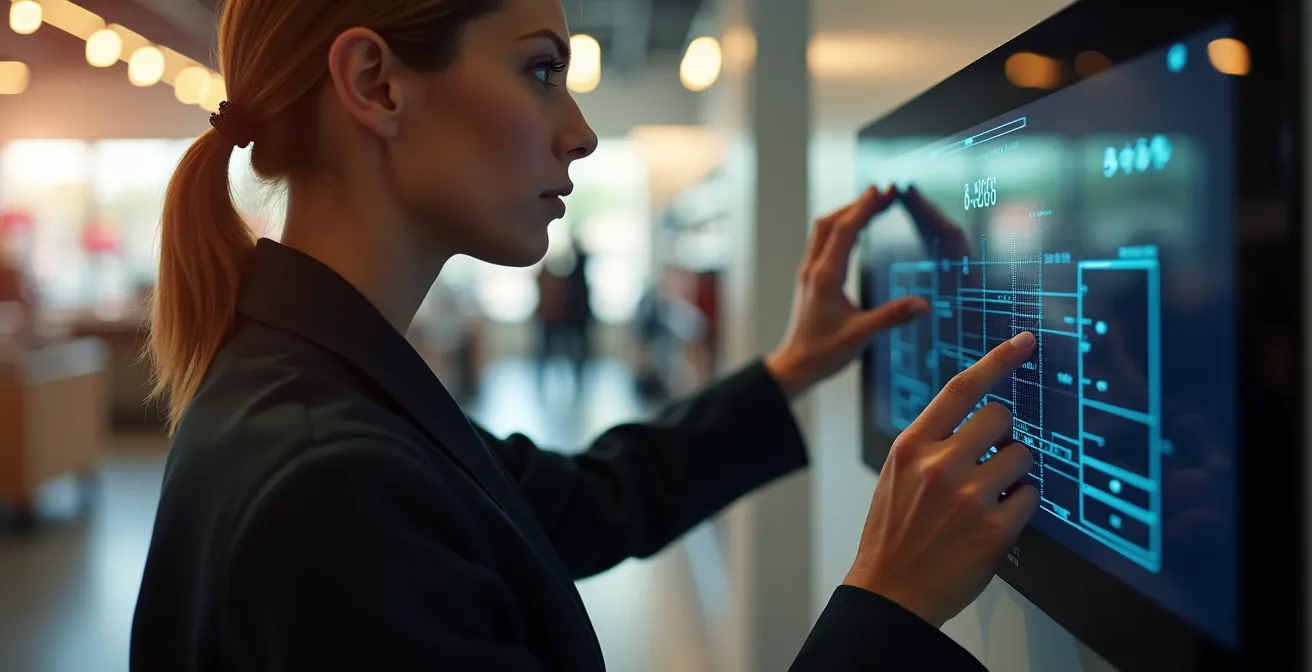
Implementing an effective dayparting strategy requires a clear plan that anticipates the natural rhythm of your specific retail environment. By mapping out the energy levels you want to achieve throughout the day, you transform your sound system from a passive music player into an active tool for crowd management and experience design.
Action Plan: Your Dayparting Music Schedule
- Morning Opening (9-11 AM): Implement slow, low-energy music (e.g., ambient, soft instrumental) to create a calm, welcoming atmosphere for early shoppers and staff.
- Late Morning Build-Up (11 AM-12 PM): Gradually increase the tempo and introduce more melodic content to build energy as foot traffic increases.
- Lunch Rush (12-2 PM): Use a moderate, steady tempo to manage customer flow efficiently without making people feel rushed or stressed.
- Afternoon Re-Energize (2-4 PM): Combat the post-lunch dip with slightly more upbeat and rhythmic tracks to re-energize shoppers and staff.
- Peak Hours (4-7 PM): Deploy a higher tempo playlist to keep the energy levels high and psychologically help maintain pace at busy checkout lines.
Why Blue Artwork Sells Better in Corporate Office Environments?
While this question focuses on visual art, the principle it uncovers is fundamental to all sensory design, including sound. The reason blue artwork performs well in corporate settings is due to psychological association: the color blue is strongly linked to feelings of trust, stability, and productivity. The art isn’t just decoration; it’s a non-verbal cue that reinforces the desired mindset of the environment. The exact same principle of contextual association applies, perhaps even more powerfully, to sound.
Sound is never just “in the background.” It is an active agent in shaping perception and context. As one of the leading voices in the field of audio branding explains, treating sound as a mere afterthought is a profound strategic error. It is, in reality, a primary component of the customer experience.
What many businesses call ‘background music’ is foreground music, it actively shapes the customer experience. Yet surprisingly, it’s often not treated as a strategic component.
– Ola Sars, interview with Knowledge Leader
Just as blue art creates a “corporate” feeling, a specific sound can create a “luxurious,” “energetic,” or “natural” feeling. A famous study published in the Journal of Retailing found that playing classical music in a wine store led customers to purchase more expensive bottles of wine. The music didn’t change the product; it changed the context. It created an upscale atmosphere that subconsciously cued shoppers to associate the wines with higher quality and value, thus making them comfortable with a higher price point. This is acoustic architecture in action: using sound to build a perception of value.
How to Design Exhibition Paths That Prevent Museum Fatigue?
The concept of “museum fatigue” is well-known: visitors become overwhelmed by the sheer volume of information and endless walking, leading to exhaustion and decreased engagement. This idea provides a perfect analogy for the retail customer journey. A monotonous, undifferentiated soundscape that is the same at the entrance as it is at the checkout creates “shopper fatigue.” It’s an aural corridor with no landmarks, no breaks, and no sense of progression, causing sensory and decision fatigue.
The solution, borrowed from exhibition design, is to create a sonic path—a curated aural journey with distinct chapters. This is achieved through “aural zoning,” where different sections of the store have their own unique but complementary soundscapes. For instance, a high-energy pop-up section could feature upbeat music, while a relaxation and wellness aisle could use calming nature sounds. This variation keeps the brain engaged and helps to subconsciously delineate the space, making the store feel more organized and navigable.
A critical element of this path is the “sonic palate cleanser.” These are moments of near-silence or neutral, ambient sound placed in transitional areas, like between major departments. These breaks give the customer’s ears a moment to reset, preventing sensory overload and making the next sonic zone feel fresh and impactful. Disney’s immersive sound design in its themed lands, such as Pandora – The World of Avatar, is a masterclass in this approach. By combining music, targeted sound effects, and ambient creature calls that change as you move through the space, they create a multi-sensory narrative that guides visitors and makes the environment feel alive and endlessly fascinating. Retailers can use this same principle to transform a simple shopping trip into a memorable journey of discovery.
Key Takeaways
- Tempo is a Pacing Tool: Slower music (60-80 BPM) directly correlates with increased dwell time and higher average spending by altering time perception.
- Consistency Over All: Volume fluctuations are a major source of customer irritation (“sonic friction”). Use LUFS normalization to ensure a seamless, professional experience.
- Invest in the Foundation: The quality of your sound system’s foundation—acoustic treatment and speaker distribution—provides a far greater ROI than a premium music subscription alone.
Building a Hi-Fi Signal Chain: Where to Invest Your Budget First?
A brilliant sound strategy is rendered useless by a poor delivery system. Tinny speakers, dead spots, and echo-filled rooms create sonic friction that undermines any psychological benefit the music might offer. Building an effective “signal chain”—the path from the audio source to the customer’s ear—is not about buying the most expensive gear, but about investing intelligently. The common mistake is to overspend on the music source (the streaming service) and underspend on the physical components that actually produce the sound.
The single most impactful investment, and the one most often overlooked, is acoustic treatment. Sound-absorbing panels, bass traps, and diffusers manage how sound behaves in your specific space. By controlling unwanted reflections and reverberation, you dramatically increase the clarity and quality of any sound played through your system. It’s the equivalent of preparing a clean canvas before you start painting; it makes every subsequent investment perform better. Only after the room’s acoustics are addressed should the budget focus on the speakers and amplifier.
The following priority matrix, based on expert analysis, provides a clear roadmap for allocating your audio budget. It demonstrates that investing in a distributed network of quality speakers to ensure even coverage is more important than having a single, premium source. This approach ensures every customer, no matter where they are in the store, experiences the soundscape as intended.
| Component | Budget Allocation | ROI Impact | Priority Level |
|---|---|---|---|
| Acoustic Treatment | 10-15% | Highest – improves all sound | 1st Priority |
| Multiple Quality Speakers | 35-40% | High – better coverage than premium source | 2nd Priority |
| DSP-Enabled Amplifier | 20-25% | High – zone control and EQ | 3rd Priority |
| Music Streaming Service | 5-10% | Medium – content quality | 4th Priority |
| Professional Installation | 15-20% | High – optimal placement | Essential |
Ultimately, a high-fidelity signal chain is the foundation of your entire acoustic architecture. As this breakdown of retail sound systems highlights, prioritizing investment in the physical environment and hardware ensures your carefully curated soundscape is heard with clarity, consistency, and maximum behavioral impact.
By moving from a mindset of “background music” to one of “acoustic architecture,” you can unlock a powerful and cost-effective lever for influencing customer behavior, enhancing brand perception, and directly increasing revenue. The first step is to listen to your space not just for what’s playing, but for how it’s performing.