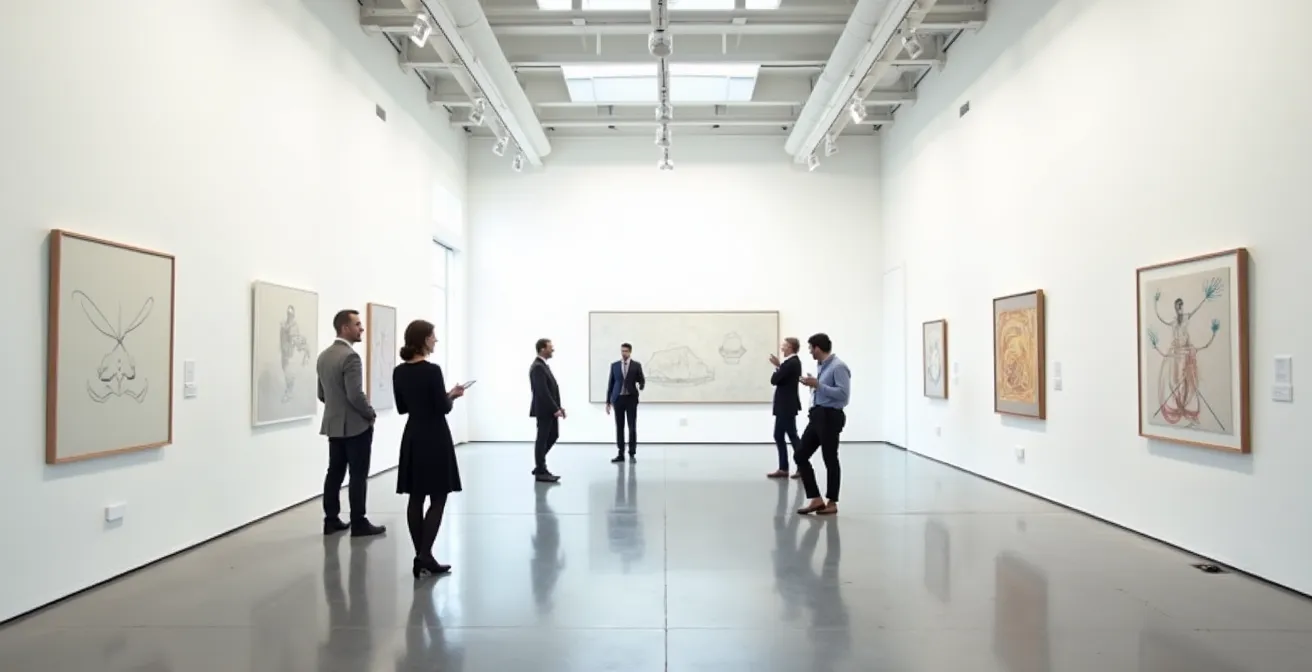
The key to successful emerging art investment isn’t spotting raw talent, but decoding the market structures that manufacture value.
- An artist’s long-term value is more dependent on their gallery’s prestige than their inherent skill.
- Social media hype is often a trap; verifiable, real-world market signals are the only reliable indicators of potential ROI.
Recommendation: Shift your focus from the art to the system around it—analyze gallery tiers, provenance integrity, and auction signals to make data-driven investment decisions.
The dream of every art investor is to discover the next Jean-Michel Basquiat or Yayoi Kusama in a small, unassuming gallery, acquiring a masterpiece for a fraction of its future worth. This pursuit, however, is fraught with risk. For every artist who achieves meteoric success, thousands remain in obscurity, their works failing to appreciate in value. The common advice—”buy what you love” or “follow artists with a strong Instagram presence”—is well-intentioned but dangerously incomplete for those focused on financial returns. These strategies treat art investment as a game of chance, relying on subjective taste or fleeting online popularity.
But what if the key to spotting future value wasn’t about developing a mystical “eye” for talent? What if, instead, it was about a rigorous analysis of the market itself? The reality is that an artist’s value is not just discovered; it is actively constructed. It is built through a series of strategic endorsements and validations from key market players. The true skill of a savvy investor lies in identifying these structural indicators of value long before the wider market takes notice and prices spike.
This guide moves beyond romantic notions of artistic genius to provide a clear, financially astute framework for investing in emerging artists. We will dissect the mechanisms that create value, from the critical role of gallery representation to the non-negotiable importance of provenance. You will learn how to distinguish between ephemeral social media hype and genuine market traction, and most importantly, how to recognize the signals that indicate the optimal moment to sell for maximum return. It’s time to stop guessing and start analyzing.
To navigate this complex but rewarding market, this article breaks down the essential factors that determine an emerging artist’s investment potential. The following sections provide a structured approach to identifying, vetting, and managing your art assets for optimal growth.
Summary: A Strategic Guide to Emerging Art Investment
- Why Gallery Prestige Matters More Than Talent for Resale Value?
- How to Document Provenance for Contemporary Works to Ensure ROI?
- Canvas or Limited Print: Which Entry-Level Investment Is Safer?
- The Instagram Hype Trap That Leaves Collectors with Worthless Art
- When to Sell a Rising Star: The 3 Market Signals to Watch
- Workshop or Luthier-Made: Which Category Holds Value Best?
- When to Call a Restorer: 3 Early Signs of Flaking Paint
- How Color Theory Influences Buyer Emotions in Modern Art Galleries?
Why Gallery Prestige Matters More Than Talent for Resale Value?
In the emerging art market, a fundamental and often counter-intuitive truth prevails: the gallery that represents an artist is a more powerful predictor of future financial success than the artist’s raw talent. For an investor, the dealer is not merely a salesperson; they are a market-maker. A prestigious gallery invests its own brand equity into an artist, providing a platform, a network of influential collectors, and a critical stamp of approval that signals to the broader market that this artist is a sound investment. This endorsement creates a feedback loop where perceived value and actual price begin to climb in tandem.
This system is highly stratified, with different tiers of galleries wielding vastly different levels of influence. Top-tier “Kingmaker” galleries like Gagosian or Pace can effectively guarantee an artist’s place in the secondary market, often leading to an immediate and substantial increase in their work’s value. Understanding this hierarchy is the first step in conducting due diligence on an emerging artist. An artist’s association with a reputable gallery is a critical structural indicator that mitigates risk and signals long-term potential far more reliably than a subjective assessment of their work.
The following analysis from Maddox Gallery provides a clear framework for understanding how a gallery’s tier directly impacts an artist’s market trajectory and pricing power. It highlights the commission structure and the typical value appreciation an artist can expect upon representation.
| Gallery Tier | Example Galleries | Commission Range | Impact on Artist Value |
|---|---|---|---|
| Tier 1 ‘Kingmakers’ | Gagosian, Pace, David Zwirner | 50-60% | 2-3x immediate value increase upon representation |
| Tier 2 ‘Star-Builders’ | Maddox, Hauser & Wirth | 45-50% | 50-100% value increase within first year |
| Tier 3 ‘Incubators’ | Regional/Emerging Galleries | 40-45% | 20-40% gradual appreciation |
Therefore, when evaluating an emerging artist, your first question should not be “Is this art good?” but rather, “Who is selling this art?” The gallery’s reputation, exhibition history, and the other artists in its stable provide a far more objective and actionable dataset for predicting future ROI.
How to Document Provenance for Contemporary Works to Ensure ROI?
If gallery representation is the engine that drives an artist’s initial value, then provenance is the vehicle’s immutable chassis and title. Provenance—the documented history of a work of art’s ownership, custody, and location—is one of the most critical factors in securing and maximizing its long-term value. For contemporary works, where history is being made in real-time, the first owner has a unique and powerful opportunity to establish a work’s origin story. A flimsy provenance, based on a simple handshake or a generic receipt, can create doubt that erodes value over time. Conversely, a robust and detailed provenance acts as a value multiplier, ensuring authenticity and providing a rich narrative that enhances the work’s desirability.

Achieving what can be termed provenance integrity goes far beyond the initial bill of sale. It involves systematically collecting a portfolio of evidence that traces the artwork’s journey from the studio to your collection. This includes photographic evidence, correspondence, and third-party validation. This process not only safeguards against future authenticity disputes but also builds a compelling story that will resonate with future buyers. For a serious investor, creating this “digital provenance kit” is not an administrative chore; it is an essential act of asset management.
To build an unshakeable provenance for a newly acquired contemporary artwork, follow these essential steps:
- Take timestamped photographs of the artwork with the artist at the acquisition site, if possible.
- Save all email correspondence with the gallery or artist’s studio in a dedicated, backed-up digital folder.
- Screenshot and archive any early online features, press mentions, or social media posts about the work or exhibition.
- Obtain a written statement from the artist specifically about the piece, detailing its concept, materials, or significance within their body of work.
- Record a short video of the artist authenticating the work, especially crucial for mediums like digital or street art that are prone to replication.
- Create a narrative document that describes your acquisition story: why you bought it, the context of the purchase, and your connection to the piece.
By meticulously documenting these details from day one, you are not just buying an object; you are curating its legacy and, by extension, securing your return on investment.
Canvas or Limited Print: Which Entry-Level Investment Is Safer?
For investors entering the emerging art market, the choice between acquiring a unique canvas or a limited-edition print presents a classic risk-reward dilemma. A unique painting offers the highest potential for appreciation, as it is a one-of-a-kind asset. However, it also carries a significantly higher entry price and greater risk; if the artist’s market fails to develop, the loss can be substantial. Limited-edition prints, on the other hand, offer a more accessible entry point into an artist’s market, acting as a lower-risk alternative for portfolio diversification.
The print market is not a minor league; it is a robust and growing segment of the art world. As ArtPrice’s 2024 market analysis reveals, the volume of print sales reached 193,000 transactions, more than doubling over the last decade. This liquidity indicates a healthy, active market. As one gallery expert from the Platform Art Investment Guide notes, “Generally speaking, if an artist’s painting market is pretty solid, the print market for that artist is typically similar—or maybe even a bit stronger because prints aren’t as difficult for someone to jump in and buy.” This suggests a strong correlation between the two markets, where success in one often buoys the other.
Case Study: Andy Warhol’s Prints vs. Canvas ROI
The market for Andy Warhol’s work provides a compelling example of this dynamic. His prints have demonstrated stable, annualized returns of 7% to 10% over the past five years. While his unique canvases can achieve astronomical figures—such as a ‘Flowers’ canvas that sold for £28 million at Christie’s in 2024—this sale created a “halo effect” that subsequently boosted the value of his print market by an estimated 15-20%. This shows how investing in prints of an established artist can offer both steady returns and benefit from the high-profile sales of their unique works.
For a savvy investor, prints are not a consolation prize. They are a strategic tool to gain exposure to a promising artist’s market with a lower capital outlay and a more favorable risk profile, offering a balanced approach to building a resilient art portfolio.
The Instagram Hype Trap That Leaves Collectors with Worthless Art
In the digital age, Instagram has become a powerful discovery tool for art collectors. The platform’s visual nature makes it an ideal showcase for emerging talent, and it’s no surprise that, according to the 2025 Art Basel and UBS Survey, 51% of high-net-worth collectors have made purchases through the platform. However, this convenience masks a significant risk for investors: the Instagram hype trap. An artist can amass tens of thousands of followers and receive widespread online praise, creating the illusion of a thriving market. Yet, this digital popularity often exists within a social media “echo chamber,” lacking the real-world validation that underpins sustainable value.
Investors who mistake likes and shares for legitimate market demand often end up with worthless art. The key is to develop a healthy skepticism and use online buzz as a starting point for investigation, not a conclusion. An investor must determine the hype-to-value ratio: is the online fame supported by tangible, offline achievements? This means cross-referencing the artist against professional databases, checking for reputable gallery representation, and looking for inclusion in curated exhibitions by respected institutions. Without these structural indicators, a high follower count is merely a vanity metric, not an investment signal.
Before investing in an artist discovered on social media, it’s imperative to verify their credibility outside the digital bubble. This audit ensures you’re investing in an artist with genuine career momentum, not just online popularity.
Your Action Plan: The Echo Chamber Breakout Test
- Cross-reference Databases: Check for the artist’s profile and sales history on professional art databases like Artnet or Artsy. A lack of presence here is a major red flag.
- Verify Representation: Confirm if the artist has legitimate gallery representation. Research the gallery’s reputation, history, and the other artists it represents.
- Look for Real-World Exhibitions: Search for the artist’s inclusion in curated group or solo shows at established physical venues, not just online galleries.
- Seek Curatorial Mentions: Look for any articles, essays, or mentions by known curators, art critics, or museum professionals. Their endorsement carries significant weight.
- Analyze Follower Quality: Scrutinize their social media engagement. Is it coming from respected collectors, curators, and other artists, or from generic accounts and bots?
Ultimately, social media is a tool for discovery, but the real work of due diligence happens offline. By piercing the echo chamber, you can separate fleeting trends from true investment opportunities.
When to Sell a Rising Star: The 3 Market Signals to Watch
Acquiring a work from a promising emerging artist is only half the battle. A truly savvy investment strategy involves knowing the optimal moment to sell. Holding on for too long can mean missing a market peak, while selling too early can leave significant profits on the table. Rather than relying on gut feelings, investors should monitor a clear set of market signals that indicate an artist’s market is maturing or potentially overheating. These signals provide data-driven exit points to maximize return on investment.

The most astute collectors treat their art portfolio with the same analytical rigor as they would any other asset class, constantly evaluating market conditions for buy, hold, or sell signals. Three primary indicators can help determine the right time to capitalize on an investment in a rising star.
First and foremost is the auction premium signal. When an artist’s work begins to consistently sell at auction for prices that are significantly higher than their primary market (gallery) prices, it’s a clear sign of peak demand. According to Artnet’s analysis of market corrections, when art consistently sells at auction for 2-3x primary market prices, it often signals a market peak is approaching, presenting a prime window for sale. Second, watch for a representation upgrade. If an artist moves from a respected Tier 2 gallery to a “Kingmaker” Tier 1 gallery, the subsequent price jump and marketing push create an ideal liquidity event. Finally, a major institutional acquisition, such as a piece being acquired for a prominent museum’s permanent collection, provides a powerful stamp of historical importance and can mark the pinnacle of their “emerging” phase, creating a perfect exit opportunity before the market stabilizes at a new, higher plateau.
Timing is everything. By tracking these specific market events, an investor can move from being a passive owner to an active manager of their art assets, ensuring they realize the full financial potential of their early conviction.
Workshop or Luthier-Made: Which Category Holds Value Best?
As an artist’s career progresses, their production methods may evolve. This often leads to a critical distinction for investors: is the work created solely by the artist’s hand, or is it produced with the help of a workshop or team of assistants? While the term “luthier-made” applies to instruments, in the art world, the equivalent is the solo-created piece. This stands in contrast to the “workshop” model famously employed by artists like Andy Warhol, Jeff Koons, and Damien Hirst, where the artist acts as a creative director overseeing a team that executes the work. For an investor, understanding the difference is crucial, as it has a direct impact on value, rarity, and risk.
Works produced by a workshop allow an artist to scale production to meet high demand, which can build brand recognition and market presence. However, this scalability often comes at the cost of rarity. As one art investment advisor from Artelier’s guide explains, “The key value driver is the degree of the master artist’s direct involvement. Pieces made entirely by assistants hold significantly less value and are a higher risk.” The highest value is typically found in works with a clear and demonstrable “hand of the artist.”
Case Study: The Warhol Factory Model
Andy Warhol’s Factory is the archetypal example of the workshop model. His brand is so powerful that even workshop-produced pieces command enormous sums; in 2024, these works averaged $4.7 million across 405 lots sold at auction. However, this model also creates a clear value hierarchy. A work fully executed by Warhol himself is exponentially more valuable than one primarily made by assistants. Interestingly, a transition to a workshop model can itself be a positive market signal. When a solo artist begins using assistants to meet demand, it often leads to a 30-50% increase in the value of their earlier, solo-created works, as the market recognizes their newfound scarcity and importance.
For an investor, the ideal position is often to acquire works created just before an artist transitions to a workshop model. These pieces represent the artist’s mature solo vision and are poised to become the rarest and most sought-after examples of their work as their production scales.
When to Call a Restorer: 3 Early Signs of Flaking Paint
Investing in a physical asset like a painting requires more than just market analysis; it demands a commitment to its physical preservation. The condition of an artwork is inextricably linked to its value. Neglecting early signs of deterioration can lead to a catastrophic loss of value that no market upswing can remedy. Proactive conservation is not an expense; it is a fundamental aspect of ROI protection. As an analysis by Grove Gallery suggests, a timely restoration costing $1,500 can prevent a potential $10,000 loss in value on a $30,000 piece. Waiting until damage is severe can lead to exponentially higher costs and, in some cases, irreversible harm.
An investor must train their eye to spot the subtle, early signs of distress before they become critical issues. For paintings, especially contemporary works that may involve experimental materials, the bond between the paint layers and the canvas or support is a primary point of failure. Ignoring these initial warnings is a costly mistake. Contacting a qualified professional art restorer at the first sign of trouble is the only prudent course of action.
There are three primary early warning signs related to paint instability that every collector should be able to identify:
- Flaking or “Tenting”: This is the most urgent sign. Look for small areas where the paint is lifting from the surface below, creating a tent-like shape or beginning to flake off. This indicates a failure of adhesion that requires immediate professional intervention to prevent paint loss.
- Unstable Cracking (Craquelure): While fine, stable cracking can be a natural part of a painting’s aging process, you should be concerned by cracks that appear to be lifting at the edges or creating a “cupping” effect. This type of unstable craquelure signals that the paint layers are under stress and are at risk of flaking.
- Discoloration or Blistering: Any localized change in color, or the appearance of bubbles or blisters on the paint surface, can indicate a reaction between paint layers, a problem with the varnish, or underlying damage from moisture or humidity. These are precursors to more severe structural problems.
By identifying these issues early and consulting a professional, you are not just repairing a painting; you are actively preserving a valuable financial asset and ensuring its longevity for the next generation of collectors.
Key Takeaways
- An artist’s value is primarily constructed by external market forces, with gallery prestige being the most critical early indicator.
- Robust provenance documentation and proactive conservation are not administrative tasks but essential acts of asset value protection.
- Market signals, such as auction premiums and institutional acquisitions, provide data-driven exit points to maximize investment returns.
How Color Theory Influences Buyer Emotions in Modern Art Galleries?
While structural indicators like gallery tiers and provenance provide a rational framework for art investment, one should not underestimate the subtle, psychological forces at play during a sale. Among the most powerful of these is color. In the pristine, white-walled environment of a modern art gallery, color is a primary tool for capturing attention, evoking emotion, and ultimately influencing a buyer’s perception of value. A savvy investor understands that an artist’s use of color is not just an aesthetic choice but can also be a strategic branding and market positioning tool.
Certain artists become synonymous with a specific color, creating instant brand recognition that translates directly into premium prices. The deep, patented “International Klein Blue” by Yves Klein or Anish Kapoor’s “Vantablack” are extreme examples where the color itself becomes a signature, driving desire and value. On a broader scale, market trends in color can have a measurable financial impact. A 2024 analysis by Sotheby’s noted that artworks featuring eco-conscious color palettes (earth tones, greens) and sustainable materials saw their prices boosted by an average of 17%. Similarly, palettes that align with current interior design trends often experience 30-40% higher initial demand, though they may carry a risk of faster depreciation as tastes change.
Galleries expertly manipulate this psychology. By isolating a single, vibrantly colored piece on a large neutral wall, they create a sense of importance and scarcity. The contrast makes the colors appear more saturated and the work more dynamic, enhancing its perceived value in the buyer’s mind. Understanding these psychological drivers adds a final, sophisticated layer to an investor’s toolkit, allowing them to see how aesthetic choices are deeply intertwined with financial outcomes.
By appreciating how color influences emotion and perceived value, you can better decode the presentation of a work in a gallery and understand the full spectrum of factors that contribute to a successful art investment.
Frequently Asked Questions About Investing in Emerging Artists
How do galleries use wall colors to influence sales?
Galleries use neutral wall colors, typically white or off-white, to make the colors in an artwork appear more vibrant and saturated. This psychological contrast creates a “stage” for the art, removing distractions and enhancing the perceived value and impact of the piece.
What role does color play in artwork placement?
Strategic placement is key. Isolating a single, powerfully colored piece on a large wall creates a focal point, signaling to viewers that the work is of special importance. This manufactured sense of significance and scarcity can subtly influence a buyer’s perception of its value and desirability.
How do color trends affect flip potential?
Artworks that align with the current color zeitgeist, often driven by fashion and interior design trends, may have higher short-term demand and “flip” potential. However, this is a double-edged sword. These pieces also carry a greater risk of faster aesthetic obsolescence and depreciation once the trend fades, making them a higher-risk, short-term play.