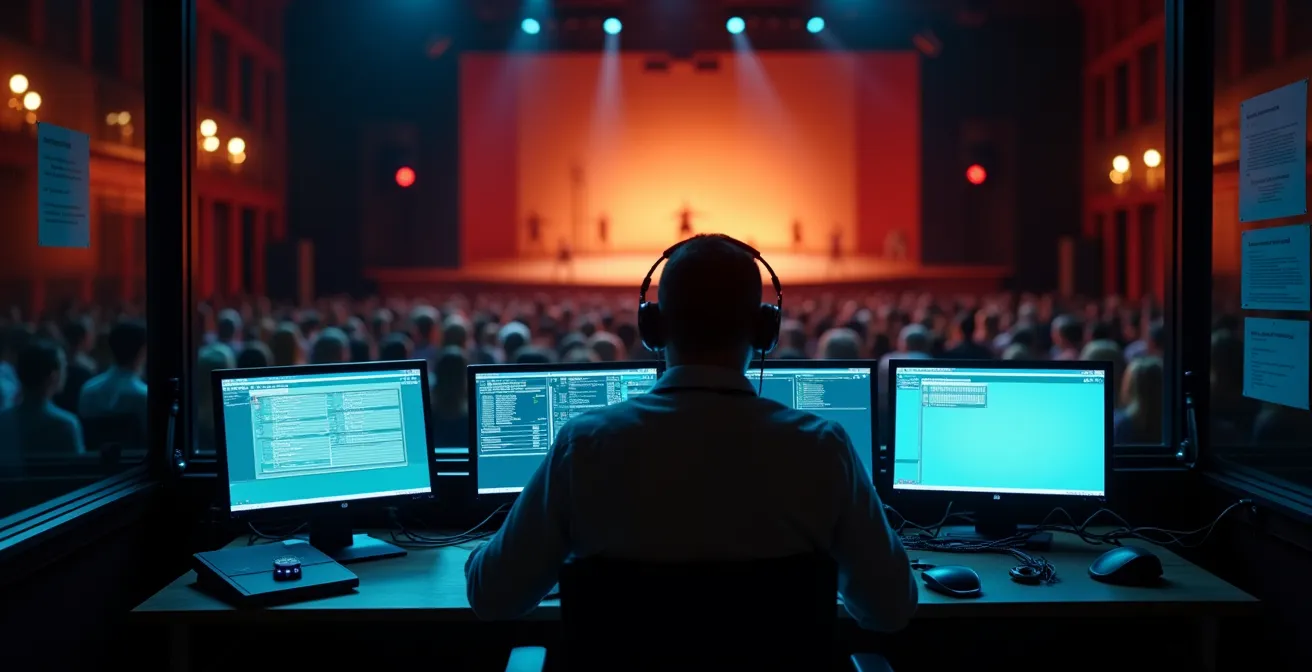
Effective theater crisis management isn’t about memorizing checklists, but building a system of human and technical resilience.
- Clear communication chains and objective decision matrices are non-negotiable for ensuring the safety of everyone on and off stage.
- Investing in experienced, adaptable actors provides critical “human redundancy” that technology alone can never replace.
Recommendation: Shift from simple pre-show checks to running surprise failure-simulation drills to build the muscle memory your team needs to transform panic into a controlled response.
The house lights are down. The audience is rapt. Then, a single spotlight flickers and dies, plunging the lead actor into darkness. Backstage, a headset crackles with a single, dreaded word: “Lost it.” For any stage manager or director, this is the moment where training meets reality. The heart pounds, but the response must be methodical, calm, and immediate. The common wisdom is that “the show must go on,” a phrase that romanticizes the grit of live performance but often dangerously oversimplifies the complex calculus of safety and professionalism required in a crisis.
Many productions rely on basic backup plans and hope for the best. They check the fire extinguishers, they have an understudy waiting in the wings, and they trust their crew. But this is a reactive posture. It prepares for a known problem, not the terrifying unknown of a cascading failure. What if it’s not just a light, but the entire grid? What if a piece of automated scenery stops, leaving a performer suspended over the stage? Simply “going on” is no longer an option; it’s a liability.
This guide moves beyond those platitudes. The true key to managing mid-show mishaps is not a binder full of contingency plans, but a deeply embedded resilience mindset. It’s a philosophy that prioritizes structured decision-making over panicked improvisation and values human adaptability as much as technical redundancy. It’s about building a system where every member of the cast and crew knows their role not just in the performance, but in the potential failure of that performance.
We will deconstruct the core pillars of this approach, from establishing unbreakable communication protocols to making the life-or-death call to stop a show. We will explore how to handle everything from a simple missing prop to a catastrophic automation failure, all through the lens of a veteran stage manager whose primary job is to ensure that when things go wrong, the response is a masterclass in control.
To navigate these high-stakes scenarios, we have structured this guide into a series of protocols. Each section addresses a critical failure point and provides the framework needed to manage it effectively.
Summary: A Stage Manager’s Protocol for Theatrical Crises
- Why Headset Protocols Save Shows When the Lights Go Out?
- How to Cover a Missing Prop Without Breaking Character?
- Stop or Continue: The Decision Matrix for On-Stage Injuries
- The Automation Failure That Can Leave Actors Stranded Mid-Air
- Running the Safety Drill: The Pre-Show Routine That Prevents Panic
- Actors or Sets: Where Should You Spend 50% of Your Budget?
- Why rolling Through the Foot Reduces Impact Force by 50%?
- Monologue Selection: Why Casting Directors Reject 80% of Classical Choices?
Why Headset Protocols Save Shows When the Lights Go Out?
When a technical failure occurs, the first casualty is information. Darkness, silence, or a stuck set piece creates a vacuum that will be filled by panic unless a clear, authoritative voice takes control. This is the non-negotiable role of the headset system. It is not merely a communication tool; it is the central nervous system of the production. A well-defined headset protocol ensures that the Stage Manager (SM) can assess, delegate, and command a response without the audience ever knowing the scale of the crisis.
The protocol is built on a strict chain of command. The SM is “central command,” the single point of truth. All department heads report status *to* the SM, who then disseminates instructions. There is no cross-chatter or independent decision-making. This disciplined flow of information prevents conflicting actions, such as one technician rebooting a lighting board while another tries to manually patch a circuit. Every second is critical, and a clear protocol turns chaos into a coordinated, multi-pronged solution.
Case Study: The ‘Great Comet’ Sound Failure
During a Broadway performance of *Natasha, Pierre & The Great Comet of 1812*, the sound system failed completely. Instead of panicking, the cast demonstrated perfect “human redundancy.” Trained for this, they immediately began to project, their voices filling the Imperial Theatre without amplification. While the actors covered on stage, the SM used the headset system to coordinate with the sound department. A calm announcement was made to the audience about the technical difficulties, the show was briefly paused, and the issue was resolved. The actors’ ability to continue and the crew’s calm coordination, all managed via headset, turned a potential disaster into a moment of theatrical magic that earned a standing ovation.
This system must have built-in redundancy. If the primary SM’s headset fails, the Deputy Stage Manager (DSM) immediately takes over the channel. If a department head goes silent, the Assistant Stage Manager (ASM) on deck is responsible for physically checking on them. This is not improvisation; it is a drilled sequence, ensuring the nervous system can never be truly severed. It is the invisible architecture that holds a show together when its visible elements fall apart.
How to Cover a Missing Prop Without Breaking Character?
A climactic sword fight begins, but the hero reaches for his scabbard and finds it empty. A character is meant to sign a life-altering document, but the pen is gone from the desk. A missing prop is one of the most common mid-show mishaps, and how it is handled separates amateurs from professionals. The audience’s suspension of disbelief is fragile. A panicked glance into the wings or a whispered curse can shatter it instantly. The solution lies not with the props master, but with the actors on stage. This is where human redundancy becomes the most critical system in the theater.
Experienced actors are trained to solve the problem, not highlight it. The protocol is simple: acknowledge, adapt, and advance. The actor must first non-verbally acknowledge the absence of the prop to their scene partner. A subtle widening of the eyes or a held gesture is enough. Then, they must adapt. This may involve pantomime, using an existing object as a substitute, or altering the dialogue to logically write the prop out of the scene. “I see you’ve come unarmed,” a villain might sneer, instantly reframing the missing sword as a plot point rather than a mistake.
This skill—the ability to seamlessly integrate a failure into the narrative—is a hallmark of a resilient performer. They understand their job is to tell the story, and the prop is merely a tool, not the story itself. Backstage, the SM will note the issue and ensure the prop is in place for the next performance, but on stage, the responsibility lies entirely with the cast to maintain the world of the play.
This improvisational save is a performance in itself, a quiet display of mastery that the audience should never even register as a problem. The tension is real, but it is channeled into the character’s intention, strengthening the performance rather than derailing it. A missing prop becomes an opportunity for actors to listen more intently and react more authentically to the new reality of the scene.
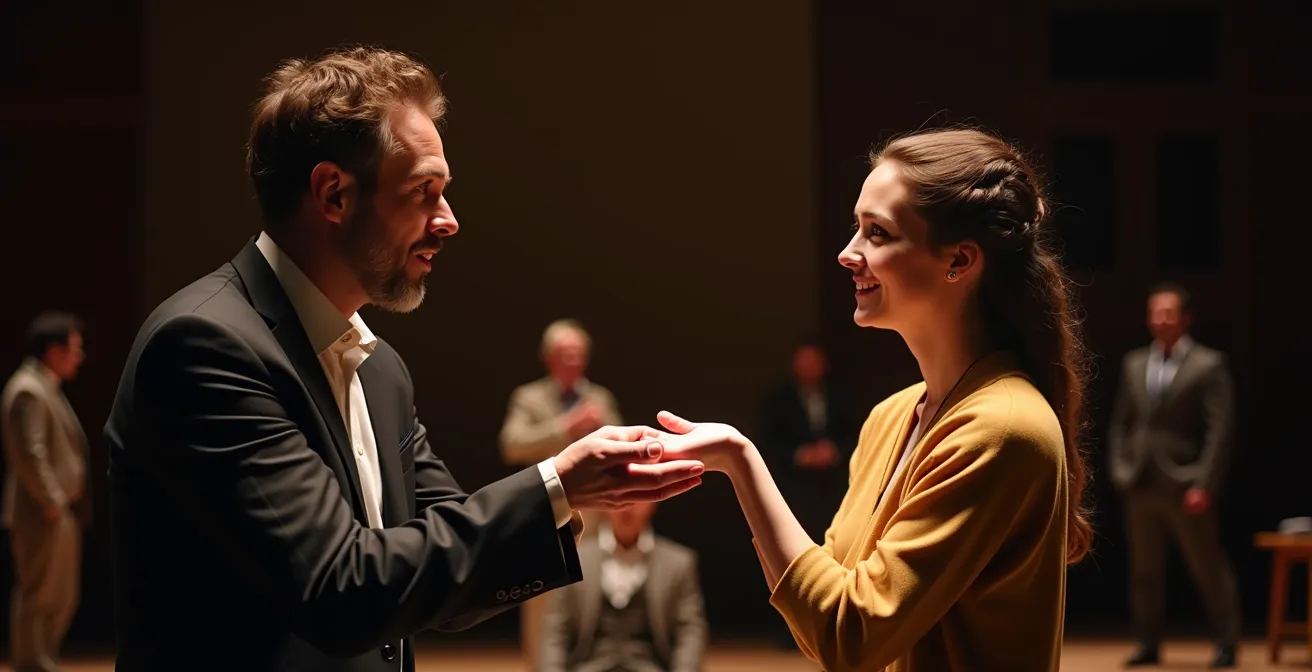
As the image illustrates, the power of performance can make the invisible visible. The focused intent between two actors can create the weight, shape, and significance of an object far more powerfully than the physical prop itself. This is the art of covering, and it is a testament to the fact that the most valuable special effect in theater will always be a well-trained actor.
Stop or Continue: The Decision Matrix for On-Stage Injuries
An actor lands awkwardly from a jump. A dancer stumbles. A piece of scenery clips a performer. In these heart-stopping seconds, the most critical decision of the entire production must be made: do we stop the show? The old adage “the show must go on” is not just outdated; it is dangerously irresponsible. The absolute, unequivocal priority is the safety of the cast and crew. To navigate this, a veteran SM does not rely on gut instinct. They rely on a pre-defined, cold-bloodedly logical decision matrix.
Cast and Crew safety COME FIRST. Heart failures, strokes, seizures, broken bones, collapsing scenery, fires, bomb threats, and severe storms do occur.
– CCSU Theatre Department, Stage Management and Assistant Stage Management Theatre Handbook
This commitment to safety is the foundation of the decision matrix. The SM is the only person with the authority to stop the show, and they must assess the situation based on severity and visibility. Is the injury minor, like a scraped knee the audience can’t see? The actor can be discreetly guided offstage at their next exit for assessment. Is the injury significant and visible, like a sprained ankle during a dance number? The SM may call a “show hold,” bringing down the lights and making a calm announcement while an understudy is prepared. Is it a severe, unmistakable emergency? The show is stopped. Instantly.
This structured framework removes emotion and panic from the equation. It provides a clear, defensible rationale for every choice made. The health of a performer is never worth a round of applause. The matrix ensures this principle is upheld with systematic precision, protecting not only the cast but also the production itself from legal and ethical fallout.
The following table, based on established emergency procedures, outlines a typical framework for this critical decision-making process. It provides a clear path of action, transforming a chaotic moment into a series of manageable steps.
| Severity Level | Visible to Audience | Action Required | Documentation Needed |
|---|---|---|---|
| Level 1: Minor | No | Continue performance, assist at next break | Post-show incident report |
| Level 2: Moderate | Partially | Quick offstage assessment if possible | Immediate notation, full report after |
| Level 3: Significant | Yes | Hold for understudy swap if available | Real-time documentation |
| Level 4: Severe | Yes | Stop show immediately | Full incident report for insurance/legal |
| Level 5: Emergency | Any | Full evacuation protocol | Emergency services documentation |
As this framework from the Performing Arts Readiness project demonstrates, every level of incident has a corresponding, pre-determined protocol. This is the essence of professional crisis management: transforming a moment of panic into a controlled, procedural response where safety is the only metric that matters.
The Automation Failure That Can Leave Actors Stranded Mid-Air
Modern productions increasingly rely on complex automation—turntables, lifts, and flying rigs—to create spectacular visual effects. But with complexity comes a higher risk of failure. An automation glitch is not like a missed light cue; it can have immediate and severe safety implications, such as an actor left stranded ten feet above the stage or a massive set piece frozen mid-transition. The stakes are incredibly high, especially when you consider that analysis shows between 30 and 40% of all musicals shut down annually for various reasons; a major, unmanaged technical failure can easily contribute to that statistic.
Responding to an automation failure requires a tiered protocol that prioritizes the performer’s safety above all else. The first step is always communication. The SM must immediately establish a calm, reassuring dialogue with the stranded actor over the God mic or their personal monitor. “Stay right where you are, we have you, we’re working on it now.” This verbal tether is crucial for preventing the actor from taking any dangerous independent action.
Simultaneously, the technical crew executes a pre-planned rescue protocol. This is typically a three-level response:
- System Reset: The automation operator attempts a standard software restart. This solves the majority of minor glitches.
- Manual Override: If the reset fails, the on-site technician engages the physical backup controls. These are mechanical levers or cranks that can move the machinery independently of the computer.
- Physical Rescue: In the gravest of situations where mechanical override also fails, a certified rope access technician may be deployed to perform a manual extraction. This is a last resort, drilled extensively but rarely used.
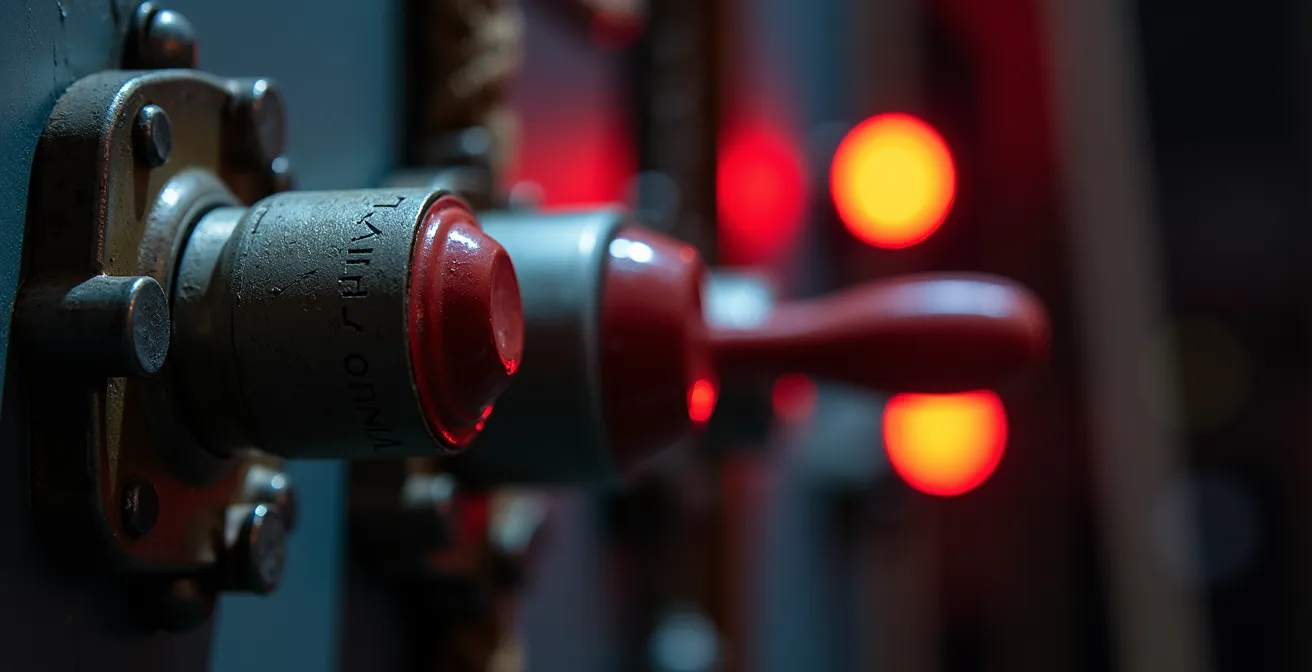
Every piece of automated equipment must have a manual override. As the detailed image of a rigging system shows, the high-tech computer control is always backed by robust, often simple, mechanical engineering. This is the ultimate safety net. The crew must be drilled not just on running the automation, but on taking manual control in a crisis. This ensures that no performer can ever be left in a position from which they cannot be safely recovered.
Running the Safety Drill: The Pre-Show Routine That Prevents Panic
The calm, controlled response to a mid-show crisis is not born of luck or innate talent; it is forged in repetition. A production’s resilience is directly proportional to the quality and frequency of its safety drills. While standard pre-show checks are essential, they often become a rote checklist. A true resilience mindset is built by moving beyond simply checking if a fire extinguisher is present and instead drilling what to do if a fire actually breaks out. The goal is to build muscle memory for the entire team, so that when adrenaline spikes, training takes over.
Effective safety drills are not just about evacuation routes. They should include surprise, simulated-failure scenarios. During a technical rehearsal, the SM might suddenly announce, “We’ve lost power to the stage right grid,” forcing the lighting department to execute their backup plan in real-time. Or they might place a “fallen” object in an actor’s path, testing the cast’s ability to clear it safely while maintaining character. These drills expose weaknesses in a low-stakes environment, allowing protocols to be refined before they are needed in front of a paying audience. The key is to build true resilience, not just demonstrate compliance.
Case Study: The ADC Theatre’s Proactive Fire Check
At the ADC Theatre in Cambridge, the protocol is clear and proactive. Their Stage Management guide mandates that “The Stage Manager should carry out a fire check before every rehearsal or performance on the stage.” This is not a passive glance but an active inspection to ensure all fire equipment is accessible, emergency passages are completely clear, and all other safety conditions are met. This routine, repeated daily, embeds a culture of constant vigilance. It ensures that the basic foundations of safety are never taken for granted, creating a secure environment in which the creative team can work.
Ultimately, the Stage Manager has the final authority to stop a performance for safety reasons. This is a heavy responsibility, and it’s one that can only be wielded confidently if the entire team trusts the SM’s judgment—a trust that is built during these drills. When everyone knows the plan and has practiced it, they understand that a call to “hold” or “stop” is not a sign of failure, but the execution of a professional safety protocol. Panic is prevented not by hoping it won’t happen, but by practicing for it until the correct response is second nature.
Actors or Sets: Where Should You Spend 50% of Your Budget?
When planning a production budget, there’s often a tug-of-war between spectacle and substance—dazzling sets versus talented performers. From a crisis management perspective, the choice is clear. While robustly engineered scenery can prevent certain mechanical failures, its ability to adapt in a crisis is zero. An experienced, resilient cast, however, is a dynamic, problem-solving asset. Allocating a significant portion of the budget to seasoned actors is a direct investment in your show’s ability to survive the unexpected.
The financial reality of theater is harsh; data shows that approximately 80% of Broadway producers and investors fail to recoup their investments. With such high stakes, every dollar must be optimized for both artistic impact and operational resilience. A less experienced actor might save money upfront but will cost you dearly when they freeze at a missed cue or break character over a malfunctioning prop. An experienced performer, on the other hand, possesses the “human redundancy” to improvise, adapt, and even turn a mistake into a memorable moment, saving the scene without the audience ever noticing the glitch.
Therefore, when building a budget with crisis mitigation in mind, the allocation should be weighted towards the human elements. This doesn’t mean neglecting set design or technical systems, but it means prioritizing the elements that can actively respond to failure. This includes not just actors, but also experienced stage managers and crew who have the training to execute complex recovery protocols.
The following table outlines a strategic budget allocation that prioritizes crisis prevention and recovery capability. It frames spending not just as an artistic choice, but as a risk management strategy.
| Investment Area | Crisis Prevention Value | Recovery Capability | Typical Allocation |
|---|---|---|---|
| Experienced Actors | High – can improvise through failures | Excellent – adapt in real-time | 40-50% of budget |
| Robust Set Design | High – fewer mechanical failures | Limited – fixed once built | 25-35% of budget |
| Resilience Systems | Critical – prevents cascading failures | Essential – enables quick recovery | 10-15% recommended |
| Technical Redundancy | Moderate – backup systems ready | High – immediate failover possible | 5-10% of budget |
As this breakdown shows, investing in experienced actors offers the highest possible recovery capability. They are your last and best line of defense when technical systems fail. A solid set is important, but a solid cast is indispensable.
Why rolling Through the Foot Reduces Impact Force by 50%?
The physical safety of a performer goes far beyond simply avoiding major accidents. It extends to the micro-traumas of daily performance: the impact of jumps, the mechanics of a stage fall, and the constant strain of moving on a raked or uneven stage. A key principle of this physical resilience is understanding how to dissipate energy. A technique as simple as “rolling through the foot”—landing on the ball of the foot and rolling down to the heel—can reduce impact forces by up to 50%. This isn’t just a dance technique; it’s a critical injury prevention protocol for any actor who moves on stage.
The cast shouldn’t set foot on the stage unless you would walk on it barefoot. Inspect the set daily for potential problems.
– Angela Mitchell, The 10 Commandments of Stage Management
This quote underscores a fundamental truth: the stage itself is a potential hazard. A loose screw, a splintered board, or a slick spot from a spilled liquid can lead to a fall. The SM’s daily inspection is the first line of defense. The actor’s physical training is the second. Performers must be trained in techniques that not only look good but are mechanically safe. This includes mastering controlled falls, developing keen peripheral awareness to avoid collisions with scenery or other actors, and understanding how to absorb momentum to prevent joint and muscle injuries.
This training is a form of physical crisis prevention. An actor who knows how to fall correctly can turn a potentially show-stopping injury into a minor stumble from which they can recover instantly. They become physically smarter, more aware of their environment, and better equipped to handle the unexpected physical demands that a live performance can suddenly present. This training is as crucial as learning lines.
To ensure actors are prepared for the physical risks of performance, a dedicated training and check-in process is essential. This moves safety from an abstract concept to a daily, practical routine.
Action Plan: Actor Physical Safety Protocol
- Practice landing mechanics: Drill controlled rolling techniques through the foot to absorb impact from jumps and unexpected momentum shifts.
- Master stage falls: Train actors in safe fall techniques specific to the show’s surfaces (e.g., wood, carpet, raked stages) to minimize injury risk.
- Develop spatial awareness: Conduct exercises that enhance peripheral vision and awareness of moving set pieces and other performers to prevent collisions.
- Establish non-verbal signals: Create and rehearse a system of non-verbal emergency signals that actors can use to alert the crew of a hazard without breaking character.
- Implement daily safety checks: Begin each pre-show warmup with a physical check-in and a quick walk of the stage to identify and report any potential hazards.
Key Takeaways
- Safety Is Not Negotiable: The “Stop or Continue” decision matrix isn’t a suggestion; it is a mandate that must be followed to protect cast and crew above all else.
- Humans Are Your Best Backup: An actor’s ability to improvise through a missing prop or sound cut is as vital to show resilience as any piece of technical redundancy.
- Drill for Failure, Not Just Success: Proactive, simulated-failure drills that create controlled chaos are what separate a professional, resilient crew from a panicked one.
Monologue Selection: Why Casting Directors Reject 80% of Classical Choices?
In the context of building a resilient production, casting is the first and most important line of defense. A casting director isn’t just looking for a performer who can deliver a flawless classical monologue. They are looking for an artist who can think on their feet, solve problems, and remain grounded under pressure. While the statistic that 80% of classical monologues are rejected is more of an industry generalization, the principle behind it is sound: a canned performance reveals very little about an actor’s ability to handle the spontaneous chaos of live theater.
A truly insightful casting process tests for resilience. This might involve giving an actor a “cold read” and then providing a redirect that completely changes the character’s motivation, forcing the actor to adapt instantly. It could mean intentionally “forgetting” a prop for a scene during a callback to see how the actor covers for it. These are not tricks; they are diagnostics. They reveal an actor’s problem-solving skills, their ability to listen, and their capacity to stay in the moment—all hallmarks of a performer who will be an asset, not a liability, when a real crisis occurs.
Case Study: Assessing Crisis Response in Professional Auditions
Organizations like The Musical Theater Center emphasize that professional development for performers and managers is about far more than artistic technique. True professionals “learn to harness the power of communication, crisis management, and creative problem-solving.” This learning comes from rigorous training and hands-on experience. A casting process that reflects this philosophy looks for evidence of this training. It prioritizes actors who can demonstrate not just what they’ve rehearsed, but how they think when the rehearsal is over. They are casting for a creative partner in problem-solving.
Therefore, the ideal cast for a complex, technically demanding show is one filled with these kinds of performers. They are chosen not just for their talent, but for their temperament. They have a deep understanding that their role includes being a part of the show’s safety and recovery system. A perfect Hamlet who panics when a light goes out is far less valuable than a good Hamlet who can hold the stage and his character while the crew fixes the problem. The resilience of a show is cast long before the first rehearsal begins.
Your next step is to move beyond theory. Implement one simulated-failure drill in your next technical rehearsal. Introduce a small, controlled problem and observe your team’s response. The safety of your cast, crew, and audience depends on this proactive commitment to building a resilient production.