
The biggest myth about monetizing poetry is that you must choose between profit and artistic integrity.
- Strategic formatting and digital products consistently outperform generic physical merchandise in both profitability and reach.
- Building an authentic author platform is far more valuable than chasing algorithmic trends that dilute your unique voice.
Recommendation: Focus on converting followers into a true readership by treating your social media as the start of a customer journey, not the final destination.
You’ve poured your soul into a stanza, found the perfect line break, and are ready to share it with the world. But then the questions start. How do you stand out in a sea of perfectly filtered squares? How do you turn likes and shares into a sustainable career without feeling like you’re selling out? For the modern poet, the glow of the screen presents both an unprecedented opportunity and a daunting challenge. The path to monetization seems littered with generic advice about printing your work on coffee mugs or simply “posting more.” This approach often ignores the core of the issue: the deep-seated fear of compromising your art for commerce.
Many artists believe that financial success requires simplifying their metaphors and pandering to the lowest common denominator. They see a binary choice between artistic purity and financial stability. This guide is built on a different premise. Monetizing your poetry isn’t about selling out; it’s about buying in—buying into your own value as a creative entrepreneur. It requires a strategic mindset that views your social feed not just as a gallery for your art, but as the foundation of a real business.
But what if the key wasn’t just *what* you sell, but *how* you present your art and build your community? What if digital craftsmanship and understanding reader psychology were your most powerful tools? This article will walk you through a playbook for turning your passion into a profession. We’ll deconstruct everything from the neuroscience of screen reading to the specific types of merchandise that actually sell, all while keeping your artistic integrity at the forefront. It’s time to move beyond the “starving artist” trope and build a career that is both profitable and authentically yours.
This comprehensive guide explores the strategic pillars for building a sustainable career as a modern poet. You will find actionable advice on formatting, publishing, product strategy, and platform building, all designed to help you monetize your work without compromising your creative voice.
Summary: Your Guide to Profitable and Authentic Poetry
- Line Breaks or Screen Width: Formatting Poems for Instagram?
- Posting Poems Online: Does It Count as “Previously Published”?
- Prints or T-Shirts: Which Poetry Merch actually Sells?
- The Algorithm Trap That Simplifies Your Metaphors
- From Follower to Reader: The Conversion Funnel for Poetry Books
- Canvas or Limited Print: Which Entry-Level Investment Is Safer?
- How Screen Reading Changes Neural Pathways for Comprehension?
- Building an Author Platform From Scratch Before Your First Book Deal?
Line Breaks or Screen Width: Formatting Poems for Instagram?
On the printed page, a line break is a breath. On a smartphone screen, it can be a disaster. The first step in becoming a successful creative entrepreneur in the poetry space is mastering digital craftsmanship. This means understanding that formatting isn’t just an aesthetic choice; it’s a functional one. Your carefully constructed stanzas can become a jumbled mess on a 6-inch screen if not handled with intention. The key is to design for the medium.
Think of each Instagram post as its own contained page. Short poems are naturally suited for this format, but longer pieces require creative solutions. Breaking a poem into a multi-slide carousel post not only preserves its structure but also encourages engagement as users swipe through. Using simple design tools like Canva allows you to establish a consistent visual brand, creating templates that control font, background, and spacing. This ensures your work is always presented as intended, with ample white space to let each line breathe and resonate.
This visual consistency does more than just improve readability; it builds brand recognition. As poet Tyler Knott Gregson has shown with his signature typewritten poems on scraps of paper, a distinct visual style can make your work instantly recognizable in a crowded feed. This becomes a form of intellectual property protection, where the formatting is as much a part of your artistic identity as the words themselves. Before you even think about selling a product, you are selling an experience. The clarity and consistency of that experience begin with thoughtful formatting.
Posting Poems Online: Does It Count as “Previously Published”?
One of the most persistent fears for poets sharing their work online is the “previously published” clause. For decades, literary journals and traditional publishers have stipulated that they will only consider “unpublished” work. Does posting a poem on your Instagram feed disqualify it from a future book deal or contest? The short answer is: it’s complicated, but the rules are rapidly changing in your favor. While some purist journals may still consider a social media post as a form of publication, the vast majority of modern publishers and agents understand that an online presence is now a prerequisite, not a red flag.
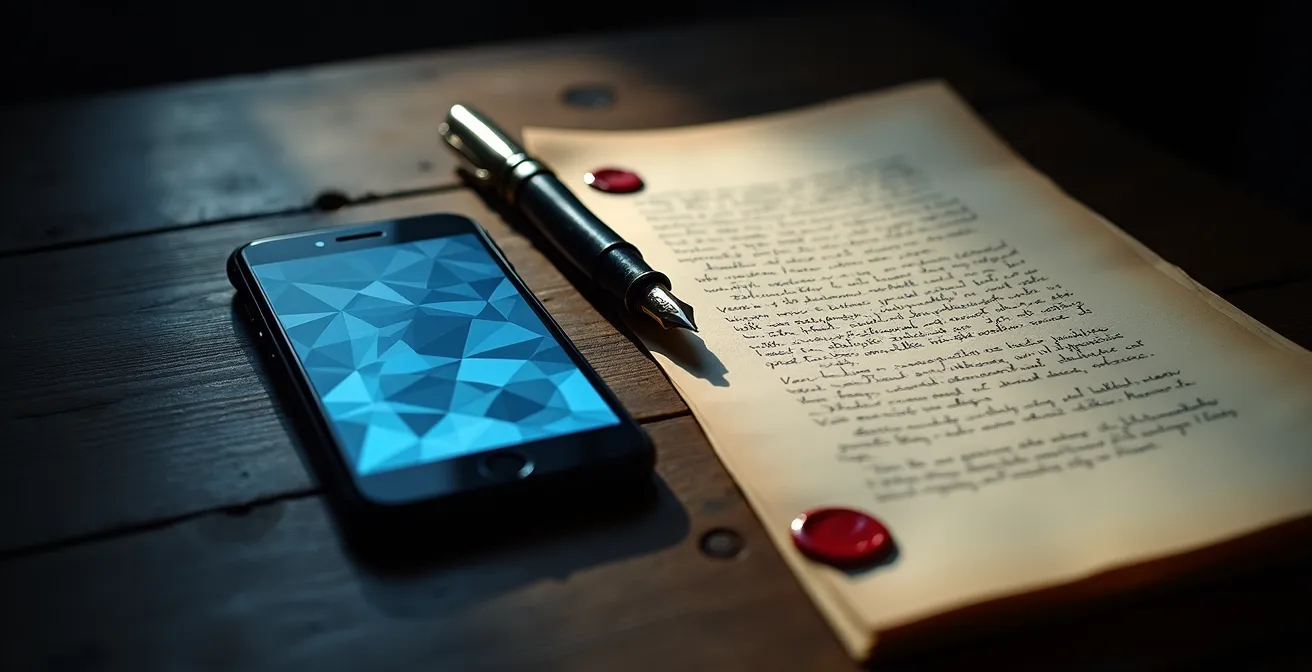
As the image above symbolizes, the line between the digital feed and the physical manuscript has blurred. Publishers now see a strong social media following not as a sign of used goods, but as proof of market viability. They are actively looking for authors who have already cultivated an audience. Your Instagram followers represent a built-in customer base for a future book. The journey of writer and YouTuber Savannah Brown is a prime example. Many poems from her self-published bestseller, Graffiti, first appeared on her YouTube channel. Her success demonstrates that sharing work online is a powerful way to build an engaged audience that is eager to purchase a physical copy.
The key is to be strategic. You don’t have to post every poem from your manuscript-in-progress. Share work that represents your voice and engages your audience, but consider holding back a few signature pieces exclusively for a future collection. This creates anticipation and gives readers a compelling reason to buy the book when it’s released. Ultimately, the fear of being “previously published” is being replaced by the greater risk of being completely unknown. In today’s market, visibility is currency.
Prints or T-Shirts: Which Poetry Merch actually Sells?
The advice to “sell merchandise” is ubiquitous, but it often leads poets down a rabbit hole of high upfront costs and unsold inventory. Before you order 200 t-shirts with your most poignant couplet, it’s crucial to analyze what actually performs in the digital marketplace. The data suggests a clear winner: digital products often have far greater potential than physical ones. They offer higher profit margins, require minimal to zero inventory investment, and provide instant delivery to a global audience.
Consider the market realities. Physical books are a cornerstone, but digital formats are rapidly gaining ground. This is a significant slice of the pie, with data showing that poetry e-books account for 20% of all e-book sales in the US. Furthermore, the market for poetry audiobooks has shown explosive growth. This shift indicates that modern readers value accessibility and portability. Creating a beautifully designed digital chapbook or a professionally recorded audiobook can be a far more scalable and profitable venture than managing a warehouse of physical goods.
This doesn’t mean physical products have no place, but they require a more strategic approach. Instead of generic items, think about products that deepen the artistic experience. A limited-edition, signed art print of a poem is a high-value item for a dedicated fan. A curated “fashion collection” inspired by a book’s themes can generate buzz, but it demands significant capital. The table below breaks down the performance and investment required for different product types, helping you make an informed decision as a creative entrepreneur.
| Product Type | Market Performance | Investment Required |
|---|---|---|
| Digital Chapbooks/E-books | 20% of e-book market | Low (design only) |
| Poetry Audiobooks | 25% revenue growth | Medium (recording equipment) |
| Fashion Collections | 20% sales increase | High (production & inventory) |
| Physical Books | 15% annual growth | High (printing costs) |
The most successful strategy is often a hybrid one. Use high-margin digital products to generate consistent income and build your audience, then offer exclusive, high-value physical items as limited drops to your most loyal readers. This minimizes risk while maximizing both profit and fan engagement.
The Algorithm Trap That Simplifies Your Metaphors
The greatest threat to your artistic integrity on social media isn’t a board of corporate censors; it’s the invisible hand of the algorithm. Platforms like Instagram and TikTok are engineered to reward content that is instantly gratifying. They prioritize posts that garner quick likes, comments, and shares, creating a powerful incentive for artists to produce work that is simple, relatable, and easily digestible. This is the algorithm trap: the subtle pressure to sand down the complex edges of your work in exchange for greater visibility.

This phenomenon has given rise to what some critics call “Instapoetry”—work characterized by its accessibility, often at the expense of depth. It’s the kind of content that is easy to consume while scrolling, but may lack the lasting resonance of more complex art. As one cultural analysis notes, this trend favors surface-level engagement over substantive quality.
Instagram poetry is described as instant, easy-to-digest and surface-level poetry that’s simple to read and go ‘huh, that’s pretty deep’ as you continue your doomscrolling.
– Trent Arthur, trentarthur.ca
Falling into this trap is a gradual process. You notice a simple, aphoristic poem gets twice the likes of a nuanced, multi-layered piece. The next time you write, you subconsciously lean toward that simpler style. Over time, your unique voice can become diluted, replaced by a version optimized for the platform’s metrics. The key to avoiding this is self-awareness. Recognize that likes are not a measure of artistic merit. They are a measure of algorithmic compatibility. Use social media as a distribution channel, not as the sole arbiter of your work’s value. The real art happens at your desk, away from the immediate feedback loop of the digital world.
From Follower to Reader: The Conversion Funnel for Poetry Books
A large follower count is a vanity metric. An engaged readership is a business asset. The most critical shift in mindset for a creative entrepreneur is to stop thinking about audience growth and start thinking about audience conversion. Your goal isn’t just to get people to follow you; it’s to guide them on a journey from being a passive scroller to becoming an active, paying reader. This is the poetry conversion funnel.
The top of the funnel is your social media feed. This is where you attract new people with free, high-quality content. The middle of the funnel is where you deepen the relationship. This could be through a newsletter where you share more personal insights, behind-the-scenes content, or exclusive poems. You are building trust and demonstrating value beyond what’s available in a public feed. The bottom of the funnel is the sale: the moment a loyal follower decides to purchase your book, a digital product, or a ticket to a reading.
The power of this model is undeniable, as poets with a strong social media presence see a 20% increase in book sales on average. The quintessential case study is Rupi Kaur. Her book Milk and Honey was originally self-published, but she leveraged her massive Instagram and Twitter following to drive incredible sales. Her initial print run of over 15,000 copies sold out largely because she had already built a direct line to her “army of social media fans.” She didn’t just have followers; she had a community that was primed and eager to buy her work. She successfully converted attention into commerce.
Building this funnel requires patience and consistency. It means providing value at every stage, not just asking for the sale. It means treating your followers as future readers and nurturing that relationship over time. Your social media isn’t the final destination; it’s the front door to your entire creative world.
Canvas or Limited Print: Which Entry-Level Investment Is Safer?
As you transition from sharing work for free to selling it, the question of initial investment becomes paramount. What is the safest and most strategic way to enter the market? The romantic vision of traditional publishing often clashes with a harsh financial reality. It’s a path that offers prestige but cedes significant control and, often, the majority of the profit. For many poets, self-publishing and direct-to-consumer sales represent a more viable, and safer, entry-level strategy.
The economics of traditional publishing can be sobering. Publishers operate on thin margins and rarely break even on poetry collections. Even for celebrated works, the sales figures are often modest. It’s a tough market, where even award-winning poetry collections typically sell a few thousand copies. This context is crucial when weighing your options. While a traditional deal provides validation and distribution, the author’s share of the revenue can be minimal.
In contrast, self-publishing and direct sales put you in the driver’s seat. As a creative entrepreneur, you retain full control over your work and keep a significantly larger margin on each sale. The table below illustrates the fundamental trade-offs between different publishing paths. Hand-selling books at readings or selling limited-edition prints directly from your own website is almost always more profitable per unit than relying on traditional royalties.
| Publishing Path | Author Control | Financial Reality |
|---|---|---|
| Traditional Publishing | Limited control | Publishers rarely break even |
| Self-Publishing | Full control | Author keeps larger margin per sale |
| Hand-selling at readings | Direct connection | More profitable than royalties |
The safest entry-level investment, therefore, is one that minimizes your financial risk while maximizing your control and potential profit. This points toward starting with digital products (as discussed earlier) or low-volume, high-value physical items like limited edition prints. These can be produced on-demand, eliminating the need for large upfront investment and inventory. This approach allows you to test the market, build your customer base, and grow your business sustainably.
How Screen Reading Changes Neural Pathways for Comprehension?
To truly master digital craftsmanship, you must understand your audience’s brain. Reading on a screen is not the same as reading on a page. Decades of user experience research have shown that our brains adapt to the digital medium by developing new reading patterns. The most dominant of these is the “F-shaped pattern.” When faced with a wall of text on a screen, users don’t read linearly. Instead, they scan: two horizontal sweeps across the top, followed by a vertical scan down the left side, creating a rough “F” shape. Studies show that users spend 80% of their time viewing the left half of the screen.
What does this mean for a poet? It means that your most powerful words, your most striking images, and your most important turns of phrase should be front-loaded. They need to appear at the beginning of lines and be positioned toward the left side of your visual layout. A long, winding line that saves its punch for the very end is likely to be missed by a scanning reader. This isn’t a call to dumb down your work; it’s a call to be a smarter digital composer. You must guide the reader’s eye.
This neurological reality is why visual formatting is so critical. Using strong headings, breaking text into smaller chunks, and incorporating visuals are not just design trends; they are neuro-hacks that create anchor points for the scanning eye. They interrupt the F-pattern and invite the reader to slow down and engage more deeply. For a poet, this could mean using a unique font for a key phrase, varying line spacing dramatically, or breaking a single stanza into its own visual block. You are working with the brain’s new habits, not against them, to ensure your poetry is not just seen, but truly read.
- Front-load Impact: Place your most crucial words and ideas at the beginning of lines and stanzas.
- Leverage the Left: Keep the core of your poem aligned to the left, where the user’s eye naturally lingers.
- Create Visual Anchors: Use spacing, bolding, or small visual elements to break up the text and draw the eye to key areas.
- Chunk Your Content: Break longer poems into visually distinct stanzas or carousel slides to make them more approachable for a scanning reader.
Key Takeaways
- Monetization is not about selling out, but about adopting a strategic “creative entrepreneur” mindset.
- Digital products like e-books and audiobooks often offer higher profit margins and lower risk than physical merchandise.
- Building a conversion funnel to turn followers into a loyal readership is more important than chasing vanity metrics like follower counts.
Building an Author Platform From Scratch Before Your First Book Deal?
In the past, the book deal came first, and the author platform followed. Today, that model is inverted. A publisher is not just investing in a manuscript; they are investing in an author’s ability to sell it. Therefore, building a robust author platform before you even have a book to sell is no longer optional—it is the single most important investment you can make in your long-term career. Your platform is your direct line to your readers, your proof of market, and your engine for future sales.
Building a platform from scratch can feel like shouting into the void. The key is consistency and value. It’s about showing up regularly for your audience and giving them a reason to listen. The success of channels like Button Poetry provides a powerful blueprint. By posting a new video every day, they have built a massive, engaged community of 1.3 million subscribers. Their model demonstrates that a relentless focus on delivering high-quality, consistent content is the foundation of platform growth. Crucially, they also pay the poets they feature, creating a sustainable ecosystem that benefits both the platform and the individual artists.
For an individual poet, this translates to defining your niche and owning it. What is the unique value you offer? Is it a raw, confessional style? Witty social commentary? A mastery of classical forms? Your platform should be a clear reflection of this brand. It’s better to be the go-to source for a small, passionate community than to be a generic voice trying to appeal to everyone. Start by auditing your current online presence to identify your unique strengths and ensure your content is cohesive and authentic.
Your 5-Step Author Platform Audit
- Points of Contact: Identify all channels where you share your work (e.g., Instagram, TikTok, newsletter, personal blog) and assess their effectiveness.
- Content Inventory: Gather your most-liked poems, visual styles, and recurring themes. What is currently resonating most with your audience?
- Coherence Check: Compare your content against your core artistic values. Does your most popular work truly represent the voice you want to be known for?
- Memorability Analysis: Pinpoint what makes your work unique. Is it a specific visual style, a recurring metaphor, a raw emotional tone, or your performance?
- Integration Plan: Create a strategy to amplify your unique signals across all channels and phase out content that feels generic or off-brand.
Your platform is more than just a marketing tool; it is the digital home for your art and your community. Building it with intention from day one is the most strategic move you can make as a modern creative entrepreneur.
Stop dreaming of being a paid artist and start building your creative enterprise. Apply these strategies today to build a career that is both profitable and authentically yours.