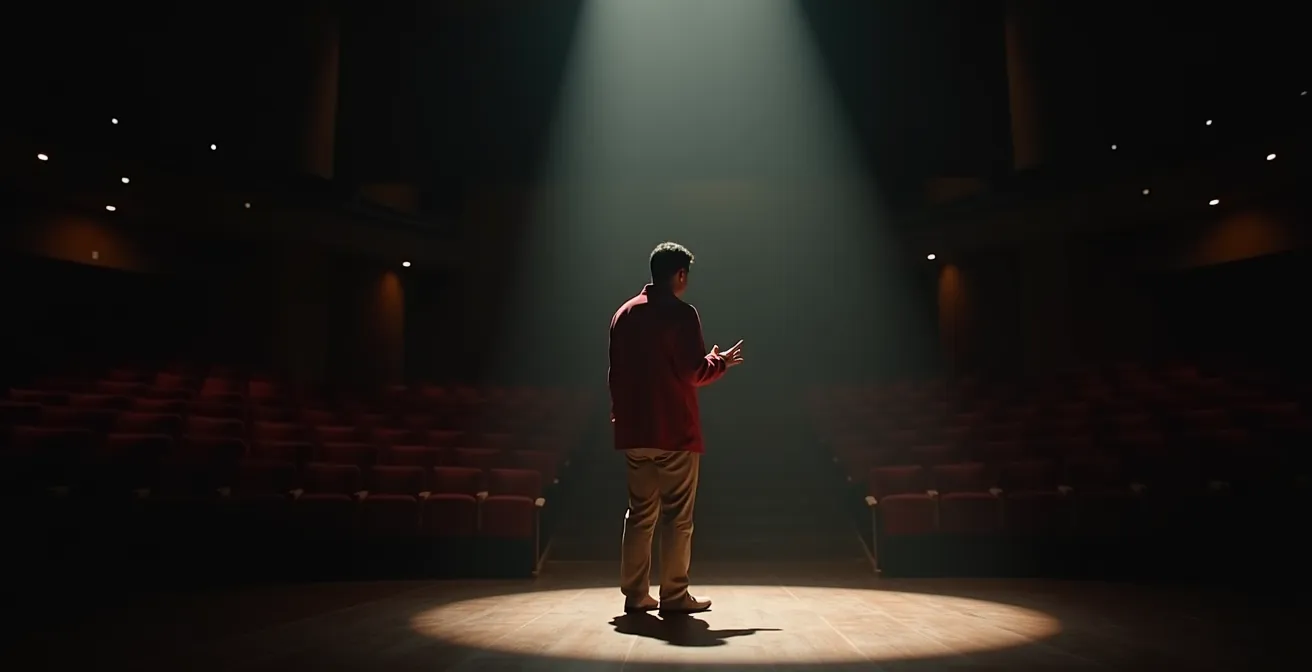
Contrary to popular belief, your classical monologue audition isn’t primarily a test of raw talent; it’s a high-stakes diagnostic of your professionalism and technical craft.
- Most rejections stem not from a bad performance, but from a failure to analyze the text’s structure and make specific, active choices.
- Your entrance, slate, and ability to handle mistakes often reveal more about your readiness to work than the monologue itself.
Recommendation: Shift your focus from “showing emotion” to demonstrating you understand the ‘why’ behind the words and the unspoken rules of the audition room.
The silence in an audition room after you’ve poured your soul into a two-minute monologue can be deafening. You gave it your all, you felt the emotion, yet you walk out with a polite “thank you” and never hear back. The common advice you’ve heard a thousand times—”pick a piece that speaks to you,” “be confident,” “connect with the character”—feels hollow. It’s good advice, but it’s incomplete. It doesn’t explain why actors who follow it still fail to make an impression.
The hard truth is that from my side of the table, most classical auditions are forgettable. Not because the actors are untalented, but because they treat the monologue as a showcase for generalized emotion instead of what it truly is: a technical demonstration. They show me they can be ‘angry’ or ‘sad’, but they fail to show me they can break down a text, understand its inherent structure, and translate that analysis into a series of specific, playable actions. They fail to understand that the audition begins the moment they walk through the door, not the moment they speak their first line.
This guide will not rehash the platitudes. Instead, it offers the casting director’s perspective. We’re not looking for a finished, polished performance. We are using your monologue as a diagnostic tool. We’re testing your preparation, your understanding of dramatic architecture, your vocal and physical discipline, and your grace under pressure. This is about moving beyond the vague notion of ‘good acting’ and into the concrete, technical skills that signal to us that you are a professional actor we can hire and direct.
This article provides a structured breakdown of the critical elements we evaluate, from the non-verbal cues you send upon entering the room to the technical mastery hidden within the verse. Follow these principles to turn your next classical audition from a hopeful plea into a professional job interview.
Summary: Monologue Selection: Why Casting Directors Reject 80% of Classical Choices?
- Why Walking into the Room Confidently Matters More Than the First Line?
- How to Scansion Shakespeare to Reveal Hidden Acting Cues?
- Comedy and Tragedy: The Monologue Pairing That Shows Range?
- The “General Emotion” Trap That Makes Performances Forgettable
- Choosing the 16 Bars: The Section That Highlights Your Belt?
- Why a Lower Larynx Position Is Essential for Unamplified Projection?
- Why Letting Actors Improvise Can Derail Your Editing Plan?
- Managing Live Theater Mishaps: Protocol When Tech Fails Mid-Show
Why Walking into the Room Confidently Matters More Than the First Line?
Let’s be blunt: I’ve often made up my mind about an actor before they’ve uttered a single word of their monologue. This isn’t arbitrary; it’s an assessment of professionalism. Your entrance is the first piece of data I receive. Are you flustered and apologetic, or grounded and ready to work? Do you make brief, confident eye contact when you slate, or do your eyes dart around the room? These are not trivial details. They tell me how you will handle the pressure of a rehearsal room, a quick change backstage, or a note from a director. In fact, some industry coaches believe that agents decide on an actor in less than 10 seconds.

Your physical presence communicates your inner state. A slumped posture, fidgeting hands, or a rushed pace signals a lack of preparation and control. Conversely, an actor who walks in with an open posture, takes a moment to breathe and establish their space, and delivers a clear, concise slate (your name, the piece) is communicating that they are in command of their instrument and respectful of the process. This initial impression of poise and preparedness creates a context of professionalism that makes me want to see your work. A brilliant monologue delivered by someone who seems like a chaotic mess is a liability; a solid monologue delivered by a consummate professional is an asset.
Think of it as the ‘business of the room.’ Before you are an artist, you are a potential colleague. Your first thirty seconds in the room should be dedicated to establishing that you are a reliable, focused, and pleasant person to have in a creative process. Don’t waste time with elaborate physical warm-ups or apologies for being nervous. Walk in, own your space, slate clearly, take a breath, and then begin. You’ve set the stage for your own success.
How to Scansion Shakespeare to Reveal Hidden Acting Cues?
If you walk into a classical audition without having scanned your text, you are essentially throwing away the playwright’s roadmap. For Shakespeare and his contemporaries, the verse is not a decoration; it is the structural integrity of the character’s thought process. Iambic pentameter, with its ten-syllable lines of unstressed and stressed beats (da-DUM da-DUM da-DUM da-DUM da-DUM), is the character’s heartbeat. When that rhythm breaks—with a short line, a shared line, or a feminine ending—it is a massive, flashing signpost from the author telling you something has shifted emotionally or psychologically.
Ignoring these cues is the number one sign of an amateur. When an actor glosses over the meter, delivering the lines as flat prose, they are telling me they haven’t done their homework. They are missing the built-in musicality, the operative words the playwright has literally stressed for them, and the shifts in thought. As legendary acting coach Kristin Linklater noted, “Scansion is a crucial tool in the actor’s toolkit, allowing us to tap into the rhythm and emotion of the text.” It is not an academic exercise; it is a practical tool for unlocking the performance.
Case Study: The Carnegie Mellon Scansion Method
Top conservatory programs build their classical training around this principle. For instance, Gary Logan, a faculty member at Carnegie Mellon’s esteemed drama school, runs intensive workshops focused entirely on scansion and textual analysis. This approach teaches actors to see the verse not as a constraint, but as a source of invaluable, tangible feedback for building a character’s journey moment by moment.
Start by marking the stresses in your monologue. Find the regular iambic lines and, more importantly, find the irregularities. Does the character suddenly speak in prose? That’s a status shift. Is there an extra unstressed syllable at the end of a line (a feminine ending)? The character is likely wrestling with something, their thought spilling over. Is a line short, leaving several beats of silence to complete the meter? That silence is written text. Your job is to fill it with a thought, a reaction, a dawning realization. This is where the acting happens—not in generalized emotion, but in the specifics of the text’s architecture.
Comedy and Tragedy: The Monologue Pairing That Shows Range?
Often, an audition will require two contrasting pieces. This is not a trick question. We are explicitly asking you to demonstrate your range. An actor who can only do brooding tragedy or only light comedy is a less versatile, and therefore less castable, instrument. The classic pairing of a dramatic classical piece with a comedic one (either classical or contemporary) is the most effective way to showcase your dexterity. This pairing reveals several key things about you as a performer: your emotional breadth, your understanding of rhythm and timing in different genres, and your ability to shift your energy.
The key is contrast. Don’t pick two vaguely dramatic pieces. A fiery, verse monologue from a Shakespearean tragedy paired with a witty, language-driven piece from Molière or a sharp, modern comedy shows true versatility. The tragic piece might showcase your vocal power and emotional depth, while the comedic piece demonstrates your timing, intellect, and connection to the audience. Be mindful of length; a powerful performance can be undone by poor time management. The industry standard, and our general preference, is for each piece to be between 60-90 seconds when performed. Any longer and you risk losing our attention; any shorter and you may not have time to establish a full arc.
Here are the core guidelines for selecting a powerful, contrasting pair of monologues:
- Have at least one classical monologue (pre-20th century) and one contemporary piece to show you can handle both heightened language and naturalism.
- Choose contrasting emotional tones—one that is primarily dramatic and one that is comedic or serio-comedic.
- Ensure both pieces showcase different aspects of your vocal dexterity and physical control.
- Keep each monologue between 60-90 seconds at a maximum performance pace.
- Select characters that are age-appropriate and align with your general casting type, while still pushing the boundaries of what you can do.
Ultimately, your choice of monologues is a reflection of your self-awareness as an actor. It tells us if you understand your strengths and how you fit into the landscape of the theatre. A thoughtful, well-curated pairing is a sign of a smart, strategic actor.
The “General Emotion” Trap That Makes Performances Forgettable
This is the single biggest mistake I see in classical auditions. An actor decides the character is “angry” and then plays “angry” for two minutes straight. The volume is high, the face is contorted, but nothing *happens*. The performance is a monotonous wash of a single color, and it’s utterly forgettable. This is the “General Emotion” trap. Great acting is not about *being* an emotion; it’s about pursuing an objective and employing different tactics to achieve it. The emotions are the by-product of that pursuit, not the goal itself.
The most compelling performances are built on tactical shifts and changing objectives. Your character wants something from the person they are speaking to (even if that person is themselves or God). What are they doing to get it? Are they threatening, pleading, reasoning, seducing, shaming? A good monologue will contain several of these shifts. Your job is to identify them in the text and execute them. When the character’s tactic changes, their physicality and vocal quality should change with it. This is what creates a dynamic, engaging performance that holds our attention.

Insight from the Casting Room: The Power of Transition
We actively look for these moments of change. As casting director Josh Costello emphasizes, actors should choose monologues that provide opportunities to demonstrate skill with transitions and beat changes. He notes that the moments where tactics shift are “where good acting happens.” An actor who can navigate these turns with specificity and clarity is an actor who is directable and understands the craft of building a performance moment by moment.
Instead of asking “What am I feeling?”, ask “What do I want?” and “What am I doing to get it?”. This shifts your focus from a passive internal state to an active, playable goal. Your performance will instantly become more specific, varied, and interesting. Break your monologue down into “beats,” with each beat representing a new tactic. This analytical work is far more valuable than trying to psyche yourself up to “feel sad.” As filmmaker Suzanne LaChasse puts it, “Acting isn’t about the ‘way’ you do your lines, it’s the ‘why’ you do your lines.”
Choosing the 16 Bars: The Section That Highlights Your Belt?
The term “16 bars” comes from musical theatre, where an actor must select the most impactful slice of a song to showcase their voice. The same principle applies directly to classical monologues. You are rarely performing the entire speech; you are performing a cut. The fatal error is making a cut that is dramatically inert. Your selection must function as a complete, self-contained story with a beginning, a middle, and an end. It needs to showcase a clear emotional or intellectual journey, even in 90 seconds. We need to see the character change from one state to another.
The most powerful cuts are built around the “volta,” or the turn. This is the moment where the character’s argument, perspective, or emotional state pivots. It’s the “ah-ha!” moment, the point of no return, or the sudden revelation. Your cut must contain this turn. A monologue that starts and ends in the same emotional place is a flat line. A monologue that shows a character grappling with an idea and arriving at a new conclusion is a dynamic arc. This is what we mean by highlighting your “belt”—it’s not about volume, it’s about showcasing your most powerful moment of dramatic change.
Your cut needs a strong “button” at the end—a final moment or line that provides a sense of closure and lands with impact, leaving a lasting impression. It shouldn’t just trail off. Think of your cut as a miniature play. Does it have an inciting incident? Does it build to a climax (the volta)? Does it have a resolution (the button)? If you can answer yes to these questions, you have a strong, playable piece of material.
Action Plan: Crafting Your High-Impact Monologue Cut
- Identify the Turn: Read the full monologue and pinpoint the “volta”—the precise emotional or rhetorical turning point. Your cut must include this.
- Structure the Arc: Ensure your selected portion has a clear beginning, a rising middle, and a definitive end. It must tell a complete micro-story.
- Showcase Revelation: Your cut must feature the key moment where the character experiences a significant change, realization, or decision.
- Craft the Button: Engineer a strong final moment. The last line should land with purpose and provide a satisfying sense of closure.
- Time and Refine: Perform the cut at a natural pace and ensure it falls within the 60-90 second window. Trim ruthlessly to preserve only the essential moments.
This careful curation of your material is a non-negotiable part of your preparation. It demonstrates your ability to analyze text for dramatic structure, a skill every professional actor must possess.
Why a Lower Larynx Position Is Essential for Unamplified Projection?
In the age of microphones, many actors have forgotten how to use their primary instrument: the voice. In classical theatre, especially in larger houses, your voice must be able to fill the space without amplification, and do so for eight shows a week without injury. This isn’t about shouting. It’s about physics. The key to healthy, powerful, and resonant projection is maintaining a neutral to lowered larynx position. When an actor gets tense or pushes for volume, the larynx (or voice box) tends to rise, constricting the throat. This creates a thin, strained, and often sharp sound that lacks richness and can cause vocal damage.
By learning to speak from a relaxed, lowered larynx, you create more space in the pharynx (the area behind your tongue). This space acts as a resonating chamber, naturally amplifying the sound produced by your vocal folds. The result is a richer, warmer, and more powerful sound that carries to the back of the house with seemingly less effort. This is the foundation of what we call vocal architecture—building the voice on a supported, open, and physically sound structure.
Case Study: World-Class Vocal Training
This is not a theoretical concept; it’s the core of elite actor training. At programs like Canada’s National Voice Intensive, faculty member Lisa works with actors to integrate this physical rigor with vocal production. Having coached notable actors like Paul Bettany and Daniel Radcliffe, her work emphasizes that a powerful stage voice is the result of precise physical technique, not just natural talent. It is a trained skill built on understanding the mechanics of the body.
When I hear an actor with a high, tight laryngeal position, I don’t just hear a less pleasant voice. I hear a lack of training. I hear an instrument that is not prepared for the demands of professional stage work. I hear a risk of vocal fatigue or injury during a long run. Conversely, an actor whose voice resonates from a place of physical openness and support is an actor who has done the work. They have a reliable instrument that a director can count on. Work with a qualified voice coach to understand your own vocal habits and to develop the physical awareness needed to maintain an open and supported instrument under pressure.
Why Letting Actors Improvise Can Derail Your Editing Plan?
In the context of a classical audition, “improvising” doesn’t mean ad-libbing lines—though that’s also a cardinal sin. It refers to a broader lack of specificity and preparation that feels like a lazy, improvised choice. The most common form of this is choosing a monologue from a generic “monologue book” or the first result on a Google search. When I hear the opening lines of “To be, or not to be” or another of the top ten most overdone pieces, it’s the actor’s equivalent of improvising. It tells me you have not done the deep, personal work of finding a piece that genuinely connects with you and showcases your unique qualities. It derails my “editing plan” for you, because I can’t distinguish your performance from the hundreds of others I’ve seen.
Casting director Erica Arvold confirms that monologues from monologue books are vastly overrepresented in the audition room. Using one of these pieces is a strategic error. It forces you into an unwinnable comparison with every other actor who has performed it, and it signals a lack of imagination and effort. The goal of an audition is to be memorable. The surest way to be forgotten is to do what everyone else is doing. Your job is to find material that is fresh to our ears, even if it’s from a well-known play.
This means reading plays. A lot of them. Go beyond the canon’s greatest hits. Explore lesser-known works by major playwrights, or discover powerful speeches in plays that aren’t famous for their monologues. The effort you put into finding your material is a direct reflection of the effort you will put into your work in the rehearsal room. It shows initiative, curiosity, and a respect for the craft. A unique, well-chosen monologue that I haven’t heard a dozen times that day makes me sit up and listen. It gives you a clean slate on which to make an impression.
Don’t “improvise” your choice of material. Be deliberate. Be a detective. The perfect monologue for you is out there, but it’s not likely to be in a book titled “60-Second Audition Pieces for Teens.” The work you do in the library is as important as the work you do on your feet.
Key Takeaways
- Your audition is a diagnostic tool for professionalism, not just a talent show. Your preparation and conduct are being evaluated from the moment you enter.
- Technical skill (like scansion and vocal control) is not academic; it’s the practical foundation that proves you are a directable and reliable professional.
- Specificity is everything. Avoid “general emotion” by focusing on the character’s objectives and the tactical shifts they use to achieve them.
Managing Live Theater Mishaps: Protocol When Tech Fails Mid-Show
In an audition, you are the entire show. There are no props, no costumes, and no safety net. Therefore, the most common “tech fail” is a personal one: you forget a line, you stumble over a word, or your voice cracks. In that moment, your monologue stops being about the character and becomes about you. How you handle that mishap is often more revealing than the performance itself. It is a real-time stress test of your grace, resilience, and professionalism.
The golden rule is: do not apologize or draw attention to the mistake. Breaking character to say “I’m sorry, can I start again?” shatters the illusion and, more importantly, signals that you panic under pressure. In a live performance, there are no do-overs. We need to know that if a prop breaks or another actor drops a line, you have the instinct and training to stay in the moment and carry on. Your ability to recover from a mistake in an audition is the best evidence you can provide of this crucial skill. As many acting coaches will tell you, “They are testing your ability to adapt in the moment and your flexibility as an actor.”
Here is the professional protocol for handling a mistake:
- If you stumble on a word, take a breath, find your place, and continue with conviction. Do not physically flinch or make a face.
- If you forget a line, stay in the moment. Take a beat. Allow the character to have a thought or a moment of discovery. Often, the line will come back to you. If it doesn’t, find a logical way to jump to a later part of the text you do remember. This shows immense composure.
- Never, ever, apologize for your performance. Showing grace under pressure is a skill that is highly valued and can turn a potential failure into a memorable demonstration of your professionalism.
- If you feel the need to restart, only do so if you can make a quick, confident decision and ask professionally: “I’d like to take that from the top.” But know that pushing through is almost always the stronger choice.
Remember, we are not looking for perfection. We are looking for professionals who are resilient, adaptable, and can think on their feet. A mistake is not a failure; it’s an opportunity to show us you have what it takes to handle the unpredictable nature of live theatre.
By shifting your perspective from delivering a perfect performance to demonstrating your professional craft, you change the entire dynamic of the audition room. It is no longer a place of judgment, but a place of opportunity—an opportunity to prove that you are not just a talented amateur, but a skilled, intelligent, and resilient artist ready for the demands of a professional career.