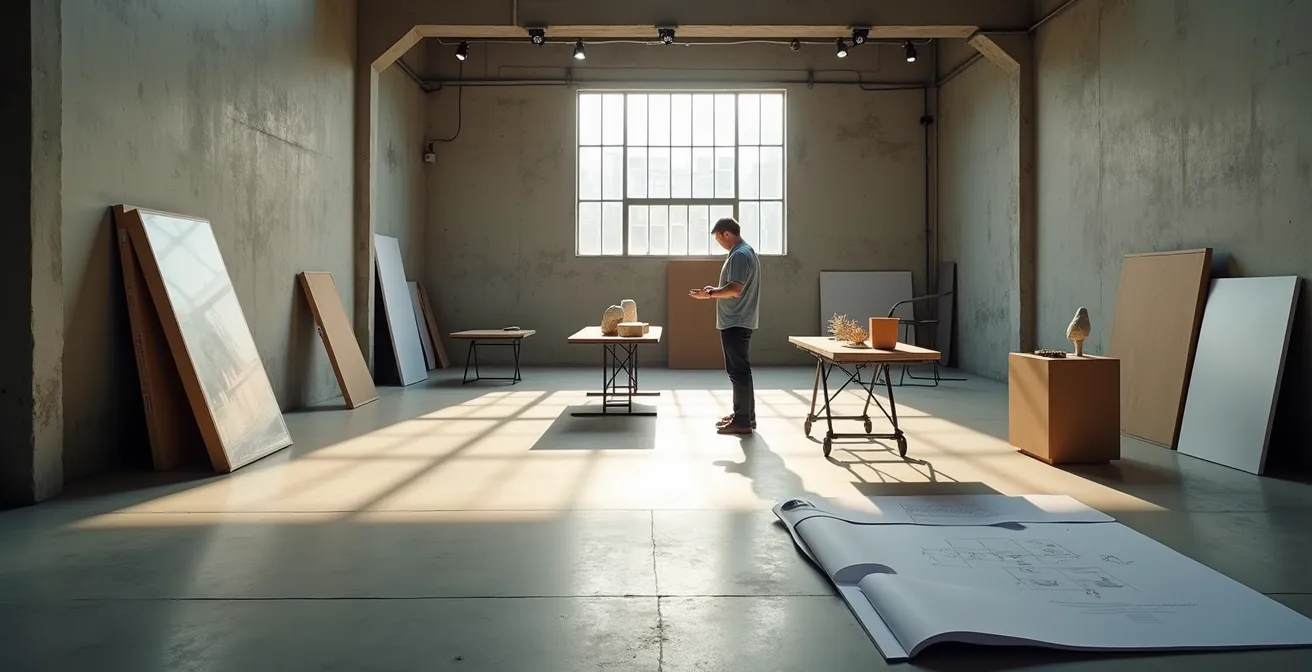
A pop-up art show’s success hinges not on the creative vision alone, but on mastering the overlooked logistical details that create significant financial and operational friction.
- Standard liability insurance is dangerously inadequate for art; specialized coverage is non-negotiable.
- Venue selection goes beyond aesthetics, involving hidden costs in raw spaces that can dwarf initial savings.
- A disciplined installation schedule and precise environmental control are your best defense against opening delays and art damage.
Recommendation: Shift your focus from just curating art to meticulously producing an event by auditing contracts, insurance policies, and timelines before signing any agreements.
For many independent curators and artists, the pop-up exhibition is the ultimate platform for creative freedom. The dream is to transform a unique space, showcase groundbreaking work, and connect directly with a new audience. The focus naturally falls on the curatorial narrative and the art itself. The common advice follows a familiar path: find a cool venue, promote it on social media, and hang the art. But this romantic view dangerously underestimates the reality of event production.
This approach ignores the significant operational friction that occurs behind the scenes. The unglamorous work of negotiating venue contracts, securing the right kind of insurance, managing environmental risks, and executing a flawless installation is where most pop-ups fail. These logistical challenges aren’t just minor hurdles; they are potential points of catastrophic failure that can lead to financial loss, damaged artwork, and a tarnished reputation. The belief that passion and a good eye are enough is a costly myth.
But what if the key to a successful pop-up wasn’t just better curation, but smarter production? This guide shifts the perspective from that of an art enthusiast to that of a pragmatic event producer. We will dissect the logistical traps that are frequently overlooked, providing a clear-eyed view of the systems and processes required for success. We’ll move beyond the platitudes to give you a strategic framework for anticipating and mitigating the risks that can derail your show.
This article provides a structured roadmap through the most critical, yet underestimated, logistical challenges of organizing a temporary art exhibition. The following sections break down each potential failure point, offering concrete strategies and checklists to ensure your event is a success from load-in to load-out.
Summary: Organizing Pop-Up Art Shows: A Logistical Deep Dive
- Why Standard Liability Insurance Won’t Cover Art Theft at Pop-Ups?
- How to Fill Opening Night Using Only Organic Social Media Reach?
- Storefront or White Cube: Which Venue Type Attracts More Foot Traffic?
- The Humidity Oversight That Can Ruin Paper Art in 48 Hours
- Planning the Install: The 3-Day Schedule That Prevents Opening Delays
- The Crowd Control Failure That Damages Visitor Satisfaction
- The Insurance Clause That Adds $1,000 to Your Venue Rental
- Investing in Emerging Artists: How to Spot Future Value Before Prices Spike?
Why Standard Liability Insurance Won’t Cover Art Theft at Pop-Ups?
One of the most dangerous assumptions a new curator can make is that a venue’s general liability insurance provides adequate protection for the art itself. It does not. Standard liability policies are designed to cover “slip-and-fall” incidents and property damage to the building, not the specialized, high-value contents of an art exhibition. These policies have cripplingly low payout limits for contents and contain numerous exclusions for theft, transit damage, and environmental factors, leaving your most valuable assets completely exposed. This is a classic example of operational friction where a misunderstanding of paperwork can lead to total financial loss.
Case Study: The Necessity of Specialized Coverage
The difference was starkly illustrated when a client’s gallery in Wynwood caught fire during Art Basel, destroying 47 pieces. A standard liability policy would have offered a negligible sum. However, their specialized art insurance policy was designed for this exact risk. An investigation by Hotaling Insurance Services shows how the policy not only covered the full value of the art, but the firm also paid out $4.2 million, a sum which included business interruption coverage that kept the gallery’s staff employed during the rebuilding process. This demonstrates that failing to secure fine art insurance isn’t a calculated risk; it’s a critical oversight.
To be properly protected, you need a dedicated Fine Art Insurance policy. This type of coverage is specifically designed to address the unique risks associated with displaying, transporting, and storing art. It covers the work at its agreed-upon value, not a depreciated estimate. Key features to look for are “wall-to-wall” or “nail-to-nail” coverage, which protects the art from the moment it leaves the artist’s studio until it is safely returned, including during transit and installation. Without it, you are personally and financially liable for any damage or loss.
How to Fill Opening Night Using Only Organic Social Media Reach?
In an era of declining organic reach, the idea of filling an opening night without a paid advertising budget can seem impossible. The common advice to “post consistently” and “use relevant hashtags” is no longer enough. The key isn’t to shout louder, but to create a promotional arc that builds momentum and leverages the principle of attention scarcity. Instead of just announcing the event, you must turn the promotion itself into an engaging, multi-week narrative that your target audience feels compelled to follow and share.
Case Study: The Museum of Ice Cream’s Shareability Engine
The Museum of Ice Cream provides the ultimate blueprint for organic promotion. It grew from a single pop-up in 2016 to a global brand with a $200 million valuation primarily through user-generated content. The founders understood a core principle: they didn’t just display art; they designed highly photogenic, experiential moments that visitors were intrinsically motivated to share on Instagram. This strategy transformed every attendee into a micro-influencer, generating massive organic reach that paid advertising could never match. The lesson is clear: design your exhibition’s social media moments with the same care you put into curating the art.
A successful organic campaign requires a disciplined timeline. Start creating buzz at least six weeks out. Begin with behind-the-scenes teasers of artwork preparation. Four weeks before, launch “artist takeovers” on Instagram Stories, where each artist shares their process and inspiration, creating a direct connection with potential visitors. Two weeks out, release a limited number of RSVPs in timed batches to create a sense of urgency and scarcity. In the final week, partner with local art bloggers and micro-influencers for cross-promotion to tap into their established audiences. On the day of the event, maintain a high-frequency posting schedule with live tours, artist interviews, and real-time visitor testimonials to create a powerful sense of FOMO (fear of missing out).
Storefront or White Cube: Which Venue Type Attracts More Foot Traffic?
The choice between a street-level storefront and a traditional white cube gallery is one of the first major decisions a curator makes, and it has profound implications for foot traffic and audience engagement. The white cube offers a controlled, pristine environment that elevates the art but can feel intimidating to casual passersby. A storefront, with its large windows and direct connection to the street, is inherently more inviting and porous. It leverages the power of curiosity and impulse, drawing in an audience that may not have planned to visit a gallery. For pop-ups aiming to engage the broader public, this accessibility is a significant advantage.
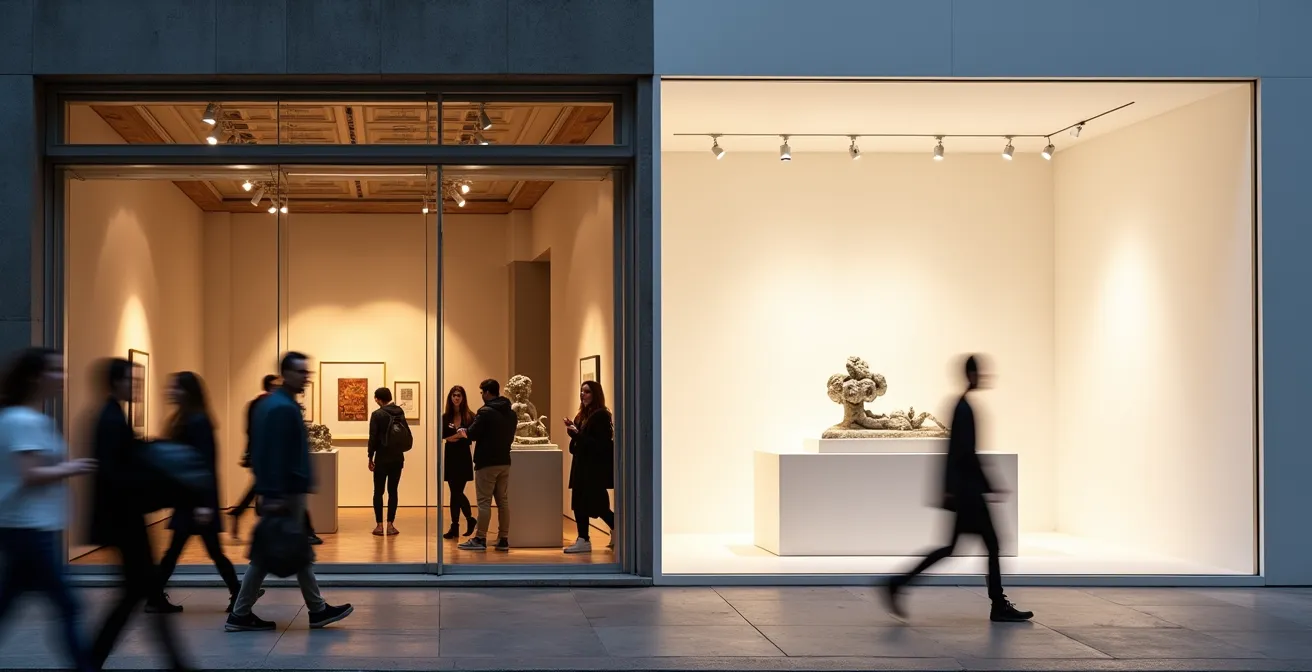
The data supports this intuition. For temporary exhibitions, venues with high organic walk-in potential consistently perform better. However, the decision is not just about foot traffic; it’s a complex trade-off between visibility and logistics. That highly visible, raw storefront space is a venue-as-a-system with numerous hidden costs. While the base rent might be lower, you are often responsible for installing everything from temporary walls and professional lighting to security systems and climate control. These costs can quickly accumulate, turning an apparent bargain into a major financial drain.
The following table, based on an analysis of hidden venue costs, breaks down the financial realities that are often overlooked when choosing a raw or storefront space over a professional gallery. This kind of risk-adjusted budgeting is critical.
| Cost Factor | Raw/Storefront Space | Professional Gallery |
|---|---|---|
| Base Rental | Lower ($500-2000/week) | Higher ($2000-5000/week) |
| Temporary Walls | Required ($1500-3000) | Included |
| Lighting Installation | Required ($2000-4000) | Included |
| Electrical Upgrades | Often needed ($1000-2000) | Already compliant |
| Climate Control | May need rental ($500-1000) | Included |
| Security System | Must install ($800-1500) | Included |
| Insurance Premium | Higher risk rating | Lower risk rating |
The Humidity Oversight That Can Ruin Paper Art in 48 Hours
Of all the invisible threats to an exhibition, none is more insidious than humidity. For works on paper, photographs, and other sensitive media, a failure to manage the atmospheric environment can cause irreversible damage in less than two days. Cockling (waving), foxing (brown spots), and mold growth are direct results of fluctuations in relative humidity (RH). Many non-traditional pop-up venues, such as storefronts or warehouses, lack the museum-grade HVAC systems needed to maintain a stable environment. This oversight represents a critical point of value erosion, where a logistical failure directly destroys the asset you are trying to showcase.
Case Study: Environmental Factors Compound Disaster
The devastating impact of environmental instability was highlighted during a hurricane in Houston. While flooding ultimately destroyed a collector’s $3.2 million art collection, investigators found that the damage had begun days earlier. The rapid changes in humidity in the period leading up to the storm had already started the process of deterioration in paper-based works that were not stored in climate-controlled conditions. This case shows how ambient environmental factors are not a secondary concern but a primary risk that can compound any subsequent disaster.
Proactive environmental monitoring is not an option; it’s a core responsibility. The industry standard for most artworks is a stable relative humidity level between 45-55% and a temperature of around 65-70°F (18-21°C). To achieve this in a temporary space, you must implement a strict protocol. This begins with a 24-hour acclimatization period for all crated works before they are unwrapped, allowing them to adjust slowly to the new environment. Digital hygrometers should be installed at multiple locations and heights to get an accurate reading of the entire space. For particularly sensitive pieces, creating microclimates with silica gel packets or display cases is a necessary precaution.
Your Action Plan: Environmental Monitoring Protocol
- Install digital hygrometers at multiple heights (paper absorbs moisture differently at floor vs. ceiling level).
- Set up automated alerts for readings outside the 45-55% relative humidity range.
- Document conditions every 4 hours during the first 48 hours after installation to establish a baseline.
- Create buffer zones using silica gel packets or vitrines for ultra-sensitive pieces.
- Implement a mandatory 24-hour acclimatization period before unwrapping any crated works.
Planning the Install: The 3-Day Schedule That Prevents Opening Delays
The installation, or “install,” is the moment where all planning converges into physical reality. It is a period of intense, coordinated activity where any prior logistical oversights become painfully apparent. A poorly planned install is the number one cause of opening night delays, creating a cascade of problems from rushed lighting adjustments to improperly hung work. To prevent this, a rigid, 72-hour schedule is not just a guideline; it is a mission-critical tool for managing complexity and ensuring a professional outcome. This is where the abstract plan confronts the operational friction of physical space and human coordination.
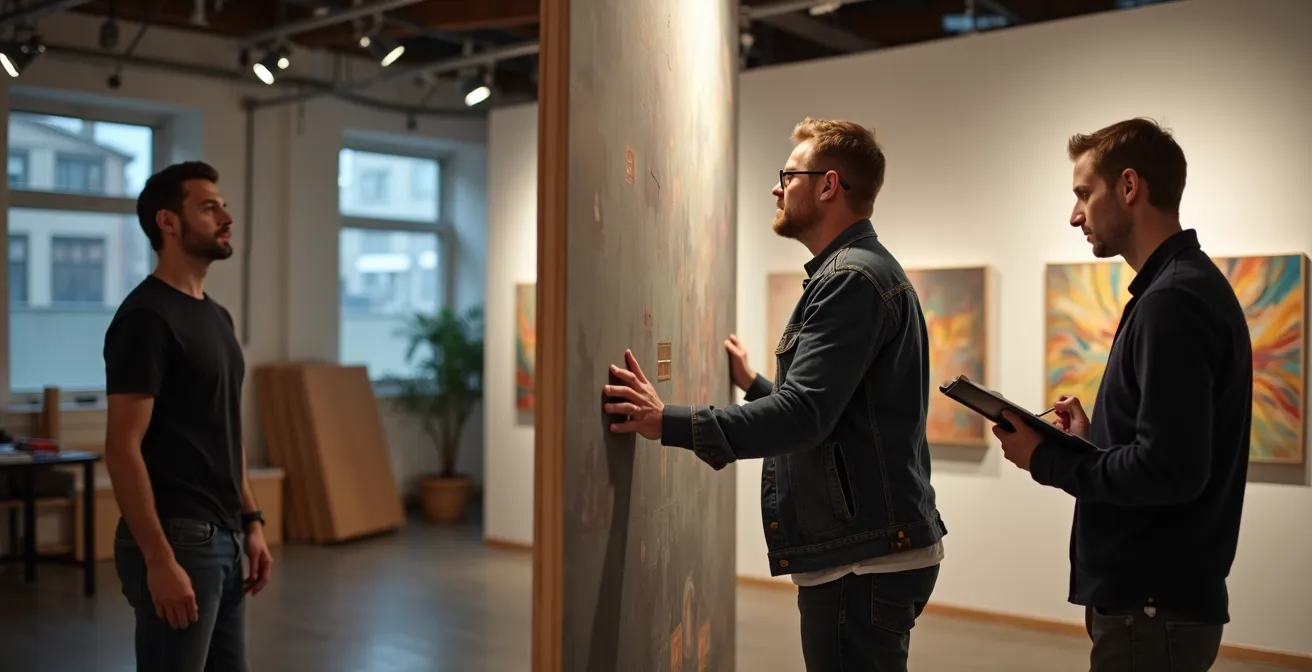
A successful install is broken into three distinct phases: Setup, Refinement, and Finalization. Day 1 is for heavy lifting. This includes the load-in of all artworks, a thorough condition check of each piece, and the construction of any temporary walls or pedestals. The heaviest pieces requiring multiple handlers should be mounted on this day. Day 2 is for precision and detail. This involves completing the hanging of all remaining works, meticulous label installation, and the setup of any audio-visual components. Crucially, this is the day for the primary lighting adjustments, which can only be done once all art is in place. Day 3 is for the final polish. It begins with a deep clean of the space, followed by final, micro-adjustments to the lighting. The curator then conducts a final walkthrough with a checklist, followed by a staff briefing on artwork details and sales procedures. This structured sequence transforms a potentially chaotic process into a manageable workflow.
- Day 1 (Setup): Focus on infrastructure and heavy pieces. Load in, condition check art, install walls/pedestals, and mount major works. End with an initial lighting setup.
- Day 2 (Refinement): Focus on placement and technology. Complete all hanging, install labels and AV tech, and perform the main lighting adjustments. Activate the security system.
- Day 3 (Final): Focus on presentation and readiness. Deep clean the space, make final lighting tweaks, conduct the curator’s final walkthrough, and brief the staff.
This timeline also applies in reverse for the de-installation. Booking professional handlers and staging packing materials in advance is essential for a smooth and damage-free exit, ensuring you meet the venue’s “broom clean” exit requirements.
The Crowd Control Failure That Damages Visitor Satisfaction
After weeks of meticulous planning, a packed opening night can feel like a victory. However, a crowd without a clear path to follow can quickly lead to a frustrating visitor experience, bottlenecks, and even accidental damage to the art. Crowd control in a temporary exhibition is not about restrictive barriers; it’s about thoughtful “wayfinding” and “flow.” The goal is to guide the visitor’s journey intuitively through the space, creating a narrative rhythm that enhances their engagement with the art. A failure in this area directly impacts visitor satisfaction and can undermine the entire curatorial effort.
Case Study: Architectural Solutions for Visitor Flow
The Pompidou Centre demonstrated a proactive approach to this challenge when it commissioned a traveling museum structure. The design’s primary innovation was its flexible, modular walls that could be reconfigured based on expected attendance for each location. This architectural solution allowed the curators to design multiple pathways, create designated rest zones, and strategically prevent the formation of bottlenecks. It serves as a powerful example of how temporary architecture can be used not just to divide space, but to actively enhance the visitor journey and manage crowd flow from the outset.
Even without a custom-built structure, you can implement effective flow optimization strategies. During setup, use masking tape on the floor to map out the intended visitor path and identify potential congestion points. Position your “hero pieces”—the most important works—at the 30% and 70% marks of this journey, not just at the beginning or end, to maintain momentum and distribute attention. To prevent visitor fatigue and clustering, create “pressure release” zones every 50 feet or so with a simple bench or an interactive element. In areas where lines are expected to form (like the entrance or bar), install artwork reproductions or artist statements to provide “queue entertainment” and make waiting feel like part of the experience.
Key Takeaways
- Pop-up success is built on mastering logistics, not just curation. Underestimating operational details is the most common failure point.
- Treat your venue as a complex system with hidden costs. A cheap storefront can become expensive once walls, lighting, and climate control are factored in.
- Risk management is paramount. This means securing specialized fine art insurance and implementing strict protocols for environmental control and installation.
The Insurance Clause That Adds $1,000 to Your Venue Rental
The rental fee is only the beginning of your venue costs. Buried within the standard rental agreement are clauses that can add thousands of dollars to your budget if not properly understood and negotiated. This is the final frontier of risk-adjusted budgeting, where reading the fine print is as important as curating the art. Landlords and venue managers use these clauses to transfer financial risk from themselves to you, the temporary tenant. Ignoring them can lead to surprise bills for cleaning, repairs, and mandatory staffing long after the exhibition has closed.
One of the most common and costly clauses is the “Additional Insured” requirement. This mandates that you add the venue owner to your liability insurance policy. While it sounds simple, this can cost several hundred dollars per venue. Another is the “Indemnification Clause,” which can make you liable for incidents you didn’t directly cause. You should always push for a mutual indemnification clause. Finally, vague requirements like a “broom clean exit” can be interpreted to mean a full professional cleaning service, while “wall repair” clauses can leave you on the hook for expensive paint matching if you use nails or screws.
This table, based on a breakdown of common exhibitor costs, highlights typical financial impacts and negotiation strategies for these hidden contractual obligations.
| Contract Clause | Typical Cost Impact | Negotiation Strategy |
|---|---|---|
| Additional Insured Requirement | $200-500 per venue | Bundle multiple venues under one policy |
| Indemnification Clause | Increases liability exposure | Request mutual indemnification |
| Broom Clean Exit | $500-1500 for professional cleaning | Document pre-existing conditions |
| Wall Repair/Paint Matching | $300-800 per wall | Use removable hanging systems |
| Utility Overages | $200-600 for lighting/climate control | Request flat-rate utilities in advance |
| Mandatory Security Staff | $25-40/hour per guard | Negotiate shared security with other tenants |
Investing in Emerging Artists: How to Spot Future Value Before Prices Spike?
For many curators, a pop-up is not just a temporary show; it’s an opportunity to champion emerging artists and, ideally, to connect them with collectors. The question of “spotting value” is often framed as a mystical talent for predicting market trends. However, a more pragmatic and effective approach for a curator is to focus on *creating* and *communicating* value through the exhibition itself. The art market is increasingly attracting serious investors; fine art insurance industry data reveals that the number of High-net-worth collectors increased by 37% from 2020 to 2024. These collectors look for indicators of professionalism and long-term potential.
Your role as a curator-producer is to provide those indicators. The perceived value of an artwork can be significantly influenced by its presentation. The most critical factor is professional, museum-quality lighting. Poor lighting can obscure an artist’s technique and devalue their work in the eyes of a potential buyer. Similarly, comprehensive wall labels that include the artist’s education, exhibition history, and a thoughtful statement add crucial context and legitimacy. This documentation is not just text; it’s provenance in the making.
There are also powerful curatorial strategies for creating value by association. Positioning an emerging artist’s work adjacent to that of a more established name can create a psychological link, elevating the former. After the show, providing each artist with a certificate of exhibition inclusion and high-quality professional documentation of their work in the space gives them a tangible asset for their CV. Ultimately, the most powerful tool is a compelling curatorial statement that thoughtfully positions the artist and their work within a broader art historical context, making a clear case for their significance. You aren’t just showing work; you are building an argument for its value.
To successfully launch a pop-up art show, you must shift your mindset from curator to producer. It requires embracing the unglamorous but essential logistics that form the foundation of a professional and profitable exhibition. Start by meticulously planning your budget to account for these hidden costs and building a timeline that protects you from last-minute chaos.