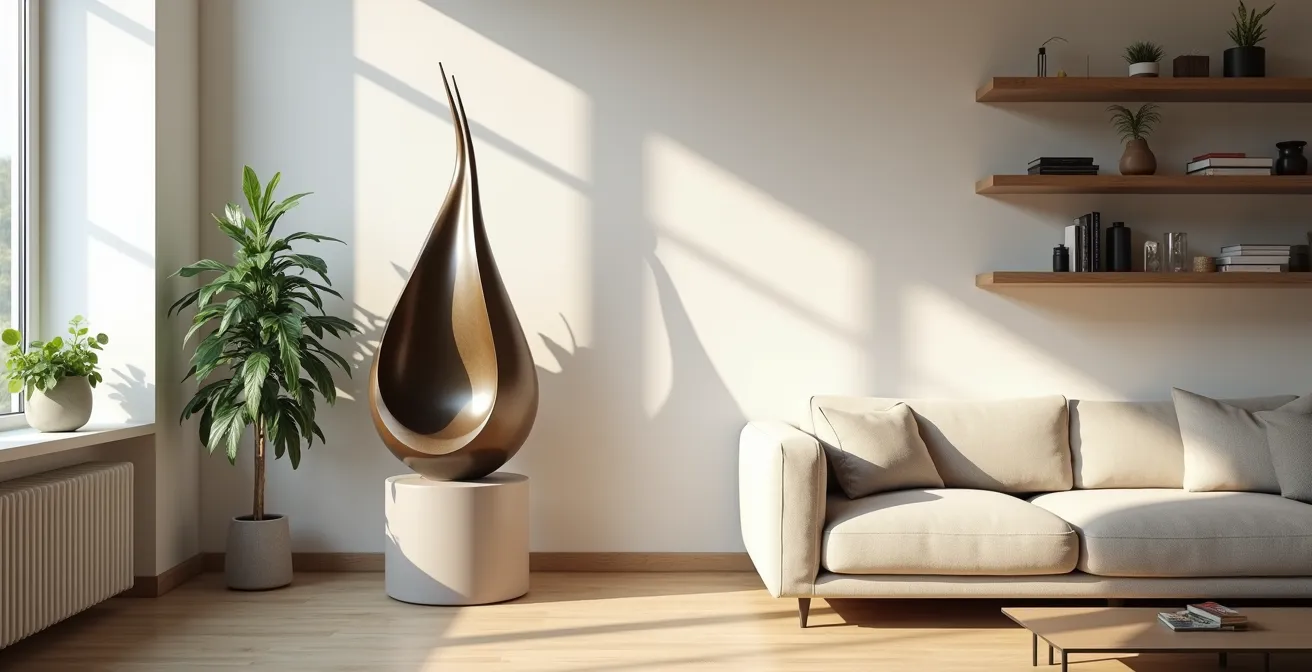
The greatest misconception is that a large sculpture will overwhelm a small room; in reality, a strategically placed piece acts as an architectural anchor that can expand the perception of space.
- Material and “visual weight,” not physical size, dictate how a sculpture feels in a room.
- Strategic lighting and placement create sightlines that guide the eye and define spatial volume.
Recommendation: Stop trying to hide your art. Instead, use its mass and form to command the space, turning a limitation into a powerful aesthetic statement.
As a collector, you’ve acquired a piece that speaks to you—a large, magnificent sculpture with undeniable presence. But back in your urban apartment, a sense of dread creeps in. The walls feel closer, the ceilings lower. The conventional wisdom for small spaces screams at you: downsize, declutter, and stick to small-scale decor. Many will advise you to place it in a corner or, worse, to reconsider the acquisition altogether. This approach stems from a fundamental misunderstanding of spatial design.
The challenge isn’t about fitting an object *into* a space; it’s about using that object to redefine the space itself. The key is to stop thinking of your sculpture as furniture and start treating it as architecture. What if its volume, texture, and materiality could be leveraged not to shrink your apartment, but to create new visual pathways, manipulate light, and establish a profound sense of scale and intention? This requires moving beyond simple decoration and into the realm of spatial dynamics, where the sculpture and the room enter a deliberate dialogue.
This guide will deconstruct the principles of placing significant artworks in limited square footage. We will explore how material dictates perception, how light can sculpt form, and how placement is not about finding a vacant spot but about orchestrating a complete sensory experience. By mastering these elements, you can transform your apartment into a gallery where your collection doesn’t just reside, but actively shapes its environment.
To navigate this aesthetic journey, we have structured this guide to address every key decision you will face. From the science of materials to the art of illumination, each section builds upon the last, providing a comprehensive framework for turning your home into a sophisticated showcase.
Summary: A Collector’s Guide to Sculptural Placement in Compact Spaces
- Why Bronze Sculptures Feel Heavier in a Room Than Glass?
- How to Light a Sculpture to Reveal Texture and Depth?
- Pedestal or Floor: Which Display Method Suits Modernist Forms?
- The Placement Mistake That Puts Sculptures at Risk of Knock-Over
- Positioning for 360 Views: The Layout That Respects the Artist’s Work
- Hanging Art at Eye Level: The Height Rule That Changes Perception
- Speaker Placement: The Triangle Rule That Fixes Muddy Bass
- The Chemistry of Art Restoration: How Experts Save 500-Year-Old Canvases
Why Bronze Sculptures Feel Heavier in a Room Than Glass?
The perception of a sculpture’s weight is governed by two distinct factors: its physical density and its visual weight. While a solid bronze piece is physically heavier, its impact on a room’s sense of space is more complex. Bronze, with its opaque, light-absorbing surface, has a high visual weight. It creates a point of gravitational pull, anchoring the space around it. In contrast, a glass sculpture, while still substantial, allows light to pass through, creating an illusion of lightness and occupying less psychic space. Material science confirms that the density of bronze, which ranges from 8.4-8.9 g/cm³, is significantly higher than that of glass, but it is the interplay of light with the material that an interior designer manipulates.
In a small apartment, a heavy visual anchor like bronze isn’t necessarily a negative. When placed correctly, it can ground a floating, minimalist design, giving the room a strong, confident core. A lighter piece, like glass or polished steel, serves to reflect light and its surroundings, promoting a sense of openness and movement. The choice is not about “heavy” versus “light” but about the desired mood.
- Bronze sculptures: Choose for a grounding effect and historical gravitas, especially in spaces with traditional or eclectic elements.
- Glass pieces: Select for modern minimalism and visual lightness in contemporary settings where maintaining an airy feel is paramount.
- Polished steel: Use to reflect light and visually expand tight corners or darker areas of a room.
- Natural stone: Position for its organic texture, which adds warmth and complexity without overwhelming small rooms.
- Mixed media: Combine materials to create a balanced dialogue, distributing visual weight across the space.
How to Light a Sculpture to Reveal Texture and Depth?
Lighting a sculpture is not about illumination; it’s about revelation. Poor lighting can flatten a three-dimensional object into a silhouette, while masterful lighting sculpts its form, reveals its texture, and tells its story. The most common error is to use diffuse, overhead ambient light, which erases shadows and, with them, all sense of depth. Instead, the goal is to use directed light to create a play of highlight and shadow that articulates the artist’s work. One of the most effective techniques for textured pieces is wall-grazing or raking light, where a spotlight is positioned at a sharp angle to the surface.

This technique, as demonstrated above, drags light across the surface, catching every indentation, tool mark, and variation in patina, creating dramatic shadows that give the piece a vibrant, tactile quality. For smoother, more volumetric forms, a combination of a key light (main source), a fill light (to soften shadows), and a back light (to separate it from the background) creates a classic, gallery-quality effect. The specifications of the light source itself are also critical for rendering color and material accurately.
The following table provides a starting point for selecting the right lighting technology, as detailed in an analysis of professional sculpture display techniques. The Color Rendering Index (CRI) is particularly important, as a high rating ensures that the material’s true colors are seen.
| Light Type | CRI Rating | Color Temp | Best For |
|---|---|---|---|
| LED Spot | 90+ | 2700K | Bronze, Wood |
| Halogen Track | 100 | 3000K | Mixed Materials |
| LED Wash | 95+ | 4000K | Steel, Glass |
Pedestal or Floor: Which Display Method Suits Modernist Forms?
The decision to place a sculpture on a pedestal or directly on the floor fundamentally alters its relationship with the surrounding architecture and the viewer. This is not merely a practical choice but a powerful curatorial statement. For many large, modernist forms, especially those with a strong verticality or a self-contained base, placing them directly on the floor integrates them into the room’s very structure. This method treats the sculpture less like a decorative object and more like an architectural column or feature, a technique that can paradoxically make a small space feel larger and more intentional.
Case Study: Brancusi-Style Floor Placement in a Studio Apartment
A compelling example from interior designer Susan Jay illustrates this principle. In a project documented in an article on sculpture placement strategies, Jay successfully placed a 5-foot modernist column directly on the floor in a 500-square-foot studio. This zero-base approach made the sculpture feel like a structural support, psychologically expanding the space by drawing the eye upward while maintaining clean sight lines across the floor. It ceased to be an “object” and became part of the apartment’s architectural soul.
A pedestal, on the other hand, elevates the work, separating it from the everyday plane of the floor and designating it as an object of contemplation. This creates a more formal, gallery-like feel. For a small space, the key is to ensure the pedestal is in proportion and doesn’t become a bulky piece of furniture in its own right. The selection process should be as deliberate as choosing the art itself.
- Measurement: The pedestal top should be at least 2-3 inches wider and deeper than the sculpture’s base.
- Material Dialogue: For continuity, match the pedestal material to the sculpture (e.g., a marble base on a marble pedestal). For creative tension, use contrasting textures, like a rough-hewn wood block for a polished metal piece.
- Height Calculation: The main goal is to position the sculpture’s visual center at a comfortable viewing height, typically 57-60 inches from the floor for a standing viewer, or lower (around 42-48 inches) in a seating area.
The Placement Mistake That Puts Sculptures at Risk of Knock-Over
In the excitement of aesthetic arrangement, the most critical factor is often overlooked: stability. A large sculpture in a small apartment is inherently at greater risk due to tighter traffic patterns. The single most dangerous placement mistake is positioning a valuable piece along a primary high-traffic pathway—the direct line from a doorway to a sofa, or from the kitchen to the dining area. This dramatically increases the chance of accidental bumps and catastrophic falls, not only endangering the art but also posing a safety hazard to inhabitants and guests. The physics of stability are non-negotiable; engineering principles for tall objects suggest that for every 5 units of a sculpture’s height, its base should be at least 1 unit wide to ensure a stable center of gravity.
Beyond this basic ratio, a rigorous pre-placement audit is essential for any responsible collector. You must analyze how you actually live in the space, not just how you imagine it. A piece may look perfect in a certain spot, but if that spot is in the turning radius for someone getting up from a chair, it’s a disaster waiting to happen. Before finalizing any position, you must assess both the environment and the object’s inherent stability.
Your Sculpture Stability Audit
- Map Pathways: Use masking tape on the floor to mark your daily walking paths for 24 hours. This will reveal the true high-traffic zones to avoid.
- Assess the Surface: Ensure the sculpture’s entire base footprint rests on a single, perfectly level surface. Never position a piece with its base partially on a rug edge and partially on a hard floor.
- Define Clearance: Maintain a minimum 3-foot clearance from all identified high-traffic pathways and the swing of any doors.
- Check the Center of Gravity: Perform a gentle tilt test. A stable piece should be able to tilt at least 10 degrees and return to center without tipping.
- Plan for Anchoring: For tall, slender pieces, use discreet security measures. Museum putty applied under the base or clear acrylic brackets fixed to a wall can provide invisible anchoring without compromising aesthetics.
Positioning for 360 Views: The Layout That Respects the Artist’s Work
Once safety is assured, the final placement should honor the artist’s intent. Sculptures are broadly categorized as either “in the round” or “relief.” A sculpture in the round is finished on all sides and intended to be viewed from multiple angles. Pushing such a piece against a wall is a disservice to the work, concealing facets the artist painstakingly created. A high-relief or frontal sculpture, however, has a distinct front and an unfinished or less important back, making it ideal for placement against a feature wall. Respecting this distinction is fundamental to proper curation.
For a true 360-degree piece, the ideal placement in a small apartment is often “off-center” in an open area, such as the junction between a living and dining space. This creates dynamic sightlines from various points in the room, allowing the sculpture’s form to change as you move around it. It becomes a pivot point around which the room’s energy flows. This requires giving the piece adequate breathing room—a minimum of a 3-foot radius is a good rule of thumb to allow for comfortable viewing and passage.
The choice between a 360-degree or a front-facing display is a primary decision determined by the nature of the artwork itself. This matrix, based on placement guidance for collectors, simplifies the thought process.
This decision matrix, adapted from curatorial advice found in guides on placing sculptural works, provides a clear framework for honoring the art’s intended perspective.
| Sculpture Type | Display Method | Space Required |
|---|---|---|
| Full Round | 360-degree/centered | 3ft radius minimum |
| High Relief | Against wall | Wall space only |
| Frontal/Unfinished back | Feature wall | 1ft from wall |
Hanging Art at Eye Level: The Height Rule That Changes Perception
The principle of “eye level” is the most crucial yet frequently ignored rule in displaying art, and it applies as much to three-dimensional pieces as it does to paintings. The common mistake is to place art too high, forcing viewers to crane their necks and creating a psychological disconnect. The universally accepted museum and gallery standard is to position the artwork so that its visual center is at average human eye level. Display standards confirm this benchmark specifies that the center of the artwork should be at 57 inches (or 145 cm) from the floor for standing viewing.
This 57-inch rule creates an immediate, intimate connection between the viewer and the artwork. For a sculpture on a pedestal, it is the center of the sculpture itself—not the center of the combined pedestal and sculpture—that should be at this height. However, this rule is not absolute; it’s a baseline that must be adapted to the context of the room. The viewing height changes depending on whether you will primarily be standing or sitting when you engage with the piece.
- Living Rooms: In areas dominated by seating, calculate the eye level from a seated position. The average is around 42 inches from the floor. This creates a balanced composition with the furniture.
- Hallways and Foyers: In transitional spaces where people are always standing or walking, adhere strictly to the 57-60 inch standing eye level rule.
- Intimate Viewing: For smaller, more detailed pieces you want people to inspect closely, placing them 6-12 inches below standard eye level can encourage a more personal, contemplative posture.
- Monumental Effect: To give a piece an imposing, monumental feel, you can intentionally break the rule and position its center 6-12 inches *above* eye level, forcing the viewer to look up in reverence.
Speaker Placement: The Triangle Rule That Fixes Muddy Bass
While seemingly unrelated, the principles of high-fidelity audio offer a powerful analogy for perfecting sculpture placement. Audiophiles know that to achieve an immersive stereo image, speakers must form an equilateral triangle with the listener’s head. When this geometry is correct, the sound is clear, centered, and detailed. When it’s wrong, the sound becomes muddy and dislocated. This same spatial logic applies to creating an optimal “viewing sweet spot” for a significant sculpture.
Instead of thinking about where the sculpture fits, think about where *you* will be when you most often appreciate it. This might be your favorite armchair, a spot on the sofa, or the entryway where you first see it upon returning home. This location is your “listener’s chair.” Your sculpture and the two most common vantage points should form a similar triangle. This creates a “visual triangle” that establishes a deliberate relationship between viewer and object. By defining this primary viewing axis, you can then arrange furniture and other elements to support, rather than obstruct, this sightline.
This approach moves beyond simply making the sculpture a “focal point” and transforms it into the apex of a planned visual experience. It ensures that from the most important seat in the house, the sculpture is perfectly framed, lit, and presented. All other arrangements become secondary to preserving the integrity of this primary spatial relationship. It is a method of bringing order and intention to the visual “soundstage” of your room.
Key Takeaways
- A sculpture’s impact is defined by its “visual weight” (material, color, form), not just its physical size. Use this to anchor or lighten your space.
- Strategic lighting is non-negotiable. Use angled spotlights to reveal texture and create depth, transforming the piece from a static object to a dynamic form.
- Placement must be intentional. Use the “visual triangle” principle to create an optimal viewing experience from a key position in the room, treating the sculpture like architecture.
The Chemistry of Art Restoration: How Experts Save 500-Year-Old Canvases
Once your sculpture is perfectly placed, lit, and secured, the collector’s role transitions from curator to custodian. The very elements we’ve discussed—materiality and environment—are central to the long-term preservation of your art. While your piece may not be a 500-year-old canvas, the principles of conservation are universal. The bronze that looks so commanding under a warm LED spotlight is slowly reacting to the air, its patina subtly changing over decades. The polished steel reflecting your apartment’s light is vulnerable to microscopic scratches and humidity.
Understanding this is the final step in responsible ownership. The world of art restoration is a complex field where chemists and conservators fight a constant battle against time, using solvents, precision tools, and deep scientific knowledge to stabilize and preserve cultural heritage. While you won’t be performing these procedures yourself, an awareness of this world informs your duties as a collector. This means controlling ambient humidity, protecting pieces from direct UV light, and knowing the proper, non-abrasive methods for cleaning their surfaces.
Your role as a collector is a commitment not just to the aesthetic presence of a work, but to its physical longevity. By creating a stable, controlled environment, you are not only showcasing your art to its best advantage but also ensuring its survival for generations to come. The dialogue between art and space is an ongoing one, and its preservation is the ultimate expression of respect for the artist’s creation.
By applying these spatial, lighting, and safety principles, you can move with confidence. Begin today to re-evaluate your collection not as objects to be stored, but as powerful tools to sculpt the very atmosphere of your home.