In summary:
- Your music generates two distinct copyrights (the composition and the master recording), which create separate revenue streams.
- Timely registration with the U.S. Copyright Office is not just for protection; it unlocks powerful legal remedies like statutory damages.
- Long-term ownership through self-publishing can be significantly more profitable than accepting a traditional publishing advance.
- Copyright clearance extends beyond audio samples to include any protected artwork, logos, or designs visible in your music videos.
For the independent composer, the digital era has opened unprecedented doors. With DIY artists and labels making up a significant portion of the music economy, the power has shifted away from traditional gatekeepers. An industry report revealed that independents now account for 46.7% of the global recorded music market, a testament to the viability of a self-directed career. Yet, this freedom comes with a critical responsibility: managing your intellectual property not just as a creator, but as a business owner. Many artists believe that simply uploading a track to a distributor is enough, or that copyright is a simple form to be filed and forgotten.
This view, however, is dangerously incomplete. The most common and costly mistake is treating copyright as a passive shield rather than an active, strategic asset. True financial success and long-term security in the music industry don’t come from just creating music; they come from understanding the intricate legal and financial structures that govern it. The key isn’t merely to register your work, but to understand precisely what you are registering, when to register it for maximum leverage, and how to structure your deals to retain control and maximize revenue.
This guide moves beyond the basics of “what is copyright?” to address the strategic decisions you face every day. We will deconstruct the core rights that generate your income, analyze the choices between performance rights organizations, weigh the pros and cons of different licensing deals, and highlight the critical, often-overlooked risks that can jeopardize your career. This is your legal and business playbook for transforming your creative output into a sustainable portfolio of assets.
To navigate these complex topics, this article breaks down the essential components of music copyright strategy. Below is a summary of the critical areas we will explore to help you build a financially secure and legally protected career as an independent composer.
Summary: Registering Music Copyrights: The Critical Business Steps Most Indie Composers Skip
- Why Composition and Master Rights Generate Two Different Checks?
- ASCAP or BMI: Which PRO Collects International Royalties Better?
- Exclusive or Non-Exclusive: Which Library Deal Suits Your Catalog?
- The Sampling Mistake That Can Get Your Track Pulled from Spotify
- When to Register a Copyright: The Window Before Release Date
- Why a $10,000 Advance Might Pay Less Than Self-Publishing?
- Blurring or Clearing: The Rule for Artwork Visible in Your Shot?
- Logic Pro vs. Pro Tools: Which DAW Streamlines Sound Design Workflows?
Why Composition and Master Rights Generate Two Different Checks?
The most fundamental principle of music copyright, and the one most frequently misunderstood, is that every recorded song contains two distinct and separate copyrights. Understanding this duality is the bedrock of your entire revenue strategy. The failure to distinguish between them is why many artists are perplexed when they see different royalty statements or miss out on entire streams of income.
The first copyright is for the composition. This is the underlying musical work itself—the melody, chords, and lyrics. Think of it as the blueprint of the song. This right belongs to the songwriter(s) and their publisher(s). The second copyright is for the master recording, often called the sound recording. This is the specific “capture” of a performance of that composition. If you record a song today and re-record it next year, you have created two separate masters of the same composition. This right typically belongs to the recording artist and the record label (or, in the case of an indie artist, the artist themself).
Because these are separate legal assets, they generate different types of royalties handled by different entities. The composition earns performance royalties (from radio, TV, live venues) and mechanical royalties (from sales and streams). The master recording earns royalties from digital performance (e.g., satellite radio) and from sales and streams. This is why you receive two different “checks”: one from your Performance Rights Organization (PRO) for the composition, and another from your distributor (like DistroKid or TuneCore) for the master. To properly manage this, a split sheet is a non-negotiable legal document you must create for every song, listing all contributors and their exact ownership percentages for the composition before any release.
ASCAP or BMI: Which PRO Collects International Royalties Better?
Once you understand that your composition generates performance royalties, the next logical question is: who collects this money for you? This is the role of a Performance Rights Organization (PRO). In the United States, the dominant players are ASCAP (American Society of Composers, Authors, and Publishers) and BMI (Broadcast Music, Inc.). As a songwriter, you can only be affiliated with one for the purposes of writing credit. The choice between them is a significant business decision, particularly when considering international revenue.
Both ASCAP and BMI have reciprocal agreements with foreign PROs around the world to collect royalties when your music is played abroad. However, their operational structures and payment schedules differ, which can impact your cash flow. ASCAP operates as a non-profit organization owned by its members, while BMI has recently transitioned to a for-profit model. These structural differences can influence their approach to distributions and investments in technology.
When choosing, you must look beyond simple membership fees and consider factors like payment speed, market share, and the quality of their member services and online portals. There is no single “best” answer for every composer, as the efficiency of international collection can vary by territory and time. Your decision should be based on a careful analysis of their current performance and which model aligns best with your business needs.
The following table provides a high-level comparison of key operational differences, based on publicly available industry data, to help inform your decision.
| Feature | ASCAP | BMI |
|---|---|---|
| Membership Cost | $50 one-time fee | Free for writers, $150 for publishers |
| Payment Speed | 6.5 months after quarter | 5.5 months after quarter |
| Market Share | 700,000+ members | 1.4 million copyright owners |
| Catalog Size | 11.5 million songs | 20.6 million songs |
| Organization Type | Non-profit, member-owned | For-profit since 2022 |
Exclusive or Non-Exclusive: Which Library Deal Suits Your Catalog?
For many independent composers, particularly in the instrumental and sound design space, music libraries (also known as production music libraries) are a primary source of income through synchronization or “sync” licensing. These companies license your music for use in films, TV shows, commercials, and video games. When you place your music in a library, you will be faced with a critical choice: an exclusive or non-exclusive deal.
An exclusive deal means you grant one specific library the sole right to license a particular track. In exchange for this exclusivity, they will often promote your track more heavily and may offer a larger share of the licensing fee, or even an upfront advance. The downside is that your track is locked in with them; you cannot place it in any other library. A non-exclusive deal allows you to place the same track in multiple libraries simultaneously. While the per-license payout is typically lower and there’s no advance, you increase the track’s exposure and potential for discovery across different platforms. This is a volume-based strategy.
The choice is not a matter of right or wrong, but of portfolio strategy. Do you want to aim for high-value, targeted placements with a trusted exclusive partner, or do you prefer to cast a wider net? A well-managed catalog might even include a mix of both. Regardless of your choice, the success of your tracks in any library depends heavily on meticulous metadata tagging, including moods, instrumentation, and potential use-cases to ensure music supervisors can find your work.

Viewing your collection of tracks as a strategic portfolio, as visualized in a well-organized studio, is key. Each piece of music is an asset, and your decision on exclusivity determines how that asset is leveraged in the market. Some assets may be reserved for high-yield exclusive opportunities, while others are used for broad, non-exclusive distribution to generate consistent, smaller-scale revenue.
The Sampling Mistake That Can Get Your Track Pulled from Spotify
In the world of music production, sampling can be a powerful creative tool. However, from a legal standpoint, it is a minefield for the uninformed. The single most dangerous mistake an indie composer can make is to assume that a sample is “too short,” “too obscure,” or “too transformed” to require a license. This assumption is legally false and can have catastrophic consequences for your career, including forcing platforms like Spotify and Apple Music to pull your track and exposing you to significant financial liability.
The legal precedent is severe and unambiguous. As one federal judge famously ruled in a landmark case, the directive is clear. In the context of sampling a sound recording, the legal principle is absolute, as stated in the influential ruling:
Any musical sampling violated the sound recording copyright
– Federal Judge ruling, Bridgeport Music, Inc. v. Dimension Films precedent
This means there is no legally recognized “de minimis” or “fair use” amount for sampling a master recording. If you use any part of someone else’s recording without permission, you are infringing on their copyright. To use a sample legally, you must secure two separate clearances: one for the use of the underlying composition (from the music publisher) and one for the use of the master recording (from the record label). This process is often complex and expensive.
The Two-Clearance Requirement in Practice
Clearing a sample is a dual-pronged financial and legal endeavor. The music publisher, who controls the composition, will often require an upfront payment that can run into thousands of dollars, plus a percentage of future profits. Simultaneously, the record company that owns the master recording will demand its own fee, which may also include an advance and a “rollover” provision, where they claim a percentage of your recording royalties if your track achieves certain sales thresholds. For an independent artist, this process is particularly perilous, as you may be required to submit your finished track showing how the sample is used *before* permission is granted, risking all of your time and creative work if the license is ultimately denied.
When to Register a Copyright: The Window Before Release Date
A common misconception among creators is that copyright protection only begins once you file a form with the U.S. Copyright Office. Legally, a copyright in an original work of authorship exists from the moment it is “fixed in a tangible medium of expression” (e.g., recorded to a hard drive or written down). So, why is formal registration so critical? The answer lies in legal leverage. While you own the copyright upon creation, you cannot file a lawsuit for copyright infringement until the work is registered.
More importantly, the timing of your registration unlocks your most powerful legal remedies. To be eligible for statutory damages and attorney’s fees, you must register your work either before the infringement occurs or within three months of the work’s first publication (i.e., its release date). Statutory damages allow a court to award a set amount of money per infringement (from $750 to $150,000) without you having to prove actual financial harm, which can be difficult and expensive. Without timely registration, you are generally only entitled to actual damages and profits, which may be minimal and not worth the cost of a lawsuit. This three-month window is arguably the most important deadline in an artist’s career.

Think of your official copyright certificate not just as a piece of paper, but as a tangible asset that provides immense negotiating power. It signals to the world that you are a serious business owner who understands your rights and is prepared to defend them. This leverage is what transforms a simple creative work into a protected, monetizable asset. The cost to register a work is minimal compared to the potential financial and legal benefits it provides.
Action plan: Key steps for your copyright registration timeline
- Register your work within three months of its public release to qualify for statutory damages and attorney’s fees in an infringement case.
- Utilize the “Group Registration of Works on an Album of Music” (GRUW) option to register up to 20 tracks with a single application and one fee.
- For unpublished works, submit them as a collection using a title like “Collection of Songs by [Artist Name], Vol. 1” to bundle multiple songs under one registration.
- Use Form SR for the sound recording (the master) and Form PA for the underlying musical work (the composition). If you own both, you can often use Form SR for both.
- Ensure all co-writers are listed on the application with their full legal names, and clearly specify the ownership percentages agreed upon in your split sheet.
Why a $10,000 Advance Might Pay Less Than Self-Publishing?
In the music industry, a publishing deal with a large advance is often seen as the ultimate validation of an artist’s work. The offer of a $10,000 check can seem like a life-changing opportunity. However, from a legal and financial perspective, it’s crucial to understand what you are giving up in exchange for that upfront cash. An advance is not a salary or a gift; it is a loan that must be paid back (or “recouped”) from your future royalty earnings before you see another dollar.
In a typical co-publishing deal, you assign 50% of your copyright ownership to the publisher. They take their share of the royalties, and they also use your share to pay back the advance and any other recoupable expenses they incurred, such as marketing or legal fees. You only start earning your 50% share *after* the full $10,000 and all other costs are recouped. If the song doesn’t earn enough, you may never see any further income from it.
Contrast this with self-publishing. As an independent artist, you can act as your own publisher. This involves some administrative work and modest setup costs (e.g., affiliating as a publisher with your PRO), but it allows you to retain 100% of your copyright ownership and collect 100% of the publisher’s share of royalties. While you don’t get an upfront advance, you begin earning money from the very first stream or sale. The earning potential for indie artists is substantial, with some data suggesting that self-releasing artists and their labels collectively earned over $4.5 billion from Spotify alone in a single year.
The table below breaks down the fundamental economic differences between these two paths.
| Aspect | $10K Publishing Deal | Self-Publishing Setup |
|---|---|---|
| Upfront Cost/Income | +$10,000 advance | -$500 setup costs |
| Ownership Retained | 0% (typically) | 100% |
| Royalty Share | 50% after recoup | 85-100% (minus admin) |
| Recoupable Expenses | Marketing, legal, production | None |
| Long-term Value | Limited to contract term | Lifetime + 70 years |
Blurring or Clearing: The Rule for Artwork Visible in Your Shot?
As an indie artist, your music video is a critical promotional tool. But in producing it, your copyright vigilance must extend beyond the audio. A common and costly oversight is the failure to clear the rights for visual elements that appear in the shot, from brand logos on clothing to artwork hanging on a wall. The legal principle is the same as with audio sampling: if you use someone else’s copyrighted work without permission, you are at risk of infringement.
This applies to a surprisingly broad range of visual works. You must consider:
- Paintings and Photographs: Any artwork featured prominently requires clearance from the visual artist.
- Architectural Designs: Distinctive buildings may be protected by architectural copyright.
- Tattoos: A unique tattoo design on an actor can be the copyrighted work of the tattoo artist.
- Graffiti and Murals: Street art is often protected by copyright, even if it’s on a public wall.
The “blur it out in post” solution is a common fallback, but it can look unprofessional and may not be sufficient if the work is still recognizable. The far better approach is proactive clearance.
Beyond the Canvas: The Scope of Visual Copyright
The legal consequences of visual copyright infringement are not trivial. It’s crucial to understand that damages in these cases are not limited to the profits you made from the video. Courts can also award damages based on the harm done to the original artist’s reputation or the licensing fee they would have charged. For instance, one indie musician avoided a potential lawsuit by taking a proactive approach. After realizing a prominent piece of art was visible in their video background, they contacted the visual artist directly via Instagram. Instead of a costly legal battle, they proposed a collaboration, offering a formal credit and cross-promotion on social media, which the artist happily accepted in lieu of a fee. This illustrates that direct, respectful communication is often the most effective clearance strategy.
Key takeaways
- The dual nature of copyright—composition and master—is the foundation of all music revenue; you must manage both as separate assets.
- Timely copyright registration is a strategic tool that unlocks significant legal and financial leverage far beyond simple protection.
- Long-term ownership and control through self-publishing often outweigh the short-term allure of an advance from a traditional publisher.
Logic Pro vs. Pro Tools: Which DAW Streamlines Sound Design Workflows?
While the previous sections have focused on the legal and business framework of your music, the tools you use to create it—your Digital Audio Workstation (DAW)—also have strategic implications. The choice between industry titans like Apple’s Logic Pro and Avid’s Pro Tools is more than a matter of preference; it’s a decision that can shape your workflow, collaboration potential, and even your budget.
Logic Pro is often favored by composers and producers for its comprehensive, all-in-one nature. It comes with a massive library of high-quality virtual instruments and sounds, making it a powerful tool for creation right out of the box. Its one-time purchase price makes it a financially attractive option, though it is limited exclusively to macOS. It is a composer’s sandbox, optimized for songwriting and production.
Pro Tools, conversely, has long held the title of the industry standard for professional recording, editing, and mixing, especially in post-production for film and television. Its strength lies in its robust audio editing capabilities and session interchangeability with major studios worldwide. However, its subscription-based model represents an ongoing operational cost, and its included sound library is far more basic, often requiring additional investment in third-party plugins. It is an engineer’s precision tool, optimized for tracking, mixing, and delivery.
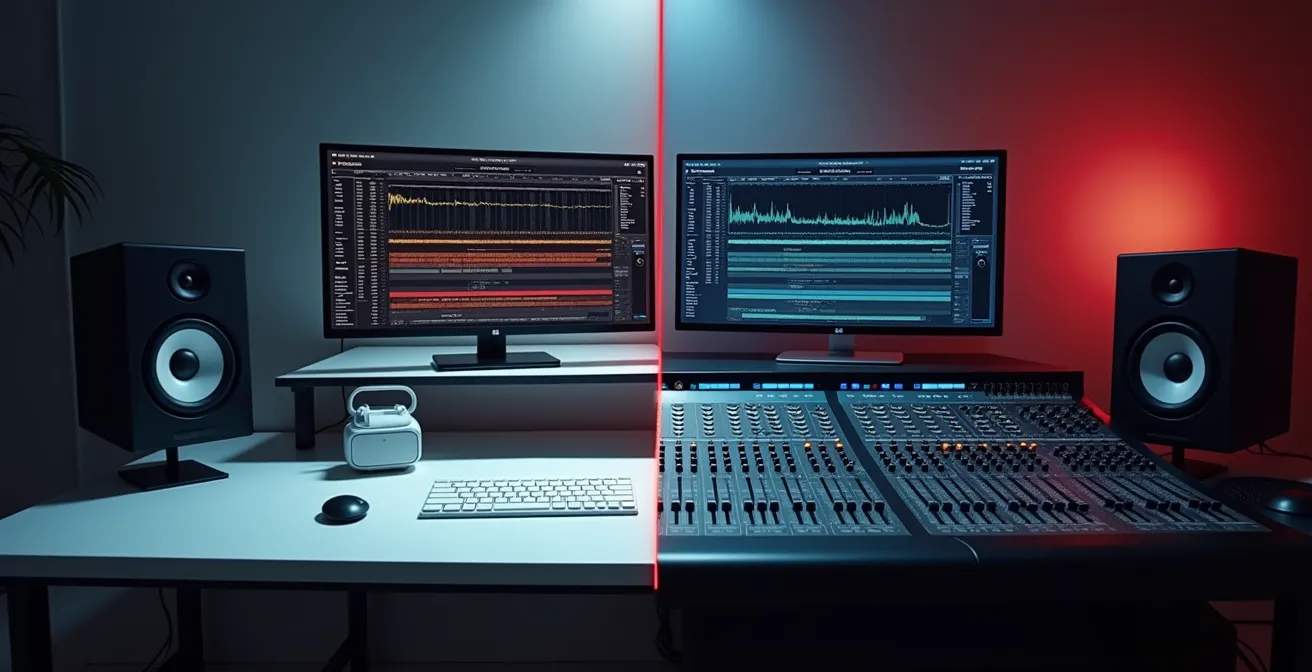
The right choice depends entirely on your primary role. Are you a solo composer-producer focused on creating music from the ground up? Or are you a sound designer or engineer who needs to collaborate seamlessly with commercial studios and post-production houses? The following table breaks down the core differences to help you align your toolset with your professional workflow.
| Feature | Logic Pro | Pro Tools |
|---|---|---|
| Entry Cost | $199 one-time | $299/year subscription |
| Included Sound Library | 70GB+ content | Basic library |
| Hardware Requirements | Mac only | Cross-platform |
| Industry Standard For | Music production | Post-production |
| Game Audio Export | Direct Wwise support | Manual workflow |
With a firm grasp of your rights and the strategic decisions that shape your career, the next step is to implement this knowledge consistently. Start today by auditing your existing catalog, creating split sheets for all collaborations, and establishing a timeline for copyright registration to build a truly sustainable and profitable business from your music.