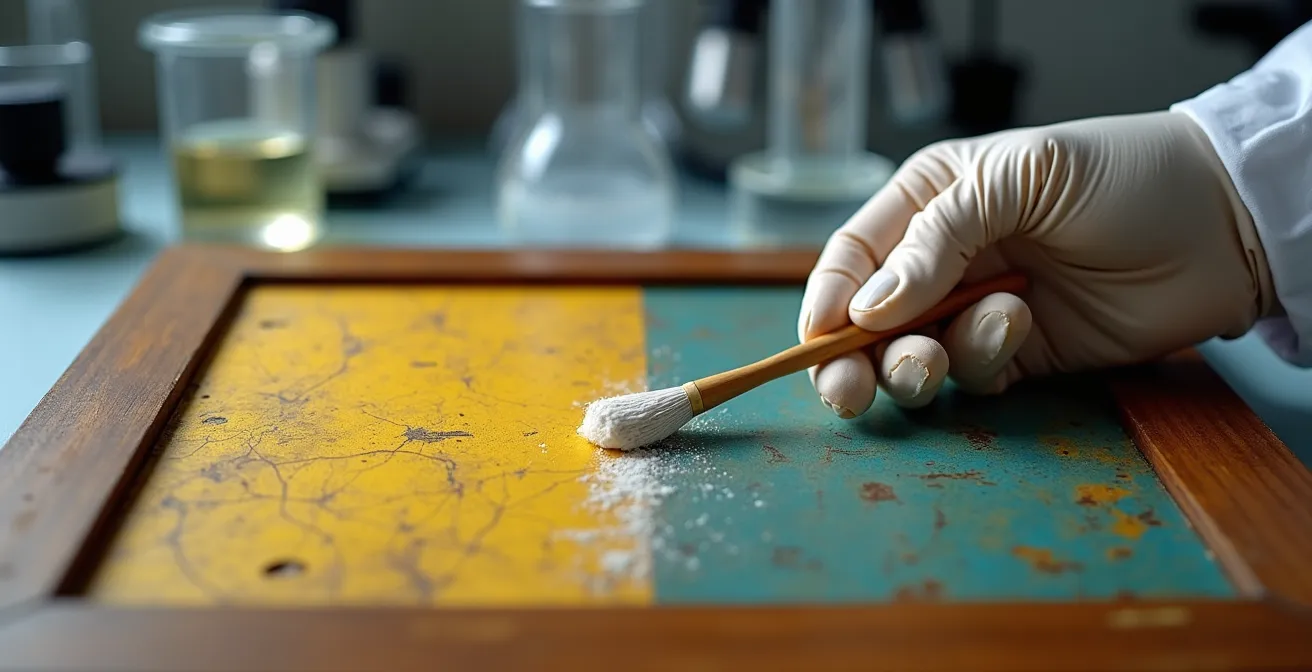
Art conservation is not an act of erasing time, but a precise scientific negotiation with the molecular decay of historical materials.
- The yellowing of old paintings is a chemical reaction—the oxidation of natural resin polymers—not just a layer of dirt.
- Removing unwanted paint layers relies on matching solvent polarity to dissolve one chemical structure while leaving the original oil binder untouched.
- Controlling humidity is critical because organic materials like canvas and wood are hygroscopic, physically swelling and shrinking as they exchange moisture with the air.
Recommendation: For collectors, understanding an artwork’s material composition is as crucial as appreciating its aesthetic. Material stability is the foundation of long-term value.
When a masterpiece begins to show its age—colors dulling, paint flaking, the surface cracking—the impulse is to “fix” it. Many believe the role of a conservator is simply to restore a painting to its former glory, a process blending artistic skill with a bit of technical magic. However, this view barely scratches the surface. True art conservation is a rigorous scientific discipline, a constant dialogue between chemistry, physics, and a deep respect for an object’s history. It’s less about restoration and more about stabilization. We don’t turn back the clock; we negotiate with its effects at a molecular level.
The real work happens in understanding the ‘why’ behind the decay. Why does a varnish polymerize and yellow under light? How can one solvent dissolve a 20th-century acrylic overpaint but leave a 16th-century oil layer unharmed? The answer lies in the distinct chemical properties of each material. This article moves beyond the romantic image of the artist-restorer to reveal the underlying science. We will explore the chemical reactions that age a canvas, the physical forces that warp it, and the ethical principles that guide every intervention, even when the topics seem as disparate as a Renaissance painting and a modern musical instrument.
For those who prefer a visual format, the following video offers a glimpse into the meticulous, hands-on process of restoring an antique print, illustrating many of the patient techniques discussed in this guide.
To navigate the complex world of art conservation, this guide breaks down the core scientific challenges and principles that every collector and enthusiast should understand. The following sections will delve into the specific chemical and physical phenomena that conservators confront daily.
Summary: The Scientific Principles of Preserving Artistic Legacy
- Why Traditional Varnish Turns Yellow on Renaissance Paintings?
- How to Remove Overpaint Without Touching the Original Pigment?
- Humidity Control: The Narrow Range That Prevents Canvas Warping
- The Cleaning Error That Permanently Strips Oil Paint
- When to Call a Restorer: 3 Early Signs of Flaking Paint
- Why Physical Photo Albums Degrade Faster in Attic Storage?
- Why a repaired Crack Devalues a French Bow by 30%?
- Investing in Emerging Artists: How to Spot Future Value Before Prices Spike?
Why Traditional Varnish Turns Yellow on Renaissance Paintings?
The golden, almost honey-toned glow of many Old Master paintings is often perceived as a sign of authenticity and age. In reality, it’s evidence of chemical decay. Traditional varnishes, often made from natural resins like dammar or mastic, are composed of complex organic polymers. Over decades and centuries, these polymers undergo a process of oxidation and cross-linking, primarily driven by exposure to ultraviolet (UV) light. This chemical reaction alters their molecular structure, causing them to absorb more light in the blue end of the spectrum, which we perceive as a yellow or brownish hue.
This isn’t just a layer of “grime”; it’s a fundamental change in the varnish itself. The result is a dramatic distortion of the artist’s original intent. Blues can appear green, whites turn cream, and the overall tonal contrast of the composition is flattened, obscuring crucial details in the shadows. A conservator’s first challenge is often to safely remove this degraded layer to reveal the artist’s true palette, a process that requires immense chemical precision.
Case Study: Louvre’s Arcimboldo ‘Seasons’ Restoration (2024)
The recent restoration of Giuseppe Arcimboldo’s famous “Seasons” series from 1573 at the Louvre provides a clear example. As detailed in a review of major 2024 restoration triumphs, conservators discovered that centuries of yellowed and cloudy varnishes had completely hidden the paintings’ original vibrancy. The careful lightening of these degraded layers was a critical step in revealing the brilliant colors of the floral and faunal elements that Arcimboldo had originally painted, transforming the viewer’s understanding of the works.
This process of yellowing is a reminder that artworks are not static. They are dynamic chemical systems in slow-motion, constantly reacting to their environment. Understanding the specific nature of these reactions is the first step in responsibly intervening. The goal is never to make the painting look “new,” but to remove a veil of degradation that is not part of the original artwork.
How to Remove Overpaint Without Touching the Original Pigment?
Overpaint—layers of paint applied by later restorers or owners—is one of the most complex challenges in conservation. These additions can obscure the original composition, alter its meaning, or simply be of poor quality. Removing them without damaging the artist’s fragile original layer beneath is a feat of chemical precision that relies on the principle of differential solubility.
Before any physical work begins, we use scientific imaging techniques. Infrared reflectography, for example, allows us to see through the upper paint layers. Because carbon-based underdrawings absorb infrared light differently than pigments, specialized fixed-wavelength cameras can pinpoint carbon-based drawings at 1,700 nanometers, revealing the artist’s initial sketch hidden beneath the paint. This gives us a roadmap of the original composition and helps identify which areas are later additions. Once an area of overpaint is identified, the real chemical work begins.
The goal is to find a solvent or gel that will dissolve the binder of the overpaint (e.g., a modern synthetic polymer) but will not affect the binder of the original layer (e.g., a centuries-old, highly cross-linked oil). This is where Hansen Solubility Parameters (HSP) come into play, allowing conservators to create custom solvent blends with very specific polarities. The process is painstaking, often performed under a microscope with tiny cotton swabs, dissolving the overpaint molecule by molecule.
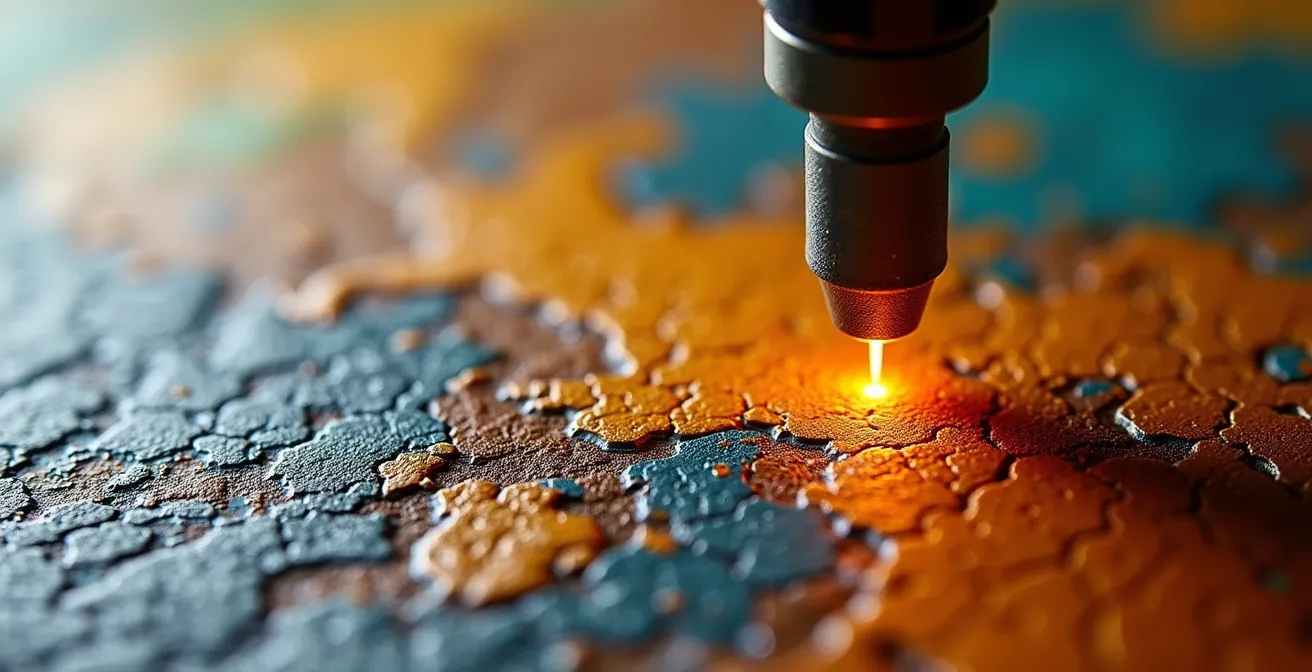
In recent years, laser ablation has also become a tool for this process, as seen in the image above. The laser is tuned to a specific wavelength and energy that vaporizes the overpaint layer while reflecting off the original pigment, offering an incredible degree of control. After removal, any losses in the original paint are “inpainted” using stable, reversible pigments. As conservation specialists note, “The conservator will carefully inpaint damaged areas using dry pigment mixed with synthetic non-yellowing solvents to ensure that a professionally restored work will rarely need further conservation.” This ensures the intervention is both aesthetically integrated and ethically sound.
Humidity Control: The Narrow Range That Prevents Canvas Warping
While chemical degradation is a slow, insidious process, physical damage from environmental instability can be swift and catastrophic. The most significant environmental factor for most artworks is relative humidity (RH). Materials like canvas (which is woven from cellulose fibers), wood panels, and paper are hygroscopic. This means they naturally absorb and release moisture from the air to reach equilibrium with their surroundings. This process is not benign; it causes the material to physically swell when humidity is high and shrink when it is low.
When these fluctuations are frequent or extreme, they create immense mechanical stress within the artwork’s structure. A canvas will tighten and slacken on its stretcher, causing the rigid layers of gesso and oil paint on its surface to crack. This cracking pattern, or craquelure, can eventually lead to the paint lifting and flaking off entirely. Wooden panels will warp, cup, or even split along the grain as different parts of the wood expand and contract at different rates.
Therefore, maintaining a stable RH within a very narrow range is the single most effective preventive conservation measure. For most collections, the goal is to keep the RH as close to 50% as possible, with minimal fluctuations. As the table below demonstrates, the “safe” zone is quite specific, and straying outside it has predictable and damaging consequences for different materials.
This data, summarized from a comparative analysis of storage conditions, highlights the universal need for climate control in preserving collections.
| Material Type | Low RH Effects (<40%) | High RH Effects (>60%) | Optimal Range |
|---|---|---|---|
| Canvas Paintings | Brittleness, cracking, paint loss | Canvas shrinkage, stretcher expansion | 40-55% RH |
| Wood Panels | Warping, seam cracking | Expansion perpendicular to grain | 45-55% RH |
| Paper Works | Brittleness, tearing | Warping, buckling, staining | 45-55% RH |
This isn’t about creating a “comfortable” environment; it’s about creating a physically stable one to minimize the mechanical forces that are constantly trying to tear the artwork apart from within. This is why museum-grade climate control systems are so vital and why storing art in an attic or basement is so perilous.
The Cleaning Error That Permanently Strips Oil Paint
Surface cleaning seems like the most straightforward task in conservation, but it is fraught with peril. The temptation for untrained individuals is to use common household cleaners, or even just water, to wipe away a layer of dust. This is often a catastrophic error. The most devastating mistake is using the wrong solvent, which can cause an irreversible type of damage known as blanching. This occurs when a solvent is too strong for the paint film, and it not only removes the surface dirt but also starts to leach out the original binder—the oil—from the pigment layer.
When the oil binder is extracted, the pigment particles are left partially unbound on the surface. Refractive indexes are altered, and the paint layer loses its saturation and depth, taking on a chalky, washed-out appearance. This damage is permanent. Once the original, cross-linked oil binder is gone, it cannot be put back. This is a common tragedy with artworks that have been “cleaned” by well-intentioned but uninformed owners. Water is particularly dangerous for many paintings, as it can be absorbed by the gesso ground layer, causing swelling, and can interact negatively with certain pigments or aged binders.
This is why a conservator’s training is so heavily rooted in chemistry. As shown in the restoration of Monet’s ‘Waterlilies’ at the Portland Art Museum, chief conservator Charlotte Ameringer, an organic chemist by training, spent six months developing and testing a customized solvent blend to remove an old varnish without affecting Monet’s delicate paint. Some artists make this even harder. As conservator Simon Gillespie notes, the 18th-century painter Joshua “Reynolds is famous (I should say infamous) among conservators for using experimental materials in his painting that are often highly sensitive to cleaning.”
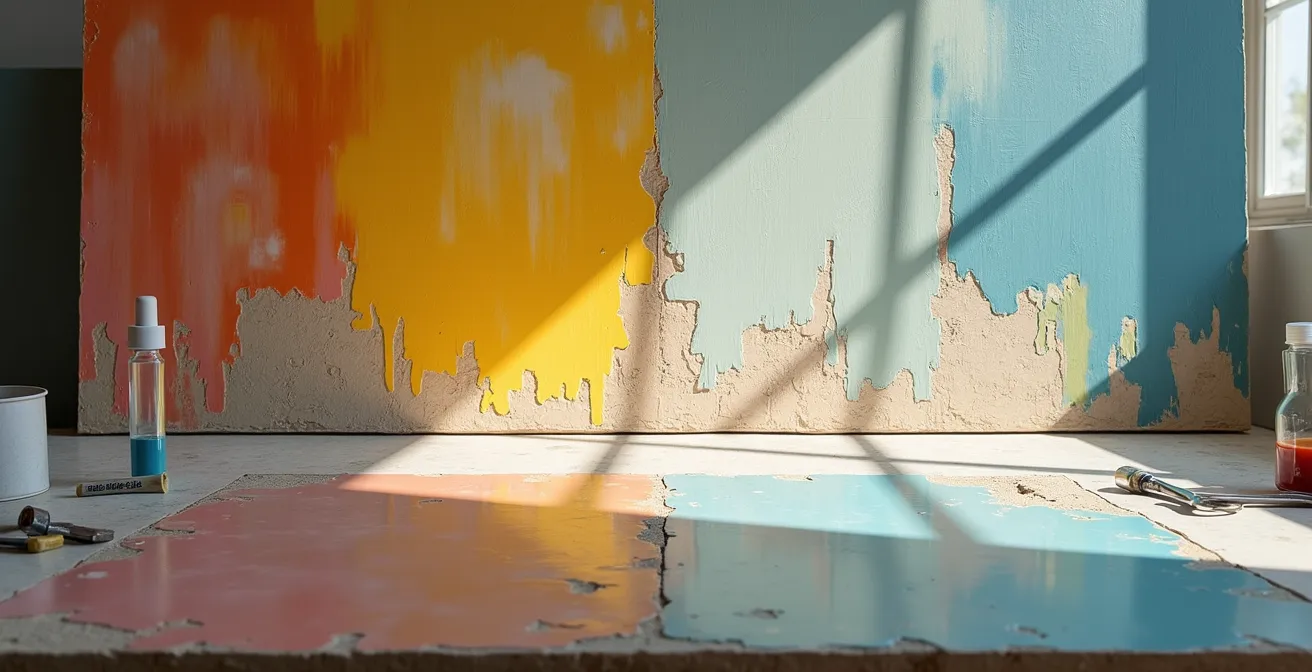
The microscopic view above starkly illustrates the consequences of such an error. The blanched area is not merely dirty or faded; its very chemical structure has been compromised. This underscores the primary rule of conservation: do no harm. An intervention must be based on a complete understanding of the artwork’s material composition, and any proposed solvent must be tested in a tiny, inconspicuous area before being applied to the whole.
When to Call a Restorer: 3 Early Signs of Flaking Paint
Preventive care is always preferable to restorative intervention. However, even in the best conditions, centuries-old materials can begin to fail. For a collector, knowing how to spot the early warning signs of serious structural problems is key to preventing catastrophic loss. Flaking paint doesn’t just happen overnight; it is the final stage of a process of deterioration. Catching it in the earlier stages can make the difference between a minor consolidation treatment and a major, expensive restoration.
The most urgent sign is any form of paint lifting or cleavage. This is when the paint layer, along with its ground layer, begins to separate from the canvas or wood support. It may appear as small, tent-like ridges on the surface, or as cracks with visibly raised edges. This indicates a failure of the adhesive bond holding the painting together, and any physical disturbance could cause the raised flakes to detach completely. Another key indicator is a change in the surface finish. If new matte, chalky spots appear on what should be a uniformly glossy surface, it often signals binder deterioration or the beginning of blanching from trapped moisture.
Finally, the presence of any biological growth is a red alert. Mold or mildew can grow on or within the paint and varnish layers, especially if the environment has been too humid. Active mold growth accelerates rapidly when humidity rises above 65% RH, and it can permanently stain and weaken the paint structure. If you see any of these signs, the time for amateur solutions is over. Do not touch the affected area, do not try to “glue it down,” and resist the urge to wipe it. The artwork should be kept flat, stable, and moved as little as possible before consulting a professional conservator.
Action Plan: Identifying Critical Warning Signs
- Check for Tenting and Cleavage: Look for small, tent-like shapes where paint is physically lifting from the ground layer. This indicates a critical failure of the adhesive bond.
- Inspect Surface Sheen: Scan the painting under angled light for any new, anomalous chalky or matte spots on an otherwise glossy surface, which signals binder decay.
- Examine Craquelure Edges: Observe the network of cracks. If the edges are sharp and uplifted, it means the paint is under tension and at high risk of detaching.
- Look for Biological Growth: Check for any fuzzy spots of mold or a white, cloudy haze under the varnish, which indicates trapped moisture and an environment that is too humid.
- Document and Isolate: If any of these signs are present, photograph them, and move the artwork to a stable, horizontal position away from vibrations or environmental shifts before contacting a professional.
Why Physical Photo Albums Degrade Faster in Attic Storage?
The principles of chemical degradation are universal, extending far beyond oil paintings. A perfect example is the common fate of physical photo albums stored in attics or basements. These locations are hostile environments for fragile organic materials. An attic experiences extreme temperature cycles, baking in the summer and freezing in the winter. A basement is often consistently damp and cool. Both scenarios accelerate the decay of photographic materials.
The core issue is chemical kinetics, the study of reaction rates. As a fundamental rule in chemistry, increasing the temperature accelerates the rate of most chemical reactions. In fact, conservation science confirms that higher temperatures exponentially increase deterioration reaction rates. For every 10°C (18°F) rise in temperature, the rate of chemical decay roughly doubles. This is known as the Arrhenius equation in practice. The heat in an attic acts as an incubator, speeding up the oxidation of paper fibers, causing them to become brittle and yellow, and accelerating the fading of color dyes in chromogenic prints.
Furthermore, both attics and basements suffer from massive humidity swings, creating the same hygroscopic stress we see in canvas paintings. Paper fibers swell and shrink, causing prints to curl and warp. The gelatin layer that holds the photographic image can become sticky in high humidity, causing photos to fuse to adjacent pages or plastic sleeves. In damp basements, the constant high RH creates a perfect breeding ground for mold, which feeds on the gelatin and paper, causing irreversible staining. Light exposure is another factor; even ambient light in a finished attic can cause photochemical damage, leading to fading and discoloration over time.
Why a repaired Crack Devalues a French Bow by 30%?
This question, seemingly from the world of music, strikes at the very heart of modern conservation ethics: the concept of reversibility and structural integrity. A fine French violin bow made from Pernambuco wood is not just a tool; it is a highly engineered object whose value lies in its original material and craftsmanship. Its ability to perform depends on the continuous, uninterrupted grain of the wood, which gives it its unique combination of strength and flexibility.
When a bow cracks, a repair might make it functional again, but it fundamentally and permanently alters its nature. Most modern adhesives used for strong structural repairs, such as epoxies, are not reversible. They form a bond that is often stronger than the wood itself. This creates a hard point in a structure that is designed to flex. The mechanical properties of the adhesive are different from the wood, creating stress concentrations at the edge of the repair, which can lead to new fractures over time. The original, continuous wood fibers are broken, and that integrity is lost forever.
This is why a repaired crack causes such a drastic drop in value. The 30% figure is a market reflection of a core conservation principle: an object’s historical and material authenticity has been compromised. In museum-level conservation, the guiding principle is that any intervention should be reversible. As conservator Monica Mull states, “Everything conservation should be reversible. That way in another 100 years or something when it’s cleaned, they can take it off and redo it.” This allows future generations, armed with more advanced science, to retreat our work and apply better methods. A permanent epoxy repair on a French bow violates this principle completely. It is a one-way ticket that prioritizes immediate function over long-term preservation and historical honesty.
Key Takeaways
- Artworks are active chemical systems; varnish yellowing and pigment fading are ongoing molecular reactions, not just surface dirt.
- Environmental stability, especially a relative humidity between 40-55%, is the most critical factor in preventing physical damage like cracking and warping.
- The core ethic of modern conservation is reversibility—all interventions should be removable by future conservators without damaging the original object.
Investing in Emerging Artists: How to Spot Future Value Before Prices Spike?
For a collector, investing in an emerging artist is a bet on their future significance. This is often seen as a matter of aesthetic taste and market trends. However, from a senior conservator’s perspective, there is a crucial, often overlooked factor that directly impacts an artwork’s long-term value: material science and archival quality. An artist’s choice of materials is as important as their vision. A stunning painting created with unstable, non-archival materials is a future conservation liability, and its value is built on a foundation of sand.
When assessing an emerging artist, a savvy collector should ask questions beyond the canvas. What type of pigments are they using? Are they professional-grade lightfast colors or cheap, fugitive craft paints that will fade in a decade? Are their canvases properly primed? Are they experimenting with unorthodox materials—like the infamous Joshua Reynolds—that may have unknown aging properties? An artist working with sound, archival techniques is creating an object that is built to last. An artist who ignores material science is creating a work that may require costly and extensive conservation just to remain stable, directly impacting its future market value.
The financial consequences of poor material choice or improper storage are not theoretical. In one case, “a collector stored paintings in a loft with poor climate control. Within two seasons of RH cycling between 70% and 40%, the canvases showed cracking and warped stretchers. Conservation was expensive and only partially restored the works.” This story is a stark reminder that the initial purchase price is only the beginning of the investment. A work that is materially unstable will accrue significant conservation costs over its lifetime, diminishing the return on investment. Spotting future value is not just about spotting talent; it’s about spotting craftsmanship and material intelligence.
Therefore, when considering an investment in an emerging artist, look for a deep respect for their craft. Assess not only the power of their images but the quality of their materials and the soundness of their technique. A wise investment is in an artist who is not only creating for today, but building for tomorrow.
Frequently Asked Questions About The Chemistry of Art Restoration: How Experts Save 500-Year-Old Canvases
What makes conservation treatments reversible?
Professional conservators use watercolor paints and specialized solvents that can be removed without damaging the original work, allowing future conservators to retreat if needed. The adhesives and varnishes used are also chosen for their known aging properties and their ability to be safely dissolved by specific, non-destructive solvents.
Why is reversibility crucial in museum-level restoration?
Reversibility is a core ethical principle that ensures future generations can remove today’s conservation treatments and apply new, more advanced techniques as science evolves. It preserves the integrity of the artist’s original work by ensuring that our interventions are not permanent and can be improved upon in the future.
How do modern adhesives affect artwork value?
Permanent adhesives like epoxies can drastically reduce an artwork’s value because they are irreversible and have different mechanical properties than the original materials. This creates stress points that can cause future damage and permanently alters the object’s historical and material authenticity.