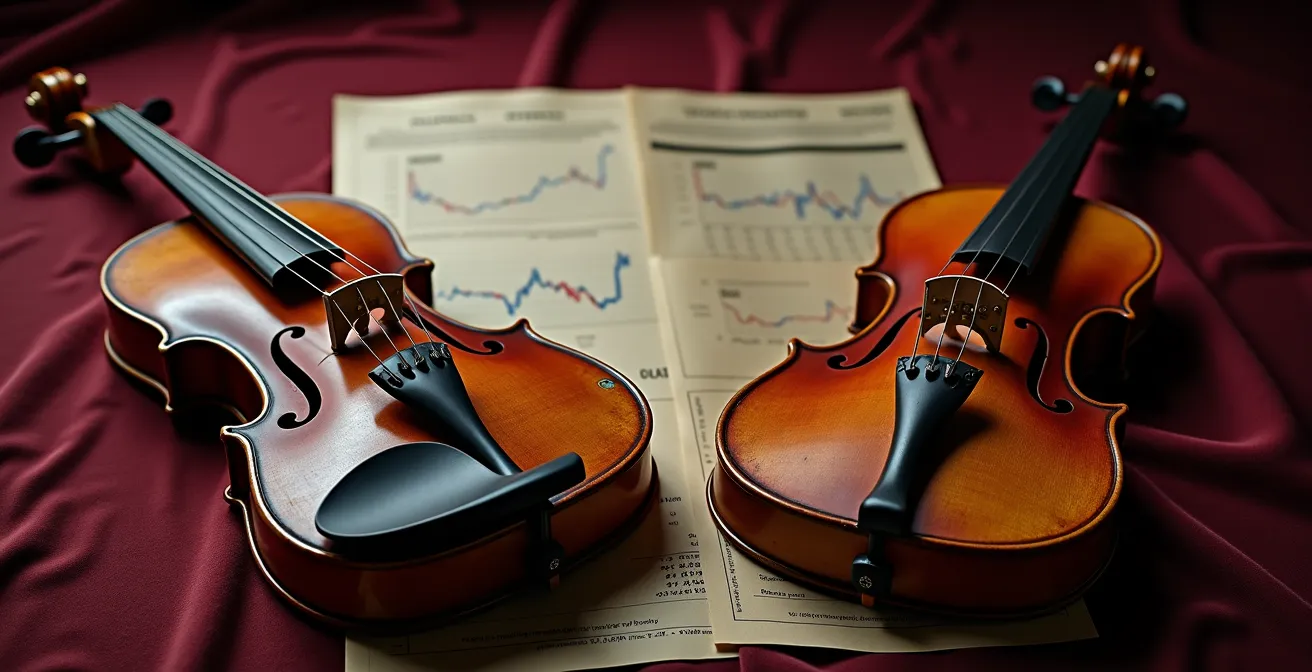
The true value of a student violin lies not in its age or label, but in its structural health and acoustic honesty.
- Severe damage, like a repaired bow crack, can erase up to 90% of an instrument’s value, far outweighing any potential vintage premium.
- Labels are notoriously unreliable; a forensic examination of tool marks and construction is the only way to verify authenticity.
- Objective acoustic testing in a controlled manner reveals an instrument’s true character, avoiding the deceptive acoustics of small rooms.
Recommendation: Before any purchase over $5,000, invest in an independent appraisal from a qualified luthier to verify the instrument’s condition, provenance, and suitability for the student.
For parents and advancing music students, crossing the $5,000 threshold for a violin is a significant investment. It’s a moment filled with both excitement and anxiety, often clouded by romantic notions of discovering a hidden gem. The persistent myth is that “old is gold”—that a vintage European instrument, with its storied past and mysterious label, inherently offers a better tone and a more secure return on investment (ROI) than a modern one. This leads many to hunt for antique bargains, believing they are acquiring an appreciating asset.
However, this perspective often overlooks the harsh realities of the string instrument market. The truth is, an instrument’s value is less about its date of birth and more about its state of health and honesty of construction. Many well-meaning buyers are seduced by a compelling story or a famous name on a paper label, only to find they’ve purchased an instrument with costly hidden damages or a fraudulent history. The key to a smart investment isn’t romanticism; it’s a forensic, practical approach to appraisal.
This guide cuts through the myths. Acting as your luthier and appraiser, we will dismantle the key factors that truly determine a violin’s value. Instead of chasing vague notions of “soul” or “projection,” we will focus on tangible assessments: the catastrophic financial impact of repairs, the hierarchy of workshop versus luthier-made instruments, and how to test an instrument’s acoustics without being fooled. This is not just about buying a violin; it’s about investing wisely in a tool for musical growth.
To navigate this complex decision, this article breaks down the essential considerations for any serious buyer. The following sections will equip you with a luthier’s perspective, providing a clear roadmap to evaluating your potential investment.
Summary: A Luthier’s Guide to Violin Investment for Students
- Why a repaired Crack Devalues a French Bow by 30%?
- How to Test Projection in a Small Room Without Being Deceived?
- Workshop or Luthier-Made: Which Category Holds Value Best?
- The Label Scam That Fools 50% of First-Time Vintage Buyers
- When to Upgrade to a Full-Size: The Growth Spurt Indicators
- Canvas or Limited Print: Which Entry-Level Investment Is Safer?
- When to Call a Restorer: 3 Early Signs of Flaking Paint
- Transitioning from Musical Theater to Opera: The Vocal Adjustment Required
Why a repaired Crack Devalues a French Bow by 30%?
The question itself is an understatement; a significant repair to a fine bow, particularly a head break, can devalue it by far more than 30%. While modern glues and techniques can make a repair visually subtle, the structural and financial damage is profound. The head of the bow is the critical point of energy transfer from the player’s hand to the string. A break here, even when masterfully repaired, introduces a discontinuity in the wood’s grain and flexibility. This permanently alters its playing characteristics and compromises its long-term stability.
From an investment standpoint, the market is unforgiving. A case study of a Charles Nicholas Bazin bow with a head break illustrates this starkly: an instrument worth £5,000 in good condition would be valued between £500 and £1,500 after repair. This represents a staggering devaluation of 70-90%. The presence of a visible spline—a small piece of wood inlaid across the break for strength—is an immediate red flag for any knowledgeable buyer or appraiser, signaling a history of catastrophic failure. The damage is not merely cosmetic; it is a fundamental flaw that permanently caps the bow’s financial and artistic ceiling.
Not all damage carries such a heavy penalty. The table below, based on common repairs, highlights the vast difference in impact. While replacing consumable parts like the winding or thumb leather has no effect on value, cracks in the frog or, most critically, the head, are financially devastating.
| Type of Damage | Value Reduction | Repair Visibility |
|---|---|---|
| Head Break/Repair | 70-90% | Visible spline |
| Winding Replacement | 0% | Not visible |
| Thumb Leather | 0% | Not visible |
| Frog Crack | 10-20% | Sometimes visible |
Therefore, when evaluating a vintage violin or bow, your first priority must be a thorough inspection for signs of major repairs. A “good deal” on an instrument with a repaired head crack is never a good deal; it is the purchase of a permanently compromised asset.
How to Test Projection in a Small Room Without Being Deceived?
One of the most misleading aspects of trying an instrument is judging its “projection” in a small, untreated room. The acoustics of a typical practice room or living room can easily deceive a player. Standing waves and reflections can make a quiet instrument sound booming or a powerful one seem thin, depending on where you stand. Relying on this subjective feeling is a common mistake. True projection is about an instrument’s ability to carry its tone with clarity and color to the back of a concert hall, not its raw volume two feet from your ear.
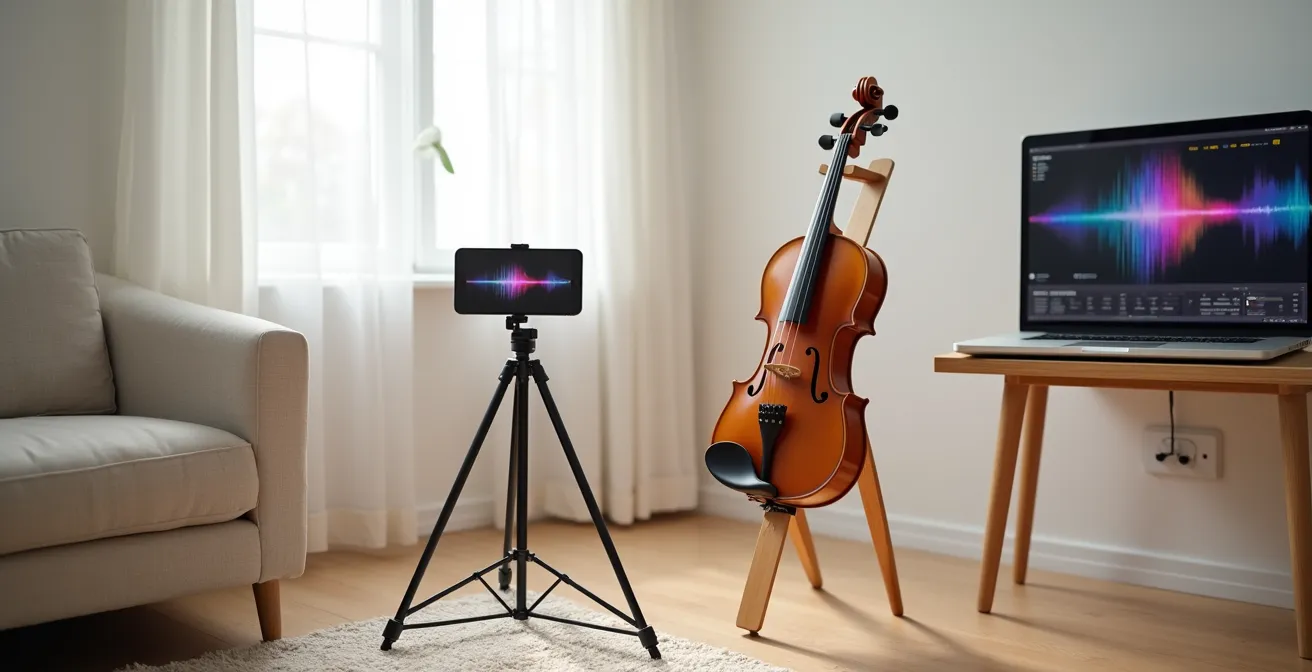
To achieve acoustic honesty in your evaluation, you must remove the room’s influence as much as possible. A simple, effective method is to record yourself. Place a quality smartphone on a tripod about 10-15 feet away, play a series of scales, long tones, and a short piece, then listen back with good headphones. This simulates the experience of a listener at a distance and reveals how the instrument truly broadcasts its sound. Does the tone remain focused and clear, or does it become thin and undefined? This method bypasses the room’s flattering or deceptive reflections.
This objective approach helps counter the powerful bias of an instrument’s story. A famous blind study demonstrated this vividly: in a New York study with 82 listeners, including professional musicians, even priceless Stradivari violins were not consistently preferred over high-quality modern instruments when the identity was hidden. This proves that what we *think* we should hear is often more powerful than what we actually hear. Trust the recording, not the romance.
Workshop or Luthier-Made: Which Category Holds Value Best?
Within the $5,000 to $10,000 price range, buyers will primarily encounter two categories of instruments: high-grade “workshop” instruments and those made by individual, lesser-known luthiers. Understanding the provenance hierarchy is crucial for predicting an instrument’s potential to hold or increase its value. A workshop instrument is not necessarily “factory-made” in the modern sense; historic workshops like those of Ernst Heinrich Roth or the Heberlein family operated with a master luthier overseeing a team of specialized craftsmen. The quality could be exceptionally high.
Generally, an instrument made entirely by a single, skilled luthier (a “luthier-made” instrument) will have a higher ceiling for value appreciation. Its uniqueness and direct connection to a single artist’s hand make it more desirable to collectors and discerning players down the line. However, a top-tier workshop instrument from a reputable name like Roth can often be a safer and better-performing choice than an instrument from an unknown or mediocre individual maker. In the $5,000-$10,000 bracket, you are at the sweet spot where you can find excellent examples of both.
The key is quality, not category. Some high-grade French and American workshop violins from the early 20th century are superb investments and playing tools. Conversely, the market for modern instruments is stronger than ever. Many players now favor the reliability, power, and immediate availability of a new instrument from a living maker. This shift demonstrates that the old myth of “vintage is always better” is fading. Your goal should be to find the best possible instrument for your budget, regardless of its origin story.
The Label Scam That Fools 50% of First-Time Vintage Buyers
The single most dangerous trap for an aspiring collector or first-time buyer is placing faith in the paper label inside the violin. A label reading “Antonius Stradivarius Cremonensis Faciebat Anno 1721” is almost certainly a reproduction. For centuries, it was common practice for workshops, particularly in Germany and France, to insert copies of famous Italian labels into their instruments as a tribute, not necessarily to deceive. Over time, however, these instruments are often passed off as the real thing to unwary buyers.
The scale of this issue is immense. According to experts, the number of mislabeled instruments is staggering; some estimate that over 90% of instruments purporting to be from the 18th-century classical Italian period are not what they claim to be. The label is merely a clue, and often a misleading one. A true appraisal ignores the label initially and focuses on the physical evidence: the tool marks, the purfling (the inlaid border), the scroll’s carving, the wood’s grain, and the varnish’s chemical composition and texture. An expert can often tell the region and even the specific workshop of an instrument’s origin just by these details, which are far harder to fake than a piece of paper.
To avoid falling victim to this, a buyer must adopt a luthier’s skeptical mindset and follow a strict verification process. The instrument’s physical characteristics must align with its purported origin. Any discrepancy is a major red flag.
Action Plan: 3-Step Verification Before a Vintage Purchase
- Independent Luthier Appraisal: Obtain a formal appraisal from a qualified expert who is not the seller. They will examine the instrument’s construction, not just its label.
- Forensic Detail Check: Ask the luthier to point out specific construction details, such as tool marks, corner work, and scroll carving, and explain how they are consistent (or inconsistent) with the label’s origin and period.
- Database Cross-Reference: For high-value instruments, check auction databases like the Tarisio or Cozio archives. While not a guarantee, finding a matching sales history can add a layer of confidence to the provenance.
Treating the label as the last piece of evidence to consider, rather than the first, is the cornerstone of protecting your investment from fraud.
When to Upgrade to a Full-Size: The Growth Spurt Indicators
For a student, the transition to a full-size (4/4) violin is a major milestone, both musically and financially. Timing this upgrade correctly is key to maximizing both playing comfort and the return on investment from their fractional-size instrument. The primary indicator is physical: when the student holds the violin in playing position, they should be able to comfortably curve their fingers around the top of the scroll with their arm fully extended. If their arm is still bent, the violin is too small, forcing poor posture and limiting technique. A teacher’s guidance here is indispensable.
From a financial perspective, there is a strategic time to sell a fractional-size violin. These instruments are in highest demand at the beginning of the school year. By planning the upgrade over the summer, you can often get a better price for the smaller instrument. A well-maintained fractional violin from a good maker can have excellent resale value, and selling before the school year can yield 15-20% more than selling mid-year. This can significantly offset the cost of the full-size upgrade. This is where investing in a quality fractional instrument pays dividends; a cheap, poorly made one has almost no resale value.
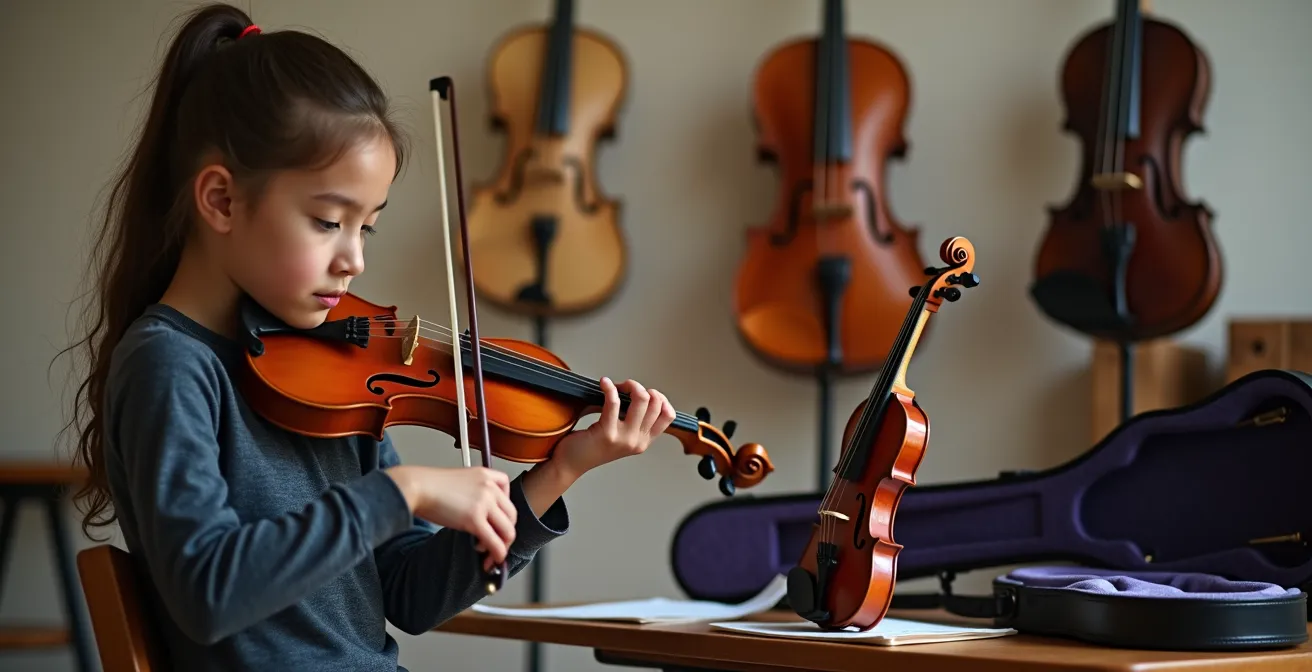
The upgrade to a full-size violin is the moment to apply all the principles of a smart investment. Since this instrument could potentially serve the student through high school, college, and beyond, it’s the time to invest in the best quality you can afford. This means prioritizing structural integrity and a proven provenance hierarchy, whether you choose a modern instrument or a vintage one.
Canvas or Limited Print: Which Entry-Level Investment Is Safer?
To better understand the risks and rewards of investing in a violin, it’s helpful to draw a parallel with the entry-level art market. A student or parent choosing an instrument faces a similar choice to an art buyer deciding between a limited edition print and an original canvas. A high-quality print from a famous artist is like a top-tier workshop violin: it’s authenticated, comes from a known source, has a predictable market, and is relatively liquid. An original canvas by an unknown emerging artist is like a violin from a contemporary, unestablished luthier: it has the potential for huge appreciation if the artist becomes famous, but it’s also a much riskier, less liquid investment.
The “unverified vintage violin” is the riskiest of all, akin to buying a painting attributed to a master from a flea market. It might be a masterpiece, but it’s more likely a copy or a forgery, and proving its authenticity is an expensive, uncertain process. The following table breaks down these comparisons, highlighting crucial factors like liquidity and sales commission—a significant cost in the violin world, where consignment fees are often 20% or higher.
| Investment Type | Initial Cost | Liquidity | Storage Requirements | Commission on Sale |
|---|---|---|---|---|
| Limited Edition Print | $500-5,000 | High (online platforms) | Minimal | 10-20% |
| Certified Luthier Violin | $2,000-10,000 | Medium (consignment) | Climate-controlled | 20-30% |
| Original Canvas | $5,000-50,000 | Low-Medium | Climate-controlled | 15-25% |
| Unverified Vintage Violin | $1,000-20,000 | Low (authentication needed) | Climate-controlled | 20-35% |
This analogy should serve as a dose of realism. While a fine violin can be an asset, it is first and foremost a tool for making music. As one expert wryly noted, the idea of instruments as pure financial investments should be met with skepticism.
Try this mental exercise- If violin family instruments and bows are such good investments, why don’t the wind players in your orchestra have a collection?
– Fein Violins Blog, The Violin Shop Blog
This perspective helps frame the purchase correctly: prioritize the instrument’s utility and quality for the player first, with investment potential as a secondary benefit.
When to Call a Restorer: 3 Early Signs of Flaking Paint
Just as a conservator watches for flaking paint on a masterpiece, a violin owner must be vigilant for early signs of varnish distress. The varnish on a violin is not just a cosmetic coating; it is a critical component that protects the wood from dirt, moisture, and wear, and it has a subtle but significant impact on the instrument’s tone. Allowing varnish damage to go unchecked can lead to more serious wood damage underneath, which is far more costly to repair and can affect the instrument’s value.
While minor scratches and dings are part of a played instrument’s life, certain patterns of wear require immediate professional attention from a luthier. Attempting to “touch up” varnish yourself with commercial products can cause irreversible damage and significantly devalue the instrument. An expert restorer uses specialized varnishes that are chemically compatible with the original and can perform invisible repairs. It’s crucial to distinguish between normal wear and signs of a deeper problem. Some issues, like an open seam (where the top or back plate separates slightly from the ribs), are often minor and easily repaired by a professional without impacting value.
You should contact a luthier immediately if you notice any of these three specific signs of varnish failure:
- Crazing: A network of fine-line cracks that appears on the varnish surface, often a sign that the varnish has become brittle with age or due to environmental stress.
- Chipping: Small pieces of varnish breaking away completely, exposing the bare wood underneath. This is common in impact areas like the edges and requires sealing to prevent wood damage.
- Alligatoring: A scale-like pattern of cracks and beads, often caused by exposure to excessive heat or a reaction to an incompatible chemical (like some polishes or bug sprays).
Regularly inspecting your instrument for these signs and addressing them early is a key part of preserving its health and financial value. It is an essential responsibility for the custodian of any fine instrument.
Key Takeaways
- An instrument’s value is determined by its condition and quality, not just its age. A pristine modern violin is a better investment than a damaged vintage one.
- Never trust a label without independent, expert verification. Focus on the physical evidence of the instrument’s construction.
- Test instruments objectively using recordings to bypass deceptive room acoustics and personal bias.
Transitioning from Musical Theater to Opera: The Vocal Adjustment Required
The final consideration in choosing an instrument is its suitability for the player’s specific needs—a concept best understood through an analogy from the vocal world. A singer trained for musical theater uses a very different technique and produces a different sound than an opera singer. One requires amplification and a bright, forward tone to cut through a modern band; the other needs to project unamplified over a full orchestra with warmth, richness, and power. Neither is “better,” but they are different tools for different jobs. The same is true for violins.
An instrument that is perfect for a chamber musician may not be ideal for a soloist who needs to “punch through” a dense Brahms concerto. The demands are different. A student needs an instrument that is responsive, easy to play, and has a pleasing tone up close. It must be a willing partner in their development. A professional soloist might prioritize raw power and projection above all else. This is why some famous soloists have preferred modern instruments. As the legendary violinist Henryk Szeryng noted, even the most venerable wood has its limits.
I mostly play one of my two modern violins. With time the wood becomes more venerable… but ultimately … too old. It does not exactly decay, but certainly does not improve, and loses elasticity.
– Henryk Szeryng, Frankfurter Allgemeine
This expert opinion underscores a critical point: the goal is to find the best tool for the job at hand. For a student, this means an instrument that facilitates learning, inspires practice, and retains its value. Whether that instrument is a 100-year-old German workshop violin or a brand-new one from a contemporary American luthier is secondary to its quality, condition, and suitability for the player.
Your next step should be to find a reputable luthier or violin shop, not just to buy, but to learn. Take this knowledge, ask informed questions, and begin the exciting process of finding the right instrument that will serve as a trusted partner for the musical journey ahead.