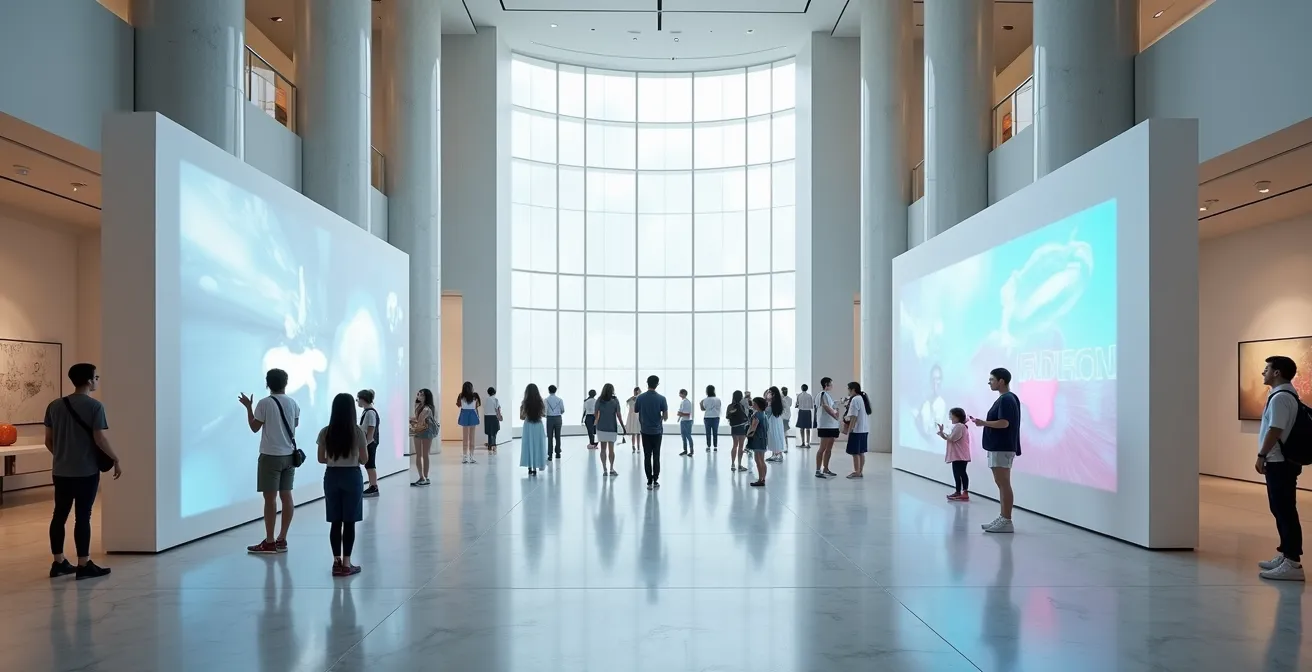
The key to boosting visitor engagement isn’t adding more technology, but redesigning the entire museum environment to align with visitor psychology.
- Successful exhibits reduce cognitive load through intentional lighting, spatial flow, and clear narratives.
- Operational choices, like dynamic pricing and relaxed dress codes, are powerful tools for managing visitor comfort and accessibility.
Recommendation: Shift focus from what technology to add, to how the physical and social environment can foster a state of comfortable, focused discovery for every guest.
The era of the museum as a silent, static sanctuary is drawing to a close. For decades, the prevailing wisdom was that reverence required distance, with artifacts kept behind glass and visitors walking hushed hallways. Today, we see visitors drifting, their attention spans waning, and our institutions struggling to compete in an experience-saturated world. Many museums have responded by rushing to integrate technology—apps, touchscreens, and VR—believing that digital interaction is the silver bullet for engagement. But this often misses the fundamental point.
True, lasting engagement is not born from a screen. It is cultivated in an environment that understands and respects the visitor’s psychological and physiological needs. The most innovative institutions are now looking beyond simple interactivity and towards a holistic, visitor-centric model. This approach considers every element, from the warmth of a spotlight and the width of a corridor to the price of a Tuesday ticket, as a crucial part of the visitor’s journey. It’s a shift from merely displaying a collection to choreographing an experience.
This article will not give you a list of gadgets to buy. Instead, we will explore the underlying principles of environmental psychology and cognitive science that are reshaping the modern museum. We’ll deconstruct how subtle changes in design and operations can dramatically reduce visitor fatigue, increase learning retention, and transform your space from a passive hall into a dynamic hub of discovery. This is the new psychology of museum design, where the ultimate goal is to make every visitor feel welcomed, comfortable, and deeply connected to the stories we tell.
To guide you through this strategic shift, this article breaks down the core components of a visitor-centric museum experience. From foundational environmental factors to advanced operational tactics, each section provides actionable insights for curators and designers ready to build the future of cultural engagement.
Summary: From Silent Halls to Sensory Journeys: The New Psychology of Museum Design
- How Lighting Temperature Alters the Perception of Classical Paintings?
- How to Design Exhibition Paths That Prevent Museum Fatigue?
- Audio Guides or Mobile Apps: Which Increases Learning Retention?
- The Crowd Control Failure That Damages Visitor Satisfaction
- Dynamic Pricing Models: The Solution for Low Weekday Attendance
- Storefront or White Cube: Which Venue Type Attracts More Foot Traffic?
- Why Relaxing Dress Codes Increases First-Time Ticket Sales?
- Organizing Pop-Up Art Shows: The Logistics Most New Curators Underestimate
How Lighting Temperature Alters the Perception of Classical Paintings?
Lighting is arguably the most powerful, yet underestimated, tool in a curator’s arsenal. It does far more than just illuminate an object; it dictates mood, directs focus, and fundamentally alters a visitor’s emotional connection to an artwork. The conversation around museum lighting often centers on conservation—protecting artifacts from UV damage. While crucial, this focus overlooks lighting’s role in the visitor experience. The choice between a warm, golden glow (around 2700K) and a crisp, neutral white (3000K-3500K) can be the difference between a portrait feeling intimate and alive versus cold and distant.
The key lies in understanding two concepts: Color Rendering Index (CRI) and color temperature. CRI is a measure of how accurately a light source reveals the true colors of an object. For art, a high CRI is non-negotiable; leading institutions know that art galleries and museums require a CRI of 95-100 to ensure fidelity. Once CRI is established, color temperature sets the scene. Warmer temperatures evoke feelings of comfort and nostalgia, making them ideal for classical portraits and historical artifacts. Cooler temperatures feel more modern and analytical, better suited for contemporary art, sculpture, and scientific displays.
The strategic use of lighting involves creating a visual hierarchy. Key pieces can be highlighted with focused spotlights, while ambient light sets the overall tone of the room. It’s also vital to manage transitions. Moving a visitor from a warmly lit gallery of Old Masters into a coolly lit modern wing without a transitional space can be visually jarring. By mastering these nuances, we guide the visitor’s eye and emotions, transforming passive viewing into an active, sensory experience. Lighting isn’t just a technical requirement; it’s the first layer of storytelling.
Action Plan: Auditing Your Current Gallery Lighting
- Points of contact: List all light sources affecting your key artworks, including spotlights, ambient fixtures, and any natural light spill.
- Collecte: Inventory the current specifications (CRI and Kelvin temperature) of the bulbs used for each of these light sources.
- Cohérence: Compare the current lighting specs against the specific needs of the artwork—does a 17th-century portrait need a warmer light? Does a minimalist sculpture benefit from a cooler tone?
- Mémorabilité/émotion: Assess whether the lighting creates a memorable, focused experience for each piece or if it’s a generic, flat wash that fails to evoke emotion.
- Plan d’intégration: Create a priority plan, starting with replacing any bulbs with a low CRI, then moving to adjust color temperatures to better match the artistic intent.
How to Design Exhibition Paths That Prevent Museum Fatigue?
“Museum fatigue” is a real phenomenon that diminishes visitor engagement and retention. It’s the mental and physical exhaustion that sets in after being overstimulated in a large, monotonous space. The traditional grid-like layout of many museums, with long, undifferentiated corridors, is a primary cause. To combat this, we can turn to environmental psychology, specifically the prospect-refuge theory. This theory posits that humans are instinctively drawn to environments that offer both open, expansive views (prospect) and smaller, protected spaces for rest (refuge).
A successful exhibition path alternates between these two types of spaces. Imagine guiding a visitor from a large, high-ceilinged gallery with a commanding view of a major sculpture (prospect) into a smaller, more intimate alcove with comfortable seating and a few detailed works (refuge). This variation acts as a “cognitive reset,” allowing the brain to process what it has just seen before moving on. These refuge spaces are not dead zones; they are critical for absorbing information and preventing sensory overload. They should be designed with softer lighting, comfortable benches, and perhaps a change in floor texture to signal a shift in pace.
This image provides a bird’s-eye view of how this principle can be implemented, showing the natural flow between open galleries and cozier rest areas.
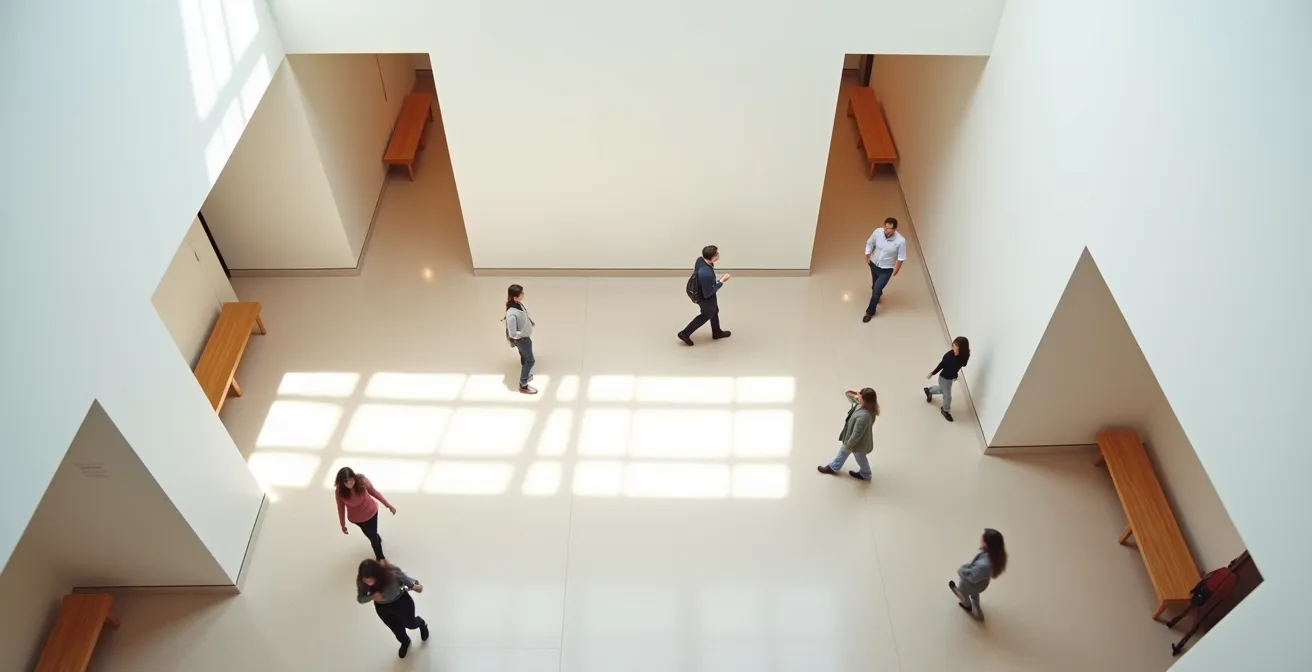
As you can see, wayfinding should feel intuitive, guided by the architecture itself rather than a confusing array of signs. Walls can be angled to subtly direct visitors, while lighting can create “pools” of interest that draw people forward. By breaking up the journey into a series of interconnected, varied experiences, we replace the exhausting marathon of a traditional museum visit with an engaging and restorative exploration. The goal is to manage the visitor’s energy and attention as carefully as we manage the artifacts themselves.
Audio Guides or Mobile Apps: Which Increases Learning Retention?
The debate between dedicated audio guides and bring-your-own-device (BYOD) mobile apps is central to the modern museum’s technology strategy. The choice is not merely about hardware; it’s a fundamental decision about controlling the narrative and managing cognitive load. Traditional audio guides offer a linear, curated experience. They tell a specific story in a specific order, focusing the visitor’s attention and minimizing distractions. This low cognitive load is ideal for complex subjects where a clear, expert-led narrative is essential for comprehension.
Mobile apps, on the other hand, offer a universe of possibilities: non-linear exploration, augmented reality (AR) overlays, gamification, and social sharing. They cater to a multi-sensory learning style and allow for deep personalization. A visitor can choose a tour based on their interests, dive deeper into related content, or even see what their friends are looking at. However, this freedom comes at a cost. The sheer number of features can fragment attention, pulling the visitor out of the moment and into their device. The temptation to check email or social media is always just a tap away.
The following table, inspired by analysis in the museum tech field, breaks down the core differences in how these technologies impact the learning experience.
| Feature | Audio Guides | Mobile Apps |
|---|---|---|
| Cognitive Load | Linear, focused narrative reduces overwhelm | Multiple features can fragment attention |
| Learning Style | Auditory-focused, passive consumption | Multi-sensory with AR, games, visual content |
| Customization | Limited to pre-recorded tours | Personalized paths based on interests |
| Social Learning | Individual experience | Can include social sharing, group challenges |
| Post-Visit Engagement | Limited to memory | Continued access, gamification after visit |
The most powerful advantage of mobile apps is their ability to extend the museum experience beyond its physical walls. Features like saved “favorite” artworks, post-visit quizzes, and access to further reading keep the engagement alive long after the visitor has left. Institutions like the Metropolitan Museum of Art have seen massive success with digital outreach; for instance, The Met 360° Project has been viewed more than 11 million times, proving the immense appetite for high-quality digital content that complements the physical visit. The ideal solution may be a hybrid approach: a mobile app that offers a simple, “guided tour” mode to reduce cognitive load, while still providing deeper content for those who seek it.
The Crowd Control Failure That Damages Visitor Satisfaction
Nothing ruins a museum visit faster than feeling packed in like sardines. The frustration of craning your neck to see a masterpiece over a sea of heads is a universally negative experience. Curators often think of crowd control as a logistical problem of physical capacity—how many people can fit in a room. However, the real issue is often one of perceptual crowding: the *feeling* of being crowded, which can occur even when a space is not technically full. This feeling is a major driver of visitor dissatisfaction and is caused by a combination of high density, confusing layouts, and sensory overload, particularly noise.
Effective crowd management, therefore, is an exercise in environmental psychology. It’s about designing spaces that feel calm and spacious, regardless of the number of people. Key strategies include:
- Acoustic Treatment: High, hard surfaces amplify noise, increasing stress and the perception of crowding. Installing sound-absorbing materials on walls or ceilings can dramatically reduce ambient noise levels, creating a more serene atmosphere.
- Visual Breaks: Long, straight corridors packed with people create a stressful sense of endless density. Creating visual breaks with partitioned areas, varied lighting zones, or even large-scale installations can make the space feel less monolithic and more manageable.
- Clear Wayfinding: When visitors are lost or confused, they tend to cluster in bottlenecks, causing congestion. A simple, intuitive layout that naturally guides people through the space is one of the most effective forms of passive crowd control.
Case Study: The Palace Museum’s Digital Solution to Physical Crowds
During the pandemic, the Palace Museum in Beijing faced the challenge of managing immense demand while adhering to strict capacity limits. Instead of simply turning people away, they harnessed technology to manage the physical crowd. As highlighted in a review of immersive technology in museums, the museum used live streaming to give potential visitors a real-time view of the experience. This not only managed expectations but also successfully limited on-site visitor numbers and reduced queuing times, demonstrating how digital tools can be a powerful ally in solving physical crowd control challenges.
By focusing on reducing the *perception* of crowding through smart design and technology, we can protect the quality of the visitor experience. It ensures that every guest, whether visiting on a slow Tuesday or a packed Saturday, has the space to connect meaningfully with the collection.
Dynamic Pricing Models: The Solution for Low Weekday Attendance
An empty museum on a Tuesday afternoon is a missed opportunity. While weekends are often packed, low weekday attendance is a chronic issue for many institutions. The traditional one-price-fits-all model fails to account for fluctuations in demand. Dynamic pricing, a strategy borrowed from the airline and hotel industries, offers a powerful solution. By adjusting ticket prices based on time of day, day of the week, or even seasonal demand, museums can incentivize visits during off-peak periods and manage crowds during peak times.
This isn’t about price gouging; it’s about accessibility and strategic visitor flow management. Offering a lower-priced ticket for a Tuesday morning could attract students, retirees, or freelancers who have flexible schedules but may be more price-sensitive. Conversely, a premium price for a Saturday afternoon could include a special exhibition or a drink voucher, adding value to justify the cost while helping to manage capacity. This approach transforms pricing from a simple revenue lever into a sophisticated tool for shaping the visitor experience across the entire week.

The goal is to create a more evenly distributed flow of visitors, which benefits everyone. Off-peak visitors enjoy a less crowded, more intimate experience, while peak-time visitors benefit from better-managed capacity. This strategy acknowledges a fundamental truth about why people visit museums. It’s not just for education; it’s for emotional and mental well-being. A recent survey of U.S. adults found that 46% feel museums bring joy and 41% feel they reduce stress. By making off-peak visits more accessible, we extend these significant wellness benefits to a wider audience.
Implementing a dynamic pricing model requires careful data analysis of visitor patterns and a clear communication strategy. But when done right, it can significantly boost overall attendance, increase revenue, and, most importantly, improve the quality of the museum experience for every single visitor, every day of the week.
Storefront or White Cube: Which Venue Type Attracts More Foot Traffic?
The “white cube” gallery—a sterile, minimalist space designed to neutralize context—has dominated the art world for a century. The philosophy was that a neutral environment allows the art to speak for itself. However, for a public that is not already deeply engaged with art, this model can feel intimidating, cold, and unwelcoming. It sends a message of exclusivity. Today, there’s a growing recognition that the venue itself is a critical part of the attraction. Architecture is not a neutral container; it is the first and most powerful piece of communication a museum has.
Institutions are now exploring more inviting and integrated venue types. A storefront location in a busy urban area, for example, breaks down the barrier between the museum and everyday life. Passersby can glimpse the art from the street, demystifying the experience and lowering the threshold for entry. This approach transforms the museum from a destination one must intentionally seek out into a natural part of the urban fabric. It’s about meeting people where they are, both physically and psychologically.
Case Study: Singapore’s Architectural Icons as Visitor Magnets
The ArtScience Museum in Singapore, housed in a visually stunning Lotus-shaped building, is a prime example of how architecture can become a primary attraction. The building itself is a landmark that draws tourists and locals alike, generating immense foot traffic before they even consider the exhibitions inside. Similarly, the National Museum of Singapore uses immersive storytelling within its historic-yet-modernized space to explore the nation’s history, proving that a museum firmly planted in the present can attract diverse audiences by making the building part of the narrative.
This paradigm shift is about moving towards the concept of the museum as a “third place”—a welcoming social environment outside of home and work. As the Otherworld Editorial Team notes, this is a response to changing audience expectations.
The shift towards immersive and interactive experiences reflects a broader change in consumer expectations. In a world where information is readily available at our fingertips, museums must offer something more to capture the public’s attention. By providing immersive experiences, museums can attract wider audiences including younger generations.
– Otherworld Editorial Team
Whether it’s a breathtaking architectural statement or a humble, accessible storefront, the most successful venues are those that actively invite the public in. They understand that the visitor experience doesn’t start at the ticket counter; it begins the moment a person lays eyes on the building.
Why Relaxing Dress Codes Increases First-Time Ticket Sales?
For many potential visitors, particularly younger generations and those new to the art world, the perceived stuffiness of a museum is a significant barrier to entry. This is often crystallized in an unspoken, yet palpable, dress code. The fear of being underdressed or “not fitting in” can be enough to deter someone from buying a ticket. While few museums have explicit dress codes today, the traditional image of a museum as a formal, high-culture institution persists. Actively dismantling this perception is a powerful way to increase accessibility and attract first-time visitors.
Relaxing dress codes—or more accurately, proactively communicating that there *is* no dress code—is an act of psychological hospitality. It tells visitors: “Come as you are. You belong here.” This is especially critical for attracting after-work crowds or tourists who may not have packed formal attire. When a person feels they can be their authentic self, they are more likely to feel a genuine emotional connection with the art and the institution. This comfort is not a trivial matter; it is the foundation of a positive and memorable experience.
This move towards inclusivity is about recognizing that the modern audience is diverse. A young professional might want to visit in their business casual attire after a meeting, while a student might feel most comfortable in jeans and a t-shirt. Forcing either to conform to an unwritten rule creates a barrier. By explicitly welcoming all forms of dress, a museum signals that it values the visitor more than it values outdated conventions. This simple shift can have a profound impact on ticket sales by broadening the museum’s appeal to a much wider demographic.
Ultimately, a museum’s atmosphere is the sum of its parts—the art, the architecture, and the people within it. Creating a welcoming environment where visitors feel no social pressure about their appearance is one of the most effective and low-cost ways to boost attendance and build a loyal, diverse community around your collection.
Key Takeaways
- True visitor engagement stems from a holistic design philosophy that minimizes cognitive load and maximizes psychological comfort.
- Subtle environmental factors like lighting, acoustics, and spatial flow have a greater impact on the visitor experience than isolated tech installations.
- Operational strategies, from dynamic pricing to relaxed social norms, are powerful, often-overlooked tools for improving accessibility and satisfaction.
Organizing Pop-Up Art Shows: The Logistics Most New Curators Underestimate
The rise of the pop-up exhibition offers an agile and exciting way to engage new audiences in non-traditional spaces. However, the temporary nature of these shows often leads curators to underestimate the sheer complexity of the logistics involved, especially on the technical and de-installation fronts. While the creative vision is paramount, a successful pop-up is built on a foundation of meticulous planning that goes far beyond simply hanging art on a wall. Many new curators pour their budget and energy into the installation, only to be caught off guard by the hidden costs and labor of the breakdown.
The technical infrastructure is a common point of failure. Interactive displays, VR headsets, and even basic app functionality rely on robust Wi-Fi and sufficient power—resources that are often lacking in temporary venues. A critical error is failing to budget for a power overhead of 20-30%, leading to outages during peak visitor times. Furthermore, the de-installation process is not simply the installation in reverse; it has its own unique challenges, including venue restoration requirements, waste management, and the documentation needed for returning loaned equipment.
Case Study: The Technical Demands of teamLab’s ‘Future World’
The “Future World” exhibit at Singapore’s ArtScience Museum, developed with the art collective teamLab, serves as a masterclass in technology-rich experiences. Featuring augmented reality, immersive projection mapping, and responsive installations, its success relies on a flawless technical backbone. This case highlights that for any pop-up aspiring to this level of interactivity, the budget for technical installation, maintenance, and skilled staff cannot be an afterthought; it must be a core part of the initial plan.
A truly professional approach requires giving equal weight to both setting up and tearing down. The following table highlights some of the often-underestimated logistical differences between these two critical phases.
| Phase | Installation | De-installation |
|---|---|---|
| Timeline | 2-4 weeks typical | 1-2 weeks often underestimated |
| Staff Requirements | Specialized art handlers, tech installers | Same specialists plus waste management |
| Hidden Costs | Power infrastructure upgrades | Venue restoration, storage fees |
| Documentation | Setup guides, tech manuals | Condition reports, return contracts |
| Equipment Risk | Damage during transport/setup | Loss/damage during rushed breakdown |
For curators venturing into the pop-up world, the key to success is a shift in mindset. Think of the exhibition not as a temporary installation, but as a complete, self-contained system that requires a plan for its entire lifecycle, from the first power cable laid to the last screw removed from the wall.
By embracing these psychological and operational strategies, you can begin to transform your institution. The next step is to move from theory to practice, auditing your own spaces and processes through the lens of the visitor-centric principles we have discussed.
Frequently Asked Questions on Why Modern Museums Are Shifting from Silent Halls to Interactive Spaces?
How have museums changed from traditional to interactive experiences?
Museums have transformed from places with glass cases meant for distant admiration to dynamic spaces of discovery with hands-on exhibits, AR/VR experiences, and interactive displays that encourage active participation rather than passive observation.
What role does technology play in making museums more accessible?
Technology breaks down barriers to understanding by making complex subjects accessible through touchscreens, VR headsets that transport visitors to other times and places, and AR apps that overlay digital information onto real-world views, creating memorable experiences for all ages and backgrounds.
Why is visitor comfort important for museum attendance?
When visitors can dress and behave in ways that reflect their personal identity, they feel more comfortable and authentic, leading to stronger emotional connections with the museum and its collection. This is particularly important for attracting diverse audiences like young professionals for after-work visits.